
Life in low-gravity environments gave rise to entirely new forms of recreation, athletics, and physical expression.
Freed from many of Earth’s gravitational constraints, Martian and Lunar colonists developed sports that combine:
- creativity,
- biomechanical adaptation,
- spatial awareness,
- and the unique possibilities of controlled artificial environments.
Over time, these activities evolved beyond simple exercise. They became cultural rituals of adaptation — new ways for humanity to rediscover movement among the worlds.
Among the most iconic sports of the Comet Surfer Universe are:
- Space Pong,
- Spaceball,
- Moonball,
- and Lunar Flight.
Space Pong
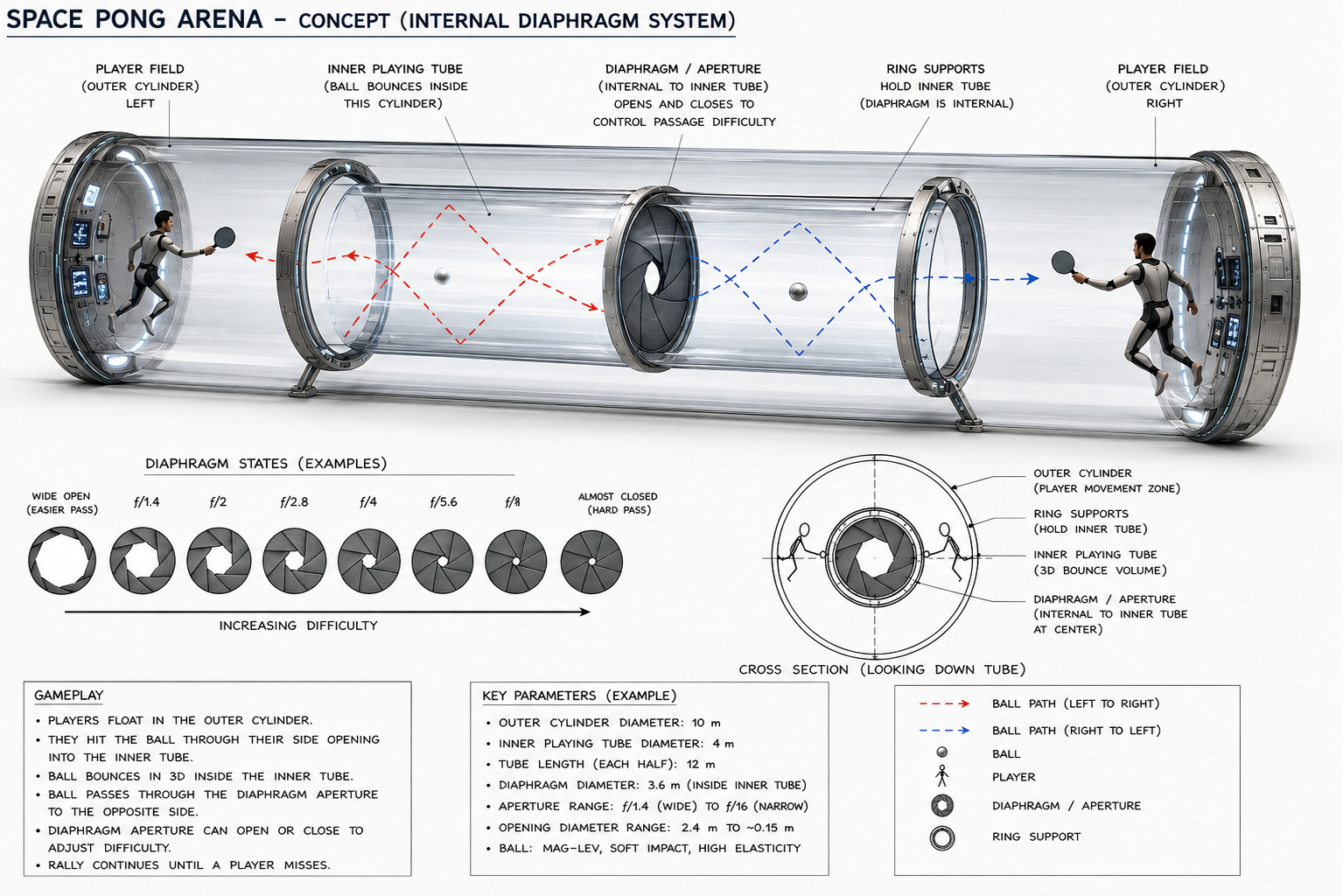
Space Pong was the first true sport designed specifically for microgravity environments.
According to colony lore, its invention is attributed to an orbital maintenance engineer during a prolonged transport mission. Searching for a way to remain physically active while maintaining social interaction with fellow crew members, he transformed a simple cylindrical maintenance tube into a three-dimensional reinterpretation of table tennis.
The original arena consisted of:
- a cylindrical chamber approximately 1.5 meters in diameter,
- and roughly 3 meters long.
At the center of the tube sat the sport’s defining feature:
a dynamic iris diaphragm.
Inspired by the aperture mechanism of a camera lens, the diaphragm could open or close during gameplay, dynamically modifying the difficulty of passing the ball between the two sides of the arena.
Players remained lightly anchored to the interior surface of the tube using adjustable restraint systems while wielding lightweight paddles.
The ball itself was intentionally unconventional:
a golf ball.
Its higher density provided greater inertia and more satisfying rebounds under microgravity conditions, creating complex three-dimensional trajectories impossible under normal Earth gravity.
Matches quickly became chaotic, strategic, and surprisingly athletic, demanding:
- reaction speed,
- rotational awareness,
- spatial prediction,
- and full-body coordination.
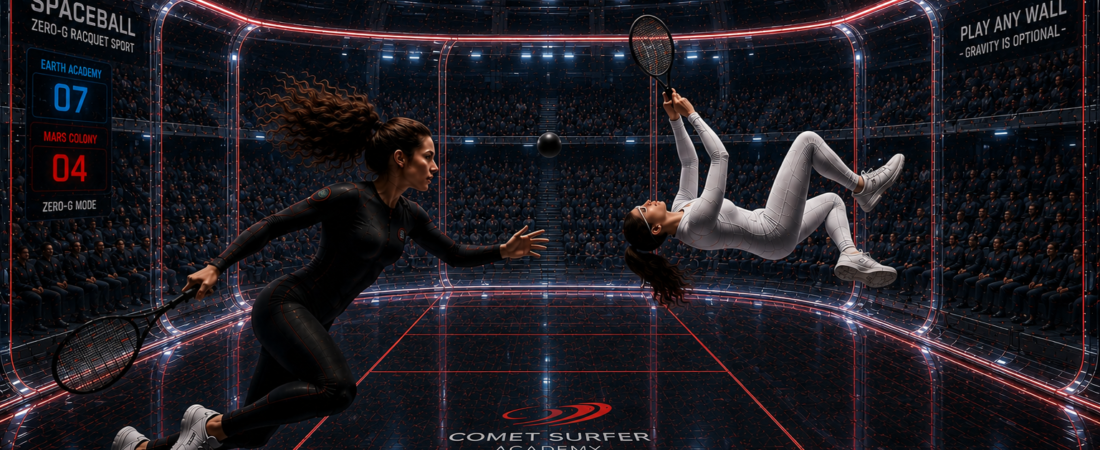
Spaceball
Inspired by the success of Space Pong, engineer Amin Chandra adapted another Earth sport to reduced gravity:
racquetball.
The result became known as:
Spaceball.
Unlike Space Pong’s enclosed cylindrical duel, Spaceball was designed for larger pressurized arenas built from repurposed cargo containers and industrial habitation modules.
The game preserved several aspects of terrestrial racquet sports:
- matches are played to 15 points,
- only the serving player may score,
- and service changes hands if the rally is lost.
However, reduced gravity completely transformed movement dynamics.
Players:
- rebound from walls,
- rotate through open space,
- use controlled momentum,
- and exploit vertical movement in ways impossible on Earth.
Because the sport required minimal infrastructure and relatively low energy consumption, it spread rapidly throughout:
- mining colonies,
- orbital stations,
- and frontier settlements.
Spaceball became especially popular among younger Martians, who viewed it not merely as exercise, but as an expression of planetary identity.
Moonball
Moonball emerged naturally as Spaceball migrated to Lunar settlements.
Under the Moon’s extremely low gravity:
0.16 g
the sport evolved dramatically.
Players wearing intelligent athletic suits could perform spectacular aerial maneuvers while striking the ball from improbable angles, combining:
- gymnastics,
- aerial dance,
- martial agility,
- and racquet sports.
Long jumps, rotational flips, and extended rebounds became central elements of gameplay.
What appears physically impossible on Earth became instinctive under Lunar conditions.
Moonball arenas eventually evolved into massive transparent domes where spectators observed athletes seemingly flying through the air against the backdrop of space.
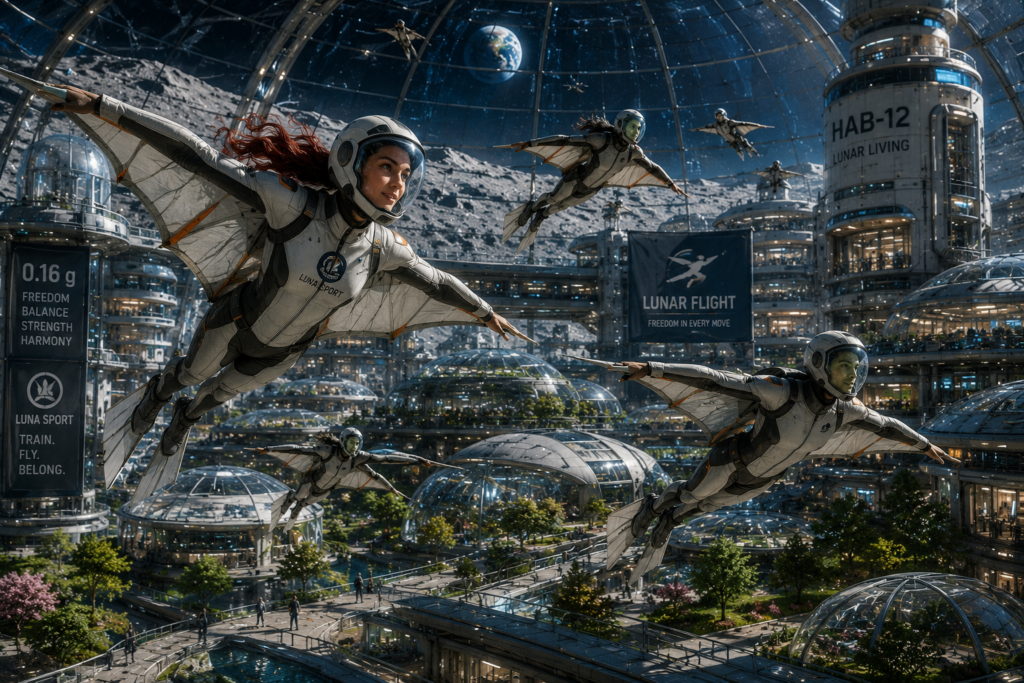
Lunar Flight
Perhaps the most poetic recreational activity to emerge from reduced gravity environments is:
Lunar Flight.
Developed inside large Lunar dome structures, participants wear lightweight wing systems attached to their arms and stabilizing fins on their legs.
The movement style resembles a combination of:
- butterfly swimming,
- wingsuit gliding,
- and slow aerial ballet.
Under Lunar gravity, trained participants can remain suspended for extended periods while generating controlled forward motion through coordinated body movement.
For some practitioners, including characters such as Valery, Lunar Flight transcends athletics entirely.
As she once described it:
“It feels like swimming through warm water suspended in air. Every movement becomes choreography. Every turn becomes conversation with space itself.”
Sports as Medicine
In extraterrestrial civilization, sports serve a critical medical function.
Reduced gravity environments create major physiological challenges, including:
- bone density loss,
- muscular atrophy,
- balance disruption,
- fluid redistribution,
- and cardiovascular deconditioning.
Space sports help counteract these effects by stimulating:
- reflex coordination,
- reaction speed,
- muscular stabilization,
- cardiovascular endurance,
- and three-dimensional spatial awareness.
Unlike many terrestrial sports, reduced-gravity athletics constantly engage stabilizing muscles throughout the body because movement occurs across all axes simultaneously.
Lunar Flight, in particular, offers physiological benefits comparable to swimming on Earth:
- upper-body strengthening,
- flexibility,
- pulmonary conditioning,
- balance training,
- and cardiovascular resistance.
Psychological and Cultural Importance
The importance of these sports extends beyond physiology.
Life inside enclosed habitats, underground settlements, and isolated colonies places enormous psychological pressure on human populations. Recreation becomes essential for:
- emotional regulation,
- social bonding,
- stress reduction,
- creativity,
- and identity formation.
Over generations, these sports evolved into cultural symbols of extraterrestrial civilization.
They reflect a simple but profound truth:
humanity adapts not only to survive,
but also to play.
On Mars and the Moon, every movement redefines what the human body can become.
And through sport, reduced gravity transforms from limitation into freedom.