

Welcome to the Intimate Space
In the unique environment of space, engaging in intimate encounters — what the saga refers to as SpaceSex — requires adapting to entirely new physical rules. Without gravity or surface friction, contact, stability, and communication become essential elements.
The Physics of Embrace in Orbit
Isaac Newton’s Third Law of Motion — “for every action there is an equal and opposite reaction” — takes on an entirely new meaning when floating in space. Without solid anchor points, any push can cause partners to drift apart, breaking contact and interrupting connection. In microgravity, traction and stabilization points change completely.
Stability Tools
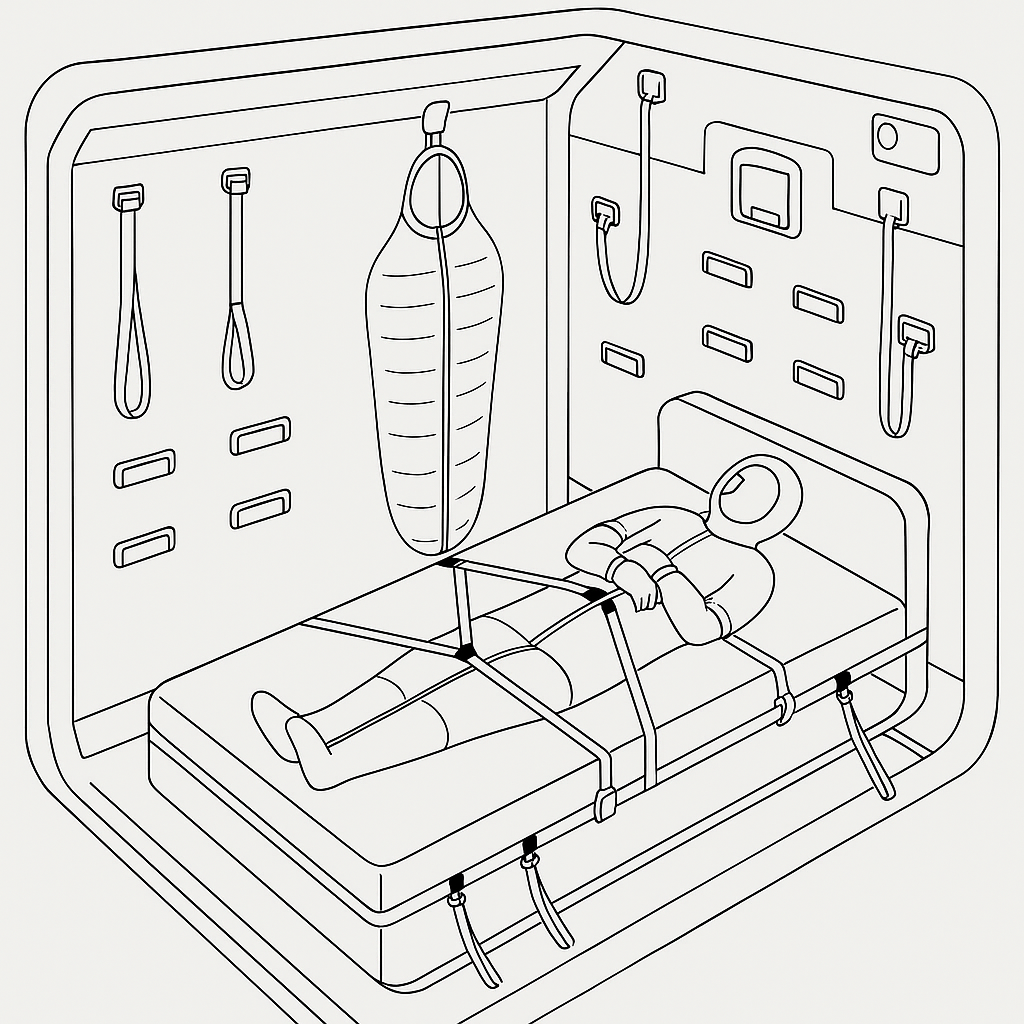
To facilitate intimacy and prevent uncontrolled drifting, the novel proposes specially designed tools:
- Secure Anchoring: Handles, bars, or surfaces designed to provide stable physical attachment points.
- Velcro or Specialized Straps: Biosuits incorporating attachment systems capable of connecting bodies without resistance.
- Body Handholds: Strategic gripping points on a partner’s body, similar to the handrails used aboard orbital stations.
- Shared Restraint Systems: Couples may use connected harness systems that allow simultaneous freedom of movement and physical contact.
- Microgravity Bed or Cocoon: Specialized surfaces with multiple anchoring points that provide comfort, privacy, and stability.

Four Basic Positions Adapted to Space
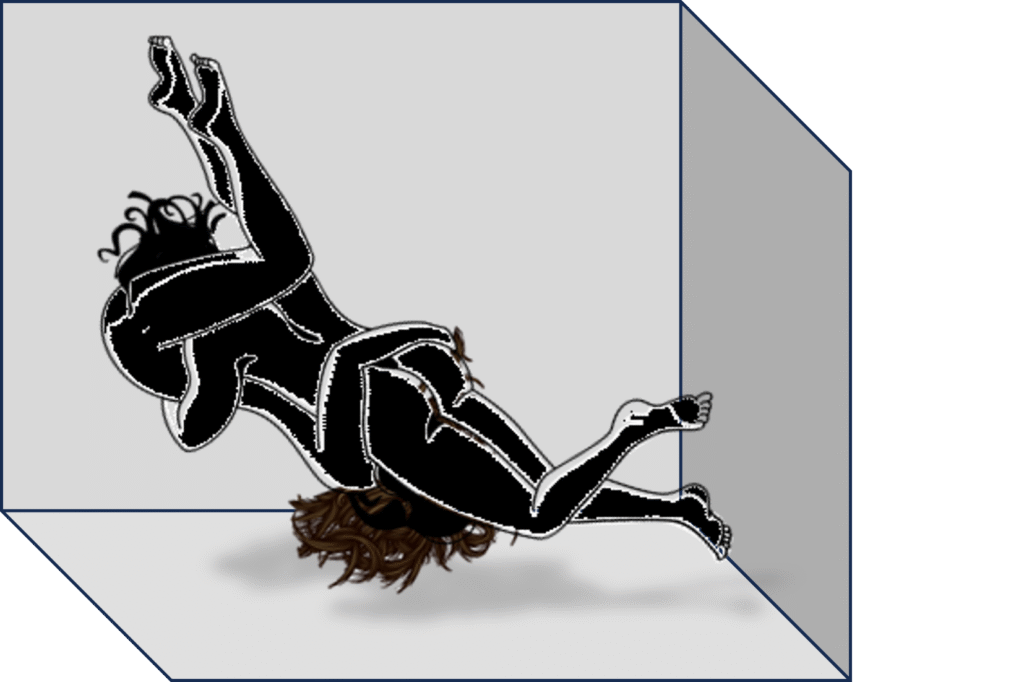
Below are four positions conceived specifically for low-gravity and microgravity environments, each adapted to maintain contact, generate traction, and preserve intimacy.

Frontal Position
The space-adapted version of the missionary position. The couple maintains direct visual contact. The receptive partner may wrap arms and legs firmly around the other person, generating traction through pelvic and abdominal muscle engagement. Stability comes primarily from using the partner’s body itself as the anchor.
Reverse Position (From Behind)
Highly recommended for beginners in microgravity. One partner maintains control from behind while the other secures themselves using leg support and body contact. Arms and legs can be used to stabilize rhythm and motion, while communication ensures synchronization and comfort.


“Seesaw” Position
Both partners remain face-to-face, allowing visual intimacy and simultaneous exploration. To stabilize themselves, participants may hold onto each other’s arms or legs. Particularly suitable for slower, more conscious, and emotionally intimate experiences.
“Space 69”
A futuristic variation of the traditional position. Partners face one another with intertwined torsos while using arms and hands to generate traction and oral contact simultaneously. In the absence of dominant gravity, limb muscles and mouth contact become part of a dynamic stabilization system. Coordination and controlled movement are essential.
Consent, Communication, and Safety
Although the environment demands technical adaptations, the fundamental principles remain unchanged:
- Enthusiastic and explicit consent is essential.
- Clear communication regarding preferences, boundaries, and comfort is critical.
- Physical and virtual privacy must be protected aboard stations and spacecraft.
- Any position should be adapted to the available environment while respecting physical tolerances and space-health protocols.
Why This Guide Matters
The Comet Surfer saga connects intimacy and technology, human beings and extreme environments, desire and science. This guide not only adds credibility to the narrative world, but also invites reflection on how human sexuality may evolve once humanity leaves Earth.
In this universe, the exploration of space also includes the exploration of desire.

Frequently Asked Questions About SpaceSex
Is sex in space actually possible?
Yes, but with challenges. Microgravity complicates physical contact and stability. Without anchoring systems, body movement naturally pushes participants in opposite directions. The Comet Surfer saga explores technologies and strategies designed to make intimacy in space both safe and pleasurable.
Why is it important to discuss sex in space?
Sexuality is an integral part of the human experience. If humanity expands into space, we will eventually need to understand how to maintain emotional bonds, reproduce, and sustain intimacy in extreme environments. The novel uses SpaceSex as a framework to explore the future of human relationships.
What role does gravity play in intimacy?
Gravity on Earth provides friction, weight, and natural anchoring. Without it, the human body behaves very differently: there is no “up” or “down,” and every movement produces a reaction. This is why strategies such as restraints, harnesses, adaptive biosuits, and floating structures become necessary.
Does the novel contain explicit sexual scenes?
Yes, but always with narrative purpose. The scenes are designed to develop characters, explore emotional complexity, and examine how intimacy evolves within the context of space exploration. They are not gratuitous, but rather an integral part of the Comet Surfer universe.
What fictional technologies are used in Comet Surfer to facilitate intimacy in microgravity?
In addition to realistic tools such as straps and anchoring cocoons, the novels introduce personalized biosuits, microgravity sleeping systems, and controlled environmental modules designed to allow safe and meaningful intimate interaction. These concepts are grounded in extrapolations of current scientific understanding.
Which position is most recommended for beginners?
The reverse position (from behind) is considered one of the most stable options for beginners because it offers strong anchoring points and mutual control. It is also easy to adapt using restraint systems.
Are there risks associated with sex in space?
Yes. Potential risks include:
- Injuries caused by uncontrolled impacts.
- Circulatory complications or inflammation in modified-pressure environments.
- Medical complications if proper hygiene and sexual health precautions are not followed.
Is reproduction in space possible?
This remains an active field of scientific research. Microgravity and radiation exposure could potentially affect fertility and embryonic development. Although the novel does not directly address this subject in detail, it recognizes reproduction as one of the greatest challenges of long-term space colonization.