
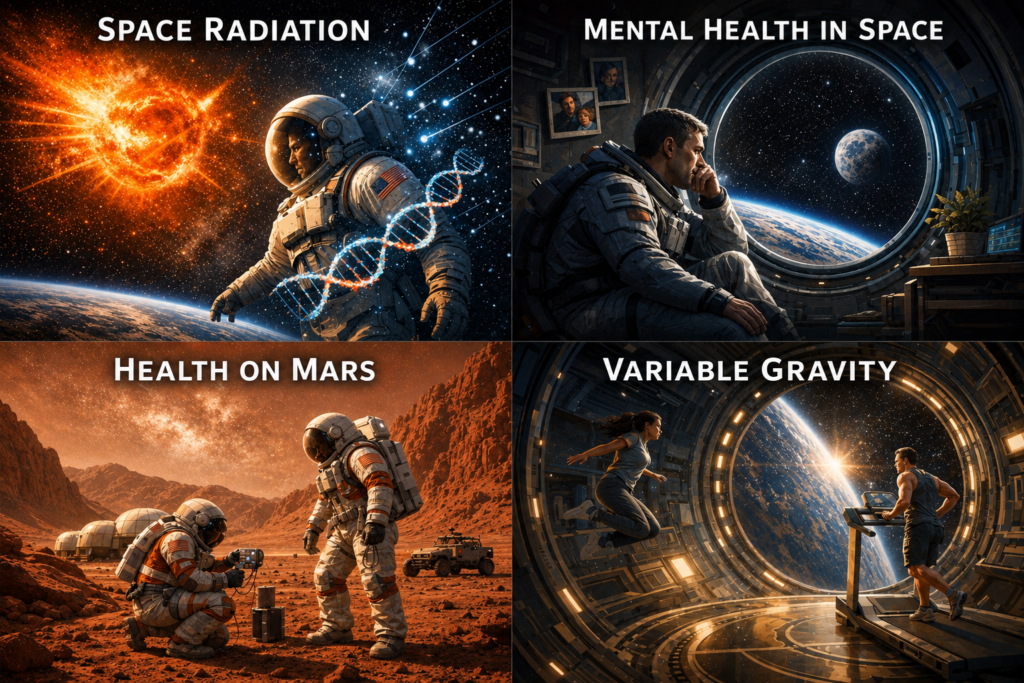
🧬 Medicine Beyond Earth
Human health in space is not simply an extension of terrestrial medicine. It is an emerging interdisciplinary field that studies how the human body and mind respond when removed from one of their most fundamental environmental parameters: gravity.
For millions of years, human physiology evolved under a constant acceleration of approximately 1 g. Every biological system — skeletal, muscular, cardiovascular, vestibular, neurological — was shaped by that condition. Remove gravity, and the body does not merely adapt.
It begins to redefine itself.
To understand health beyond Earth, it is useful to think in terms of three interconnected dimensions:
- Physics: gravity, pressure, radiation
- Biology: cellular and physiological adaptation
- Psychology: identity, isolation, and emotional resilience
In microgravity, bodily fluids redistribute toward the upper body, altering intracranial pressure and facial appearance. Bone density progressively decreases, particularly in load-bearing regions such as the hips and spine. Muscle mass diminishes in the absence of continuous mechanical resistance, while the cardiovascular system loses efficiency when it no longer pumps against a stable gravitational gradient.
These effects are not hypothetical. They have been extensively documented aboard orbital stations and long-duration missions, where even moderate stays require rigorous countermeasures to preserve astronaut health.
For an updated scientific overview of the physiological effects of spaceflight, visit NASA’s Human Body in Space initiative:
👉 https://www.nasa.gov/humans-in-space/the-human-body-in-space/
But medicine in space extends far beyond physiology.
It also involves the design of systems, habitats, interfaces, and technologies capable of sustaining human life in radically different environments. In this context, health becomes as much an engineering problem as a medical one.
The work conducted by the MIT Media Lab in the field of Space Health illustrates this convergence between biology, technology, and design, proposing new models of monitoring, intervention, and human adaptation beyond Earth:
👉 https://www.media.mit.edu/projects/space-health/overview/
Intravenous Fluids in Microgravity
One of the simplest — yet most revealing — examples of how medicine changes in space is the administration of intravenous fluids.
On Earth, gravity allows IV solutions to flow simply by raising a fluid bag above the patient. In microgravity, this principle no longer functions in the same way. Hydrostatic pressure ceases to dominate fluid movement, and flow instead depends on pressurized systems, pumps, and carefully engineered environmental configurations.
The following simulator explores how intravenous systems behave under different gravitational conditions and estimates the height required for proper fluid delivery in varying planetary environments.
These tools do more than illustrate physical principles.
They reveal a deeper reality:
In space, medicine does not merely adapt to the patient.
It adapts to the universe in which the patient exists.
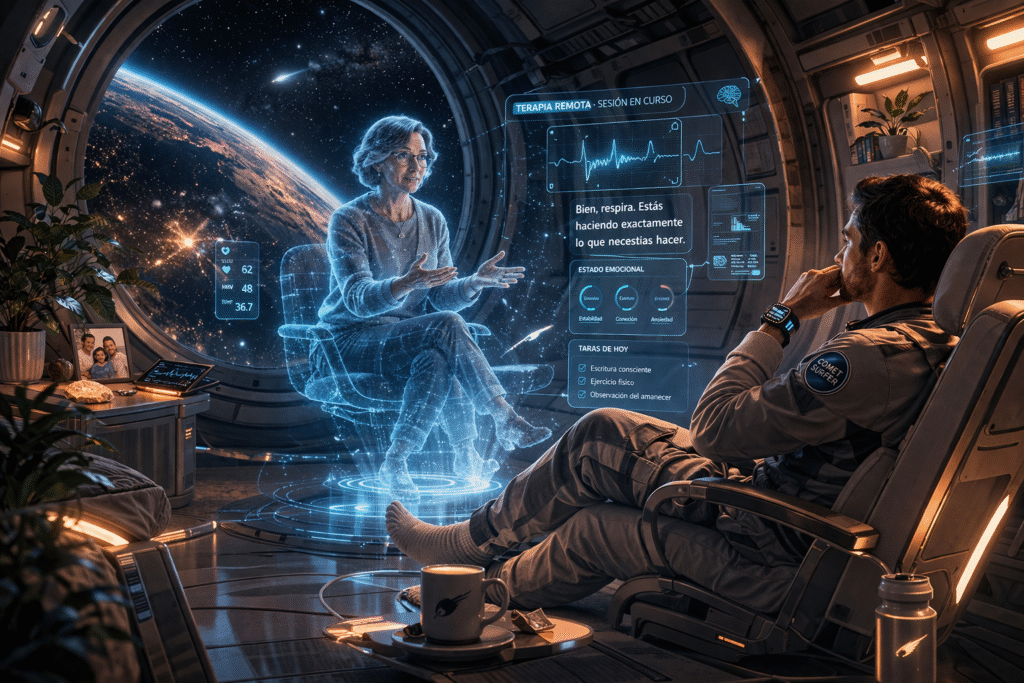
🧠 Mental Health Beyond Earth
Mental health in space is not a secondary concern — it is a critical component of survival. Prolonged isolation, confinement, communication delays, and irreversible distance from Earth create psychological conditions unlike anything experienced in terrestrial medicine. Emotional resilience therefore becomes an essential part of mission design.
In the Comet Surfer universe, mental healthcare integrates teletherapy, AI-assisted cognitive support, sensory regulation, interpersonal bonding, and purpose-driven activity to help sustain emotional stability in extreme environments.
➡️ Explore the full entry: Mental Health Beyond Earths.
☢️ Radiation: The Invisible Enemy
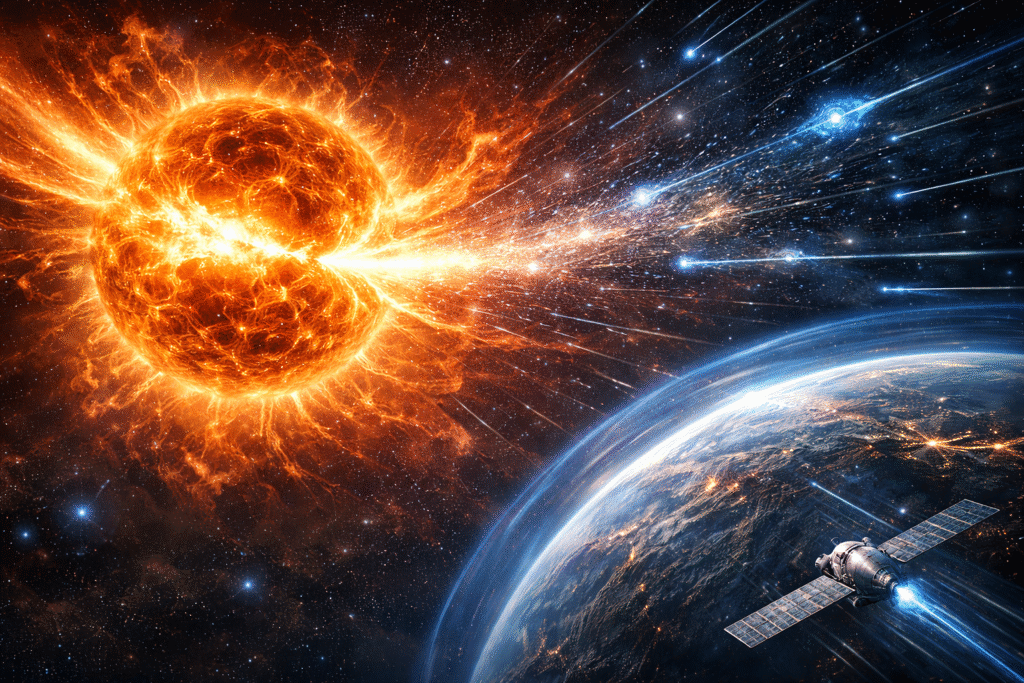
Beyond gravity, radiation represents one of the greatest threats to human health outside Earth.
Unlike our planet, where the atmosphere and magnetosphere provide natural shielding, deep space exposes the human body to a continuous flow of energetic particles capable of penetrating tissues and disrupting fundamental biological processes.
The primary sources of radiation include:
- Galactic Cosmic Rays (GCRs) originating from high-energy astrophysical events outside the Solar System,
- and Solar Particle Events (SPEs) associated with solar flares and coronal mass ejections.
While GCRs produce chronic low-flux exposure, SPEs can generate sudden and dangerous spikes of radiation within short periods of time.
The biological consequences are profound:
- DNA damage,
- increased cancer risk,
- cellular dysfunction,
- cardiovascular deterioration,
- cognitive changes,
- and potential neurodegenerative effects.
Mars itself presents additional challenges. Its thin atmosphere and weak global magnetic field provide only limited protection, forcing colonies to adopt mitigation strategies such as:
- underground habitats,
- regolith shielding,
- advanced composite materials,
- storm shelters,
- and partially protective biosuits.
In this environment, prevention becomes inseparable from engineering.
Radiation is not an occasional hazard of space.
It is a permanent environmental condition.
🧬 Health on Mars Under Present Conditions
Discussing health on Mars is not simply discussing medicine. It is discussing survival inside an environment fundamentally incompatible with unprotected human life.
The Martian surface possesses:
- atmospheric pressures below 1% of Earth’s,
- extreme cold,
- toxic dust,
- low gravity,
- and elevated radiation exposure.
Direct exposure would rapidly lead to unconsciousness and death. Medicine therefore begins not with treatment, but with environmental containment through:
- pressurized habitats,
- life-support systems,
- environmental regulation,
- and technological barriers separating humans from the external world.
Even within controlled habitats, however, the human body does not behave exactly as it does on Earth.

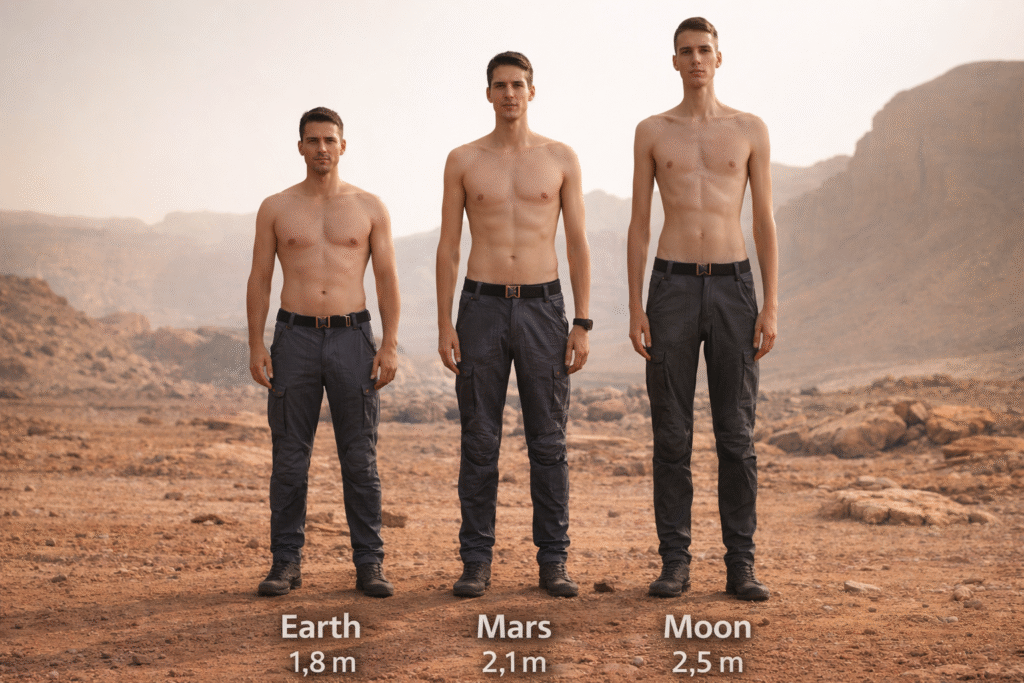
Mars’ gravity — approximately 38% of Earth’s — gradually reshapes physiology. Bones lose density, muscles weaken, and body proportions adapt over generations. These changes may eventually limit the ability of Martian-born humans to tolerate terrestrial gravity for extended periods.
At the cellular level, gravity itself acts as a biological signal through mechanisms of mechanotransduction, where cells convert physical forces into biochemical responses. Altering gravity therefore alters cellular behavior, affecting tissues, organs, and entire physiological systems.
These changes extend beyond humans. Plants and animals also adapt differently under Martian conditions, influencing:
- agriculture,
- nutrition,
- ecology,
- and life-support systems.
But perhaps the greatest challenge is psychological.
Many children born on Mars never experience open skies, rain, oceans, forests, or natural terrestrial environments. Their perception of reality develops almost entirely within controlled ecosystems and artificial habitats.
To address this, systems such as Martian Cognitive Anthropogogy (MCA) were developed to guide emotional adaptation and identity formation under conditions of planetary isolation.
On Mars, health is no longer simply a state of the body.
It becomes a dynamic balance between:
and design.
- biology,
- environment,
- psychology,
⚙️ Variable Gravity: Redefining Medicine
If gravity defines physiology, then the ability to control gravity would redefine the limits of medicine itself.
In the Comet Surfer universe, one of the most transformative future technologies is the Variable Gravity Generator (GGV): a system capable of creating controlled gravitational environments within confined spaces.
Although such technology does not currently exist, its conceptual foundation emerges from a well-established scientific reality:
the human body depends on gravity to maintain its structure and function.
As humanity expands into low-gravity worlds such as Mars and the Moon, deep biological divergences begin to emerge between planetary populations. Variable gravity systems therefore become essential tools for:
- rehabilitation,
- bone and muscle preservation,
- childhood development,
- interplanetary adaptation,
- and long-duration space habitation.
More importantly, they raise profound philosophical questions:
Should humans adapt to planets — or should planets adapt to humans?
Variable gravity transforms gravity itself from a universal constant into a controllable environmental parameter.
And in doing so, it redefines:
- medicine,
- architecture,
- education,
- reproduction,
- sports,
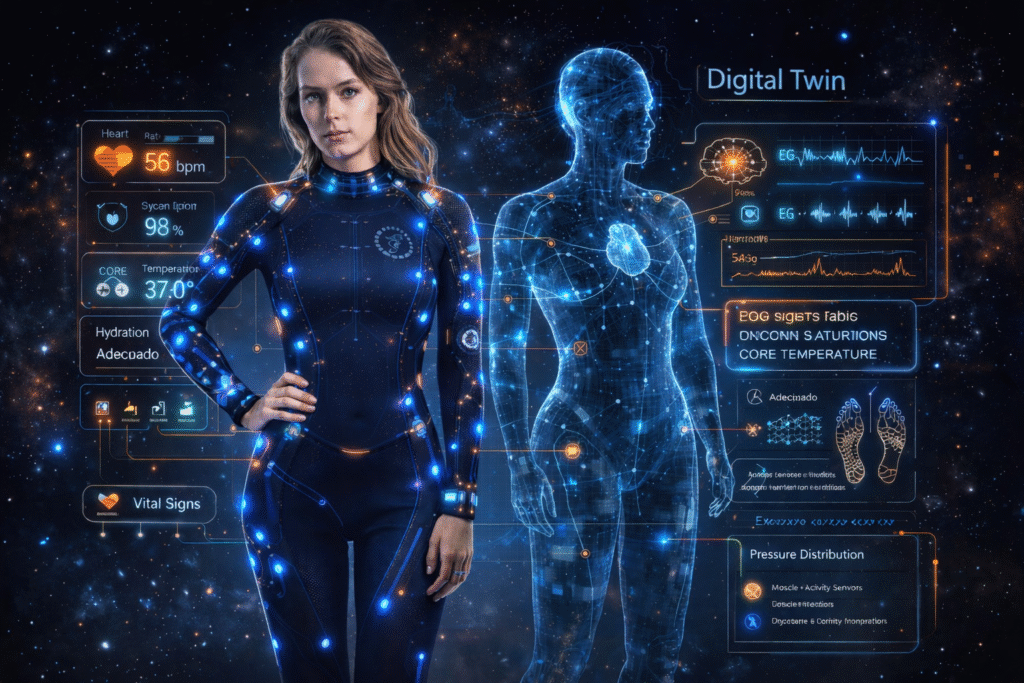
🧥 Biosuits: Medicine as a Second Skin
In extraterrestrial environments, medicine is often worn rather than administered. Biosuits function as intelligent biomechanical systems capable of monitoring physiology, regulating temperature, assisting movement, and adapting dynamically to hostile environments.
Far more than protective garments, biosuits act as continuous interfaces between the human body and the surrounding world, integrating healthcare, engineering, environmental adaptation, and even aspects of emotional well-being and human intimacy.
➡️ Explore the full entry: Biosuits: Biosuitshttps://cometsurfer.net/biosuits/
Related Topics
➡️ Mental Health Beyhttps://cometsurfer.net/mental-health/ond Earth
➡️ Biosuits: Medicine as a Second Skin
➡️ Relationships & Intimacy in Space
➡️ Agriculture & Closed Ecological Systems
➡️ Martian Civilization