
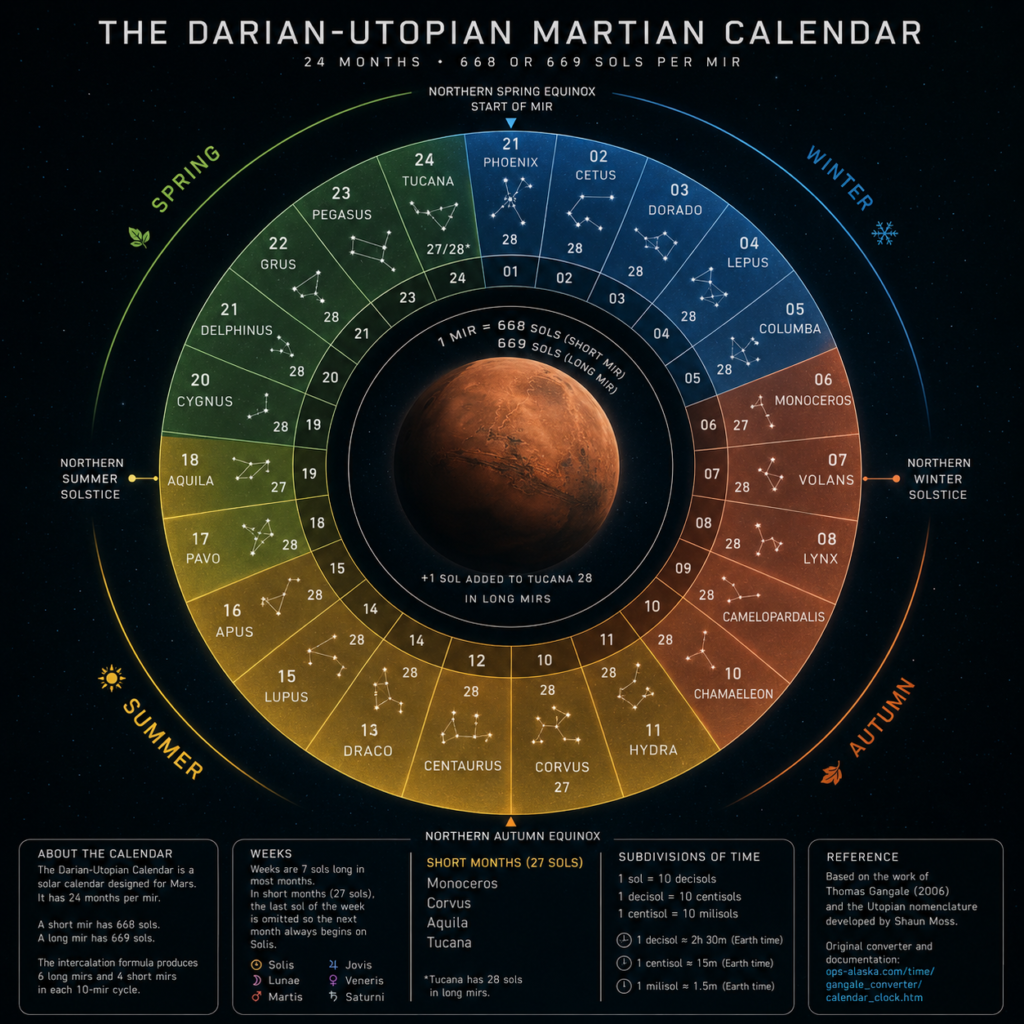
As humanity expands beyond Earth, time itself must evolve. The Martian Calendar used throughout the Comet Surfer universe is based on the Darian Calendar developed by Thomas Gangale, adapted using the Utopian nomenclature system with permission from its creator. Designed specifically for the rhythms, seasons, and orbital mechanics of Mars, the calendar represents one of the earliest serious attempts to build a functional civil timekeeping system for future Martian civilization.
The Darian-Utopian Martian Calendar
The Martian calendar shapes everyday life throughout the colonies of the Comet Surfer universe. It is based on the Darian-Utopian system, originally proposed by Thomas Gangale and later adapted using the Utopian nomenclature developed by Shaun Moss.
Martian Calendar
Immerse yourself in the traditions of the Comet Surfer universe through the Martian Date Calculator — a tool that translates Earth dates into Martian time, aligning with the calendar system that governs daily life, work cycles, education, and cultural rituals on the Red Planet.
👉 See how Mars became humanity’s second home.
Once the first Martian government was established, Mars officially adopted the Darian-Utopian calendar system. Below are some of its defining characteristics.
The Martian Year: Mir
The Martian year is known as a mir and lasts approximately 668.59 sols, or Martian days. This corresponds to roughly 686.86 Earth days.
Martian Days: Sols
Martian days are called sols and are approximately 39.5 minutes longer than a solar day on Earth.
Mir 0
The first mir in this calendar corresponds to the Earth year 1609. This year was selected because it marked major astronomical milestones, including Johannes Kepler’s publication of Astronomia Nova and Galileo Galilei’s telescopic observations of Mars.
The first sol of Mir 0 corresponds to March 12, 1609, on Earth.
Months and Constellations
The Darian-Utopian calendar consists of 24 months per mir. In the Utopian nomenclature, each month is named after a constellation. The first day of the Martian year coincides with the northern
hemisphere spring equinox on Mars.
| Month Number | Utopian Month Name | Sols in Standard Mir | Notes |
|---|
| 1 | Phoenix | 28 | Begins the Martian year |
| 2 | Cetus | 28 |
| 3 | Dorado | 28 |
| 4 | Lepus | 28 |
| 5 | Columba | 28 |
| 6 | Monoceros | 27 | Short month |
| 7 | Volans | 28 |
| 8 | Lynx | 28 |
| 9 | Camelopardalis | 28 |
| 10 | Chamaeleon | 28 |
| 11 | Hydra | 28 |
| 12 | Corvus | 27 | Short month |
| 13 | Centaurus | 28 |
| 14 | Draco | 28 |
| 15 | Lupus | 28 |
| 16 | Apus | 28 |
| 17 | Pavo | 28 |
| 18 | Aquila | 27 | Short month |
| 19 | Vulpecula | 28 |
| 20 | Cygnus | 28 |
| 21 | Delphinus | 28 |
| 22 | Grus | 28 |
| 23 | Pegasus | 28 |
| 24 | Tucana | 27 / 28 | Short month; receives the leap sol in long mirs |
Leap Years and Long Mirs
The Martian calendar includes leap years known as long mirs.
A short mir contains 668 sols.
A long mir contains 669 sols.
The additional sol is added at the end of the mir, during Tucana 28.
The intercalation formula divides each Martian decade into six long mirs and four short mirs. This system maintains synchronization between the calendar and the orbital cycle of Mars.
Short Months
To preserve alignment between the calendar and the Martian orbital year, several months are intentionally shorter.
The short months are:
- Monoceros
- Corvus
- Aquila
- Tucana
In a short mir, these months contain 27 sols. In a long mir, Tucana receives one additional sol, bringing it to 28 sols.
Weeks on Mars
The Darian-Utopian calendar uses a seven-sol week. The week is restarted at the beginning of each month. In months with 27 sols, the final sol of the week is omitted, allowing the first sol of each month to begin consistently with the start of the week.
The days of the week are:
- Solis
- Lunae
- Martis
- Mercurii
- Jovis
- Veneris
- Saturni
Subdivisions of Time
A sol is divided into smaller time units including decisols, centisols, and millisol units.
Each sol contains:
- 10 decisols
- 100 centisols
- 1000 millisol units
As a reference:
- a decisol lasts approximately 2.5 Earth hours
- a centisol lasts approximately 15 Earth minutes
- a millisol lasts approximately 1.5 Earth minutes
These subdivisions simplify scientific operations, scheduling, navigation, engineering, and daily life within Martian civilization.
A Calendar for a New Civilization
Calendars do more than measure time. They shape culture, memory, work, education, celebration, and identity itself.
The Darian-Utopian calendar therefore represents more than a scientific framework. Within the Comet Surfer universe, it stands as one of the first true cultural foundations of an emerging human civilization beyond Earth.
References
The Martian calendar system used throughout the Comet Surfer universe is based on the pioneering work of Thomas Gangale and the Darian Calendar project, adapted using the Utopian nomenclature system developed by Shaun Moss.
Additional information and the original Earth-Mars calendar converter can be explored at:
https://ops-alaska.com/time/gangale_converter/calendar_clock.htm