
Saturn: The Jewel of the Solar System
Saturn is one of the most recognizable worlds in the Solar System. Surrounded by magnificent rings and accompanied by a rich family of moons, it has fascinated astronomers, explorers, and dreamers for centuries.
Within the Comet Surfer universe, Saturn plays a particularly important role. Several pivotal events in The Seduction of Nadeah unfold within the Saturnian system, making it both a destination of scientific interest and an important stage in humanity’s expansion across the outer Solar System.
Interactive Exploration
Saturn, Its Rings, and Major Moons
Explore the Saturnian system through an interactive orbital simulation.
Observe the motion of Saturn’s major moons, investigate the structure of the rings, and gain a deeper appreciation for the complexity of one of the most beautiful planetary systems ever discovered.
A Giant Among Giants
Saturn is the sixth planet from the Sun and the second-largest planet in the Solar System after Jupiter.
Classification: Gas Giant
Mean Radius: ~58,232 km
Mass: ~95 Earth masses
Length of Year: 29.5 Earth years
Average Distance from the Sun: 9.5 AU
Unlike Earth and Mars, Saturn has no solid surface. Beneath its cloud tops lies an immense atmosphere composed primarily of hydrogen and helium, gradually transitioning into layers of liquid metallic hydrogen under enormous pressure.
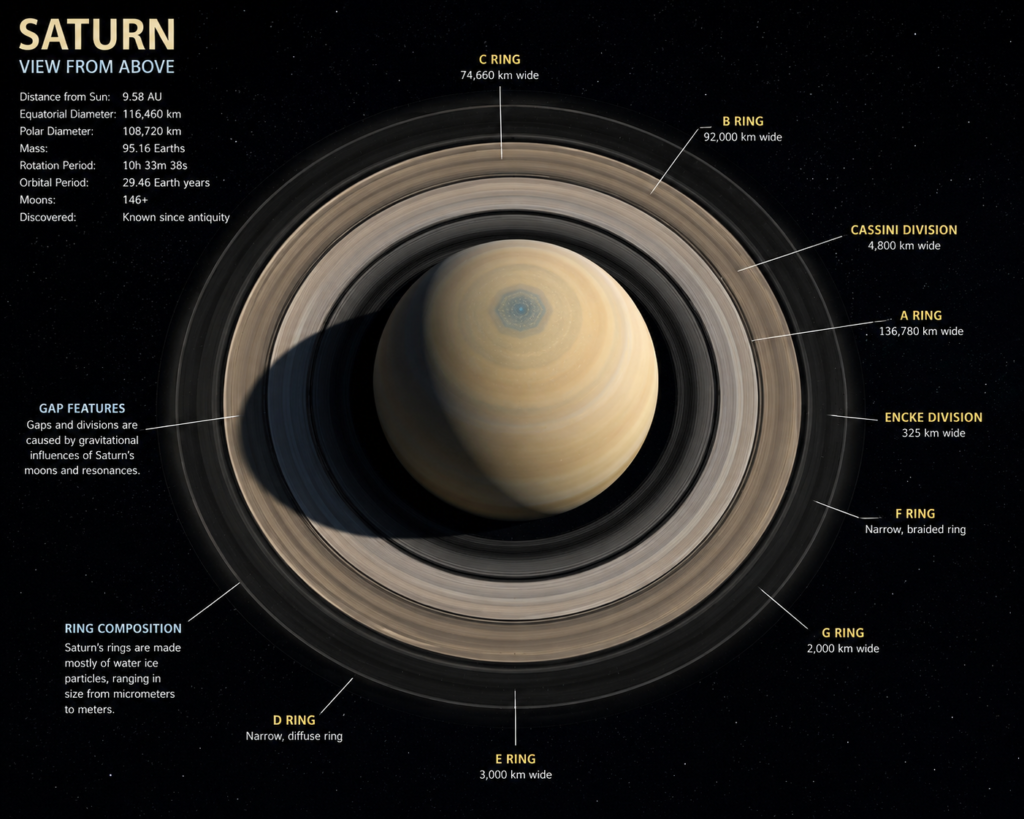
The Rings of Saturn
No feature of Saturn is more famous than its rings.
Although they appear solid from a distance, the rings are composed of billions of particles ranging from microscopic dust grains to objects the size of mountains. These particles orbit Saturn in an intricate gravitational dance shaped by the planet and its moons.
The rings are divided into several major regions:
- D Ring
- C Ring
- B Ring
- Cassini Division
- A Ring
- F Ring
- G Ring
- E Ring
In the Comet Surfer saga, the rings serve as both a breathtaking backdrop and a strategic environment where exploration, navigation, and discovery converge.
The Saturnian Magnetosphere
Saturn possesses one of the largest magnetospheres in the Solar System.
This immense magnetic field traps charged particles from the solar wind and interacts continuously with Saturn’s rings and moons.
The magnetosphere extends millions of kilometers into space and creates complex auroral displays near the planet’s poles.
Understanding these interactions is critical for future exploration and long-duration operations throughout the Saturnian system.
Titan: A World Unlike Any Other
Among Saturn’s moons, Titan is perhaps the most extraordinary.
Titan is the only moon in the Solar System with a dense atmosphere and the only world besides Earth known to possess stable liquids on its surface.
Instead of water, Titan’s lakes and rivers are composed primarily of liquid methane and ethane.
Its thick atmosphere, low gravity, and abundant resources make Titan one of the most promising destinations for future exploration.
👉 Explore the full Astropedia entry on Titan.
Enceladus: The Ocean Beneath the Ice
Small but remarkable, Enceladus has become one of the most scientifically important worlds in the Solar System.
Giant geysers erupt through fractures near its south pole, ejecting water vapor, ice particles, and organic compounds into space.
Evidence strongly suggests that a global liquid-water ocean exists beneath its frozen crust.
Because liquid water, energy, and organic molecules appear to coexist there, Enceladus is considered one of the most promising locations in the search for extraterrestrial life.
👉 Explore the full Astropedia entry on Enceladus.
Saturn and the Martian Calendar
The influence of Saturn extends beyond astronomy and exploration.
Within the Martian calendar used throughout the Comet Surfer universe, the names of the weekdays preserve humanity’s ancient connection to the planets visible from Earth.
Saturday traces its origins to Saturn, carrying forward a tradition that spans thousands of years from ancient civilizations to future settlements on Mars.
The continued use of planetary names reflects humanity’s enduring relationship with the Solar System and its history.
Saturn in The Seduction of Nadeah
Several important events in The Seduction of Nadeah occur within the Saturnian system.
The rings, Titan, and other regions of Saturn’s domain provide the backdrop for encounters, discoveries, and decisions that help shape the future of humanity’s expansion beyond Earth.
Saturn serves not merely as a destination, but as one of the great frontiers of the story.
👉 Discover Saturn’s role in The Seduction of Nadeah.
The Rings of Mars
Saturn also plays a significant role in The Rings of Mars.
It is within the Saturnian rings that readers first encounter Bilan, the Pirate Queen, whose rivalry with Bob Oliveira begins amid the vast ice fields orbiting the giant planet.
The complex geography of the rings—part shipping lanes, part wilderness, part refuge for those wishing to remain unseen—provides the perfect environment for smugglers, pirates, explorers, and opportunists.
The tensions and relationships forged in Saturn’s domain will later influence events throughout the Solar System.
From Saturn to Mars
When the comet Nadeah later transforms Mars, fragments of the captured comet eventually contribute to the formation of the new Martian rings.
Although vastly younger than Saturn’s ancient ring system, the Rings of Mars inevitably draw comparisons to their majestic Saturnian counterparts.
For generations of Martians, Saturn’s rings served as inspiration, a symbol of beauty and wonder in the night sky. The emergence of rings around Mars represented more than a scientific phenomenon—it marked the arrival of a new era in Martian history.
The ancient jewel of Saturn had become a model for a new celestial landmark closer to home.