
Isolation, Identity, and Emotional Survival in Space
Human mental health in space cannot be approached reactively. In environments defined by prolonged isolation, irreversible distance from Earth, confinement, and constant exposure to risk, psychological stress is not an exceptional event — it is an expected condition of the system itself.
Space medicine therefore extends beyond physiology.
It becomes the science of sustaining the human mind in environments for which it was never originally designed.
One of the most significant psychological conditions observed during long-duration missions is known as Earth-out-of-reach syndrome. This phenomenon extends beyond simple nostalgia or homesickness. It emerges from the profound realization that returning to Earth may be impossible, impractical, or permanently out of reach.
This condition may manifest through:
- separation anxiety,
- emotional disconnection,
- existential isolation,
- loss of environmental reference,
- depressive symptoms,
- and chronic anticipatory stress.
For many individuals, these emotional responses are not irrational. In deep-space environments, perceived risks often reflect legitimate physical realities.
As a result, mental health care in extraterrestrial environments requires a continuous, multidimensional, and preventive approach.
Behavioral and Environmental Regulation
The first layer of psychological support begins with seemingly simple interventions:
- sleep regulation,
- balanced nutrition,
- physical exercise,
- and structured daily routines.
In isolated environments, these factors become critical stabilizers of emotional and cognitive function.
Sensory regulation also plays an important role. Natural anxiolytic infusions such as chamomile and lemon balm, along with aromatherapy using compounds like lavender, are commonly employed to reduce baseline stress and improve sleep quality. In environments where natural stimuli are scarce, carefully designed sensory experiences gain therapeutic value.
Lighting systems, environmental acoustics, artificial ecosystems, and simulated natural environments are frequently integrated into habitat design to reduce cognitive fatigue and emotional fragmentation.
Teletherapy and Cognitive Support Systems
For more complex psychological conditions, behavioral adjustments alone are insufficient.
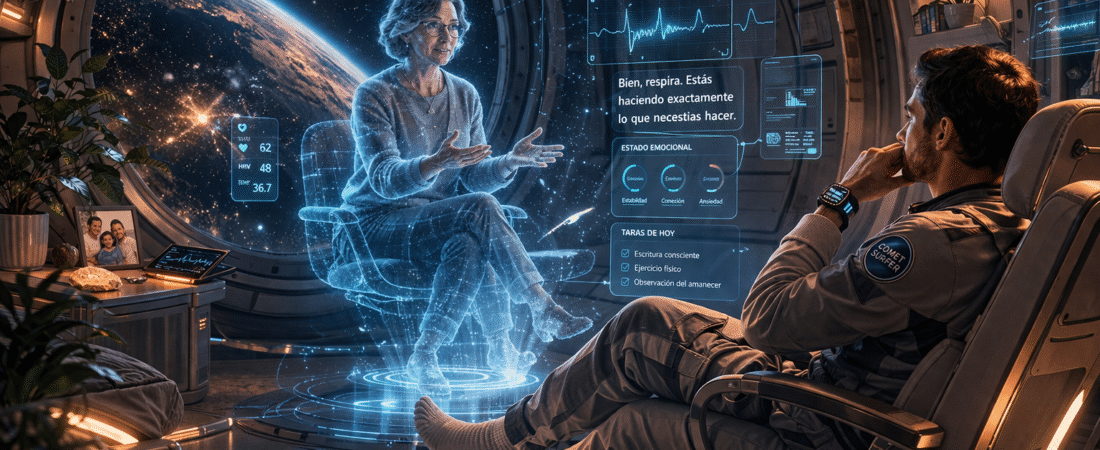
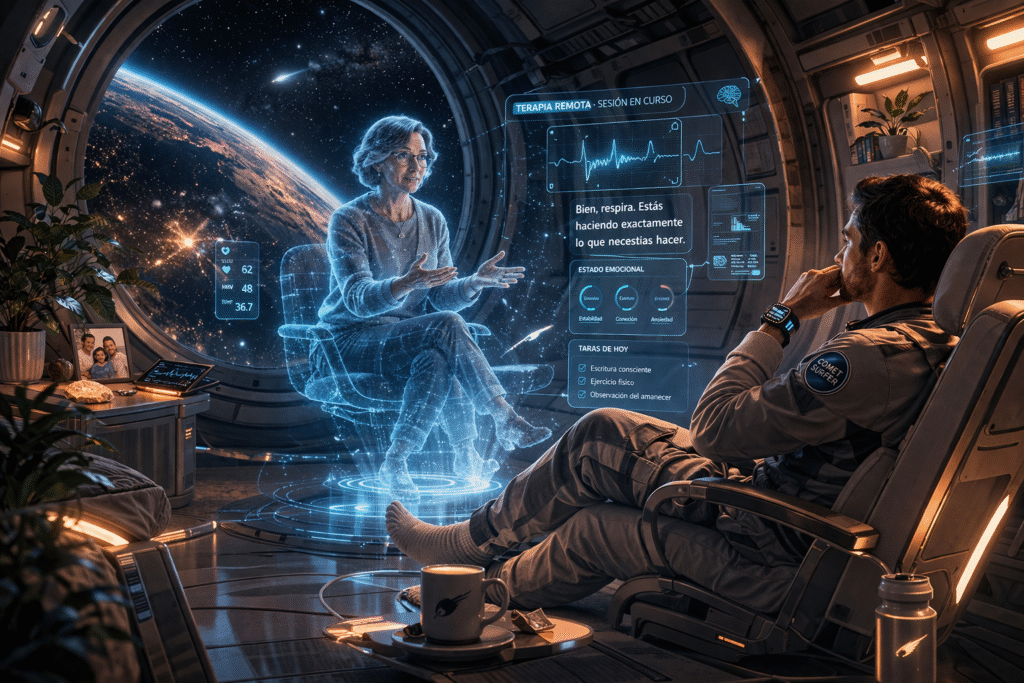
Mental healthcare in space relies heavily on advanced teletherapy systems capable of maintaining continuity of care across long distances and communication delays. Structured psychological interventions such as Cognitive Behavioral Therapy (CBT) became particularly valuable due to their adaptability, measurable outcomes, and compatibility with digital platforms.
Within this framework, individuals learn to identify:
- anxiety triggers,
- maladaptive thought patterns,
- emotional responses,
- and behavioral feedback loops.
Treatment is supported by continuous assessment tools such as Patient-Reported Outcome Measures (PROMs), allowing emotional states to be quantified, monitored, and adjusted over time.
Mental health thus evolves into an actively measured and continuously managed process.
AI Companions and Emotional Systems
One of the most transformative developments in Martian mental healthcare is the integration of artificial intelligence into emotional support systems.
Advanced cognitive assistants such as ANNIE are not viewed merely as software tools. They function as emotionally responsive companions capable of:
- observing behavioral patterns,
- detecting emotional deterioration,
- reinforcing positive behaviors,
- facilitating therapeutic exercises,
- and providing continuous interpersonal interaction between therapy sessions.
Rather than replacing human therapists, AI systems act as extensions of the therapeutic process itself.
This creates a fundamentally new therapeutic model:
not simply patient–therapist,
but patient–therapist–system.
Over time, many Martians develop deeply personal and almost symbiotic relationships with their AI companions. These systems participate not only in healthcare, but also in:
- education,
- family dynamics,
- mission planning,
- emotional regulation,
- and personal identity formation.
Artificial intelligence becomes woven directly into the emotional architecture of civilization.
Purpose, Intimacy, and Human Connection
Research in long-duration missions increasingly suggests that emotional stability depends heavily on meaningful activity and interpersonal connection.
Mission-focused work provides:
- structure,
- cognitive engagement,
- purpose,
- and emotional grounding.
At the same time, intimacy, affection, companionship, and human touch play essential roles in long-term psychological regulation. Emotional relationships help mitigate isolation, stabilize identity, and preserve mental resilience under extreme conditions.
These realities gave rise to entirely new areas of research within space medicine, including:
- relationship dynamics in confinement,
- emotional adaptation,
- interpersonal compatibility,
- and intimacy in microgravity environments.
➡️ Related: Relationships & Intimacy in Space
➡️ Related: Biosuits and Human Adaptation
The Psychological Architecture of Mars
Perhaps one of the greatest challenges for Martian civilization is that many individuals born on Mars never experience Earth directly.
They grow up without:
- open skies,
- rainfall,
- forests,
- oceans,
- or natural terrestrial environments.
Their perception of reality is mediated almost entirely through artificial ecosystems and controlled habitats.
To address this challenge, educational and psychological frameworks such as Martian Cognitive Anthropogogy (MCA) were developed to support emotional identity formation in isolated planetary environments. Through holographic storytelling, sensory simulations, and cultural immersion, children are introduced to Earth’s legacy while simultaneously developing pride and belonging within Martian civilization.
Mental health on Mars therefore becomes more than treatment.
It becomes:
- environmental design,
- identity formation,
- social architecture,
- and emotional engineering.
Beyond Survival
In the Comet Surfer universe, mental health is not about returning the individual to a previous emotional state.
It is about sustaining the human mind while humanity learns to live in worlds fundamentally different from the one in which it evolved.
Because survival beyond Earth depends not only on sustaining the body—
but also on preserving meaning, connection, and hope.