

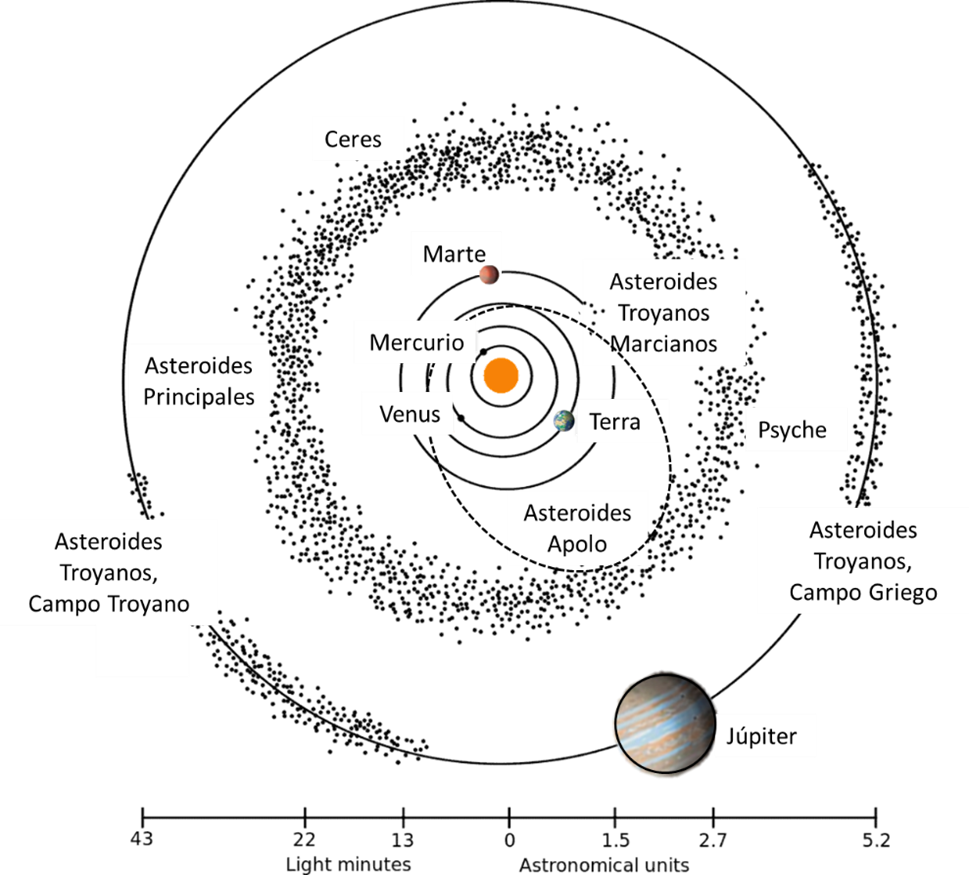
Asteroids are small rocky objects that orbit the Sun. Most asteroids are found within the Main Asteroid Belt, located between the orbits of Mars and Jupiter. These bodies typically orbit at an average distance of about 2.7 times the distance between Earth and the Sun.
In addition to the Main Belt, there are two other important groups of asteroids.
The Jovian Trojans are icy asteroids that orbit in two large clouds around Jupiter’s Lagrange Points 4 and 5.
Similarly, the Martian Trojans are asteroids that share Mars’ orbit around the Sun.
Another important category is the Apollo Asteroids, a group of Near-Earth Asteroids (NEAs) whose perihelion distances are less than 1.017 AU (Astronomical Units) and whose semi-major axes exceed 1 AU. Most Apollo asteroids are smaller than 10 kilometers (6 miles) in diameter, with 1866 Sisyphus being the largest known member of the group.
Apollo asteroids are particularly important because they frequently cross Earth’s orbit. Many are classified as Potentially Hazardous Asteroids (PHAs) due to their proximity to Earth and their potential to collide with our planet in the future.
Classification of Asteroids
Asteroids are generally classified into three major compositional groups:
- C-type (Carbonaceous)
- S-type (Silicaceous)
- M-type (Metallic)
C-Type Asteroids
C-type asteroids, also known as carbonaceous chondrites, are the most common.
They are composed primarily of clay-rich minerals and silicate rocks, giving them a dark appearance. Because they have undergone relatively little alteration since the formation of the Solar System, they are considered among the oldest and most primitive objects known.
S-Type Asteroids
S-type asteroids, often called stony asteroids, consist mainly of silicate materials mixed with nickel-iron metals.
They possess a rocky composition and are intermediate in abundance between C-type and M-type asteroids.
M-Type Asteroids
M-type asteroids are dominated by metallic materials, primarily nickel and iron.
Scientists believe that some M-type asteroids were once part of larger bodies that experienced internal heating and partial melting. During this process, heavier metals sank toward the center while lighter materials rose toward the surface.
Some of these objects may represent the exposed cores of ancient protoplanets that never completed their formation into full-sized planets.
Ceres: The Largest Object in the Main Belt
Ceres is the largest object in the Main Asteroid Belt and is classified as a dwarf planet.
It has a radius of approximately 476 kilometers (296 miles).
To put its size into perspective, if Earth were reduced to the size of a nickel, Ceres would be roughly comparable to a poppy seed.
Its surface is composed of a mixture of water ice and hydrated minerals, including carbonates and clay-rich compounds.
Ceres has become an important target for scientific exploration because it may preserve clues about the early history of the Solar System and the role of water in planetary evolution.
Psyche: A Window into Planetary Interiors
Another remarkable asteroid is 16 Psyche, located within the Main Asteroid Belt.
Classified as an M-type asteroid, Psyche is believed to consist largely of metallic materials.
With an average diameter of approximately 226 kilometers (140 miles), it is roughly comparable to the distance between Los Angeles and San Diego.
Psyche is of particular interest because many scientists believe it may be the exposed metallic core of a failed protoplanet—a planetary embryo that never accumulated enough material to become a fully formed planet.
Studying Psyche may provide a unique opportunity to examine a planetary core directly, something impossible on Earth or any of the terrestrial planets.
Why Asteroids Matter
Asteroids are far more than scattered rocks drifting through space.
They preserve valuable information about the origin and evolution of the Solar System, acting as time capsules from its earliest history.
By studying their composition, structure, and orbital dynamics, scientists gain insights into:
- The formation of planets
- The distribution of water and organic materials
- The history of impacts throughout the Solar System
- The resources available for future space exploration
Understanding asteroids helps us better understand our own origins—and perhaps our future among the stars.