
A Martian Business Case in Strategic Positioning
Narrative Introduction
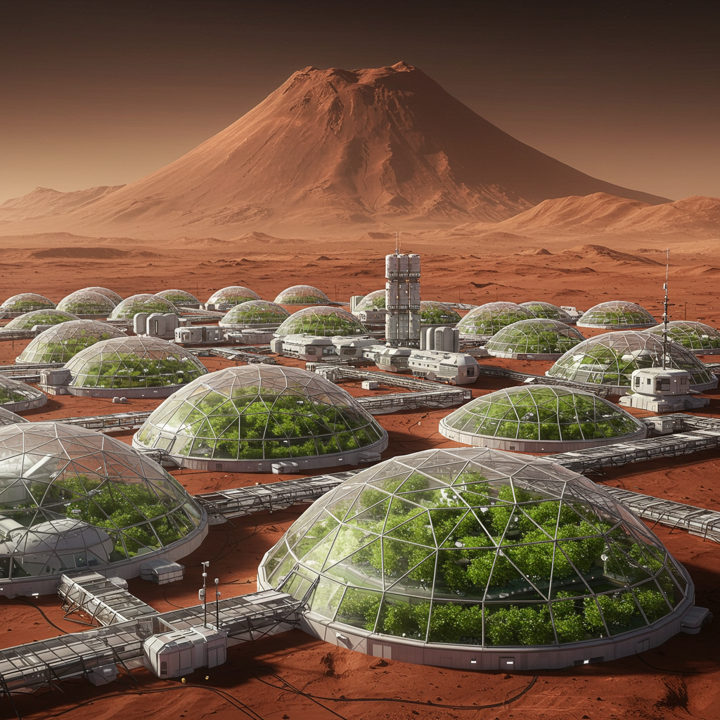
The year is 2121. Humanity now inhabits two cradles: Earth and Mars. What began as a bold engineering experiment decades earlier has matured into a structured planetary civilization. Mars is no longer an outpost. It is a network of interconnected cities, each protected by controlled environmental systems and sustained by circular agricultural ecosystems. While Mars remains dependent on Earth for certain high-value imports, the majority of food, energy, and industrial production is locally generated.
The Martian economy has evolved around three structural realities:
- Closed-loop sustainability
- Regional specialization
- High infrastructure dependency
Every Martian city operates large greenhouse complexes integrated into its life-support systems, forming the backbone of a highly efficient and circular food economy (see Martian Gastronomy and Agriculture) Vegetables, fruits, and grains are grown hydroponically, while protein is primarily produced locally through closed-loop systems including crickets (processed into “Crickey” protein), aquaculture species such as tilapia and shrimp, and controlled frog farming. Bees serve as pollinators within agricultural domes, and silkworm production supports both textile manufacturing and broader bio-industrial processes.
Although core nutrition is locally abundant, flavor complexity often depends on inter-city trade. Before analyzing the cities individually, take a moment to explore their location and context using the Interactive Martian Map. Certain cities specialize in specific agricultural outputs:
- Huǒ Xīng — Golden Rice production
- Mansikhar — Indian spices
- Saint Maroun — Syrian/Lebanese spices, textiles, power generation
- New Recife — Vegetable oil production and refinery products
- Kopernika — Polish cultural and agricultural heritage
Most inter-city trade occurs through sub-orbital flights, which are fast but capacity-constrained and occasionally disrupted by dust storms. Imports from Earth arrive via Solar Sail transport vessels but are extremely expensive and reserved for ceremonial or luxury markets.
Culinary and Technological Constraints
Because Martian cities operate inside pressurized habitats, restaurants function under strict technological and environmental regulations.
Open flame cooking is prohibited due to fire containment risks.
Restaurants instead rely on:
- induction systems,
- pressure cooking,
- enclosed baking systems,
- microwaving,
- and sealed frying technologies.
Lower Martian gravity also affects food preparation:
- frying creates larger bubbles,
- fermentation behaves differently,
- carbonation expands more aggressively.
Meanwhile, hydroponically grown produce tends to be physically larger but often less flavor-intensive than Earth-grown equivalents. As a result, spices play a major role in culinary differentiation.
The New Recife Dining Competition
Within the city of New Recife — a culturally vibrant settlement of approximately 150,000 residents — two restaurants have emerged as major competitors:
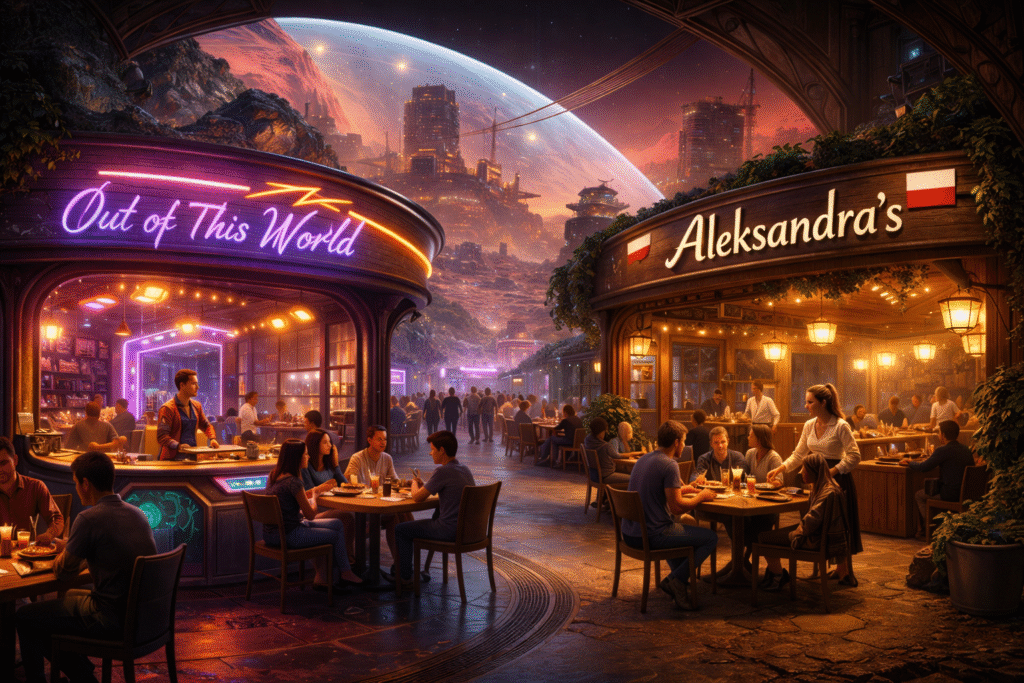
Out of This World
Located within New Recife’s entertainment district, Out of This World benefits from heavy tourism, nightlife activity, and inter-city visitor traffic, but also faces higher expectations for novelty, atmosphere, and experiential differentiation. It provides a Venezuelan-inspired immersive dining experience known for:
- theatrical atmosphere,
- holographic entertainment,
- spice-forward cuisine,
- and experiential hospitality.
Aleksandra’s
Located near New Recife’s academic and research district, Aleksandra’s is a Polish restaurant founded by a nutritionist, which primarily serves residents, researchers, educators, and long-term professionals seeking nutritional consistency, affordability, and operational reliability, emphasizing:
- operational discipline,
- nutritional integrity,
- comfort food adaptation,
- and repeat-customer loyalty.
Both restaurants:
- operate under identical Martian environmental constraints,
- rely primarily on local food systems,
- face transportation volatility,
- and compete for the same limited consumer spending.
However, their strategic positioning differs significantly.
Martian Human Capital and Economic Structure
Mars is not only a technological civilization; it is an educational civilization.
From early childhood, Martians are shaped by a structured academic system rooted in lifelong learning, competency mastery, and applied experience. Education progresses through structured three-month “triads” grouped into competency levels, culminating in professional and master-level expertise. Advanced mastery — often doctoral-level — is common.
As a result, Mars has developed:
- A highly educated population
- Strong scientific and nutritional literacy
- Systems-level thinking as a cultural norm
- A technocratic and meritocratic governance structure
This educational framework directly influences economic behavior.
Income Distribution and Consumption Norms
Mars operates as an open, privately owned small-business economy embedded within a Northern European–style social infrastructure.
Restaurants and retail establishments are privately owned. However, taxation (effective rate approximately 35–40%) funds robust public services, including:
- Environmental life-support systems
- Integrated greenhouse complexes
- Waste recycling loops
- Transportation networks
Food production infrastructure serves both agricultural and atmospheric regulation functions. As a result, baseline food inputs are partially socialized through taxation.
Economic implications:
- Income inequality is low
- Salary dispersion is modest
- Disposable income is stable across households
- Extreme wealth concentration is absent
Martians are not prone to conspicuous luxury consumption. Money functions primarily as a coordination mechanism to sustain quality of life.
Cultural Attitudes Toward Food
Martians are:
- Nutritionally conscious
- Aware of ingredient sourcing
- Attentive to sustainability
- Skeptical of superficial marketing
Food decisions balance:
- Health optimization
- Cultural identity
- Community experience
- Operational sustainability
Luxury dining exists but does not dominate the market. Restaurants must justify differentiation through meaningful value rather than prestige.
Restaurant Profiles
Out of This World
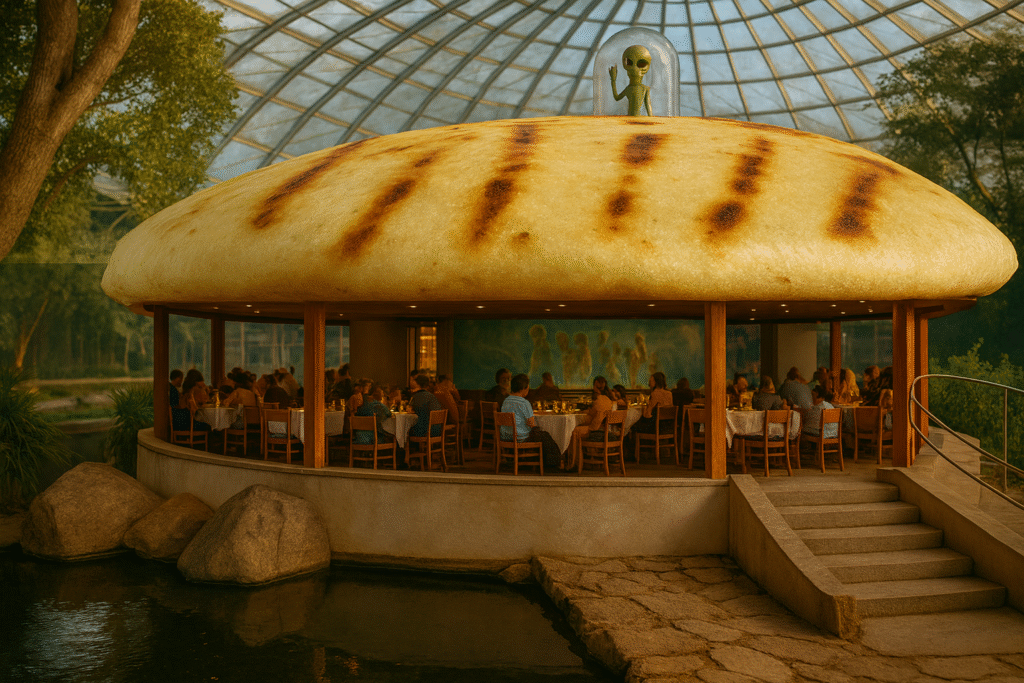
A Venezuelan-inspired immersive dining experience located in New Recife’s entertainment district. The architecture resembles a giant arepa. Interiors feature holographic projections, Venezuelan music, and themed hospitality.
Menu Characteristics
Signature items include:
- Arepa Rompe Colchón (aquaculture-based filling)
- Venezuelan chalupa adapted with Crickey protein
Key inputs:
- Corn-based products
- Locally abundant vegetable oils
- Mansikhar spice imports
- Aquaculture proteins
Operational Characteristics
- Labor-intensive service model
- Higher energy usage (immersive environment)
- Greater exposure to spice import volatility
Customer Base
- Residents seeking experiential dining
- Inter-city visitors
- Tourism peaks during Solar Sail docking
Aleksandra’s
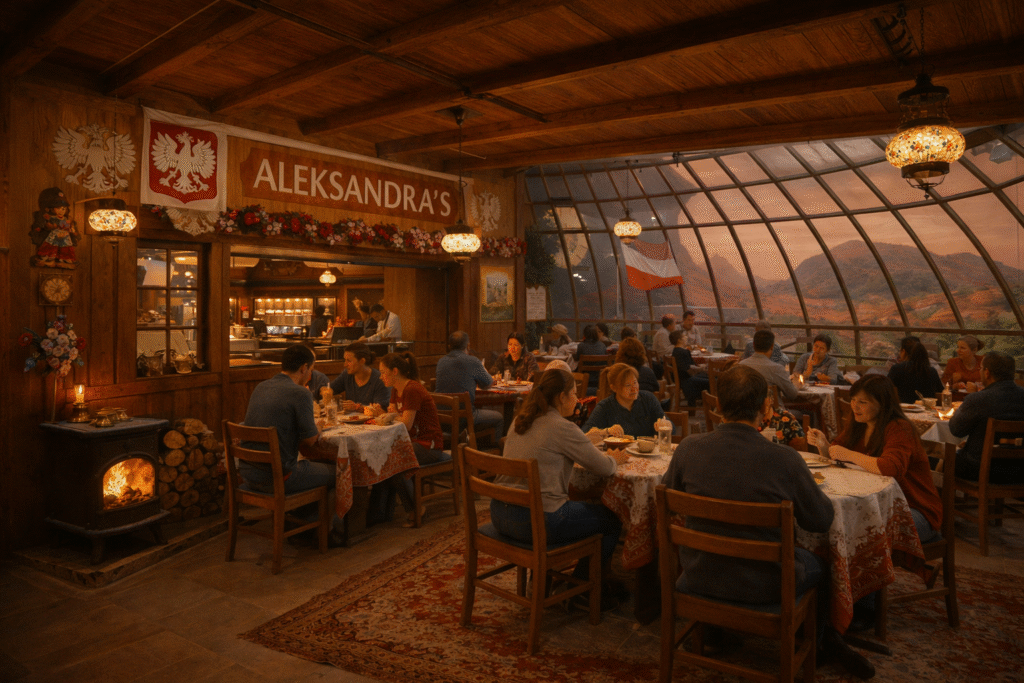
A Polish restaurant near the planetarium, at New Recife’s academic and research district. Founded by a nutritionist, it emphasizes disciplined operations and nutritional integrity.
Menu Characteristics
Signature items include:
- Crulasz (goulash-style dish using extruded Crickey)
- Adapted potato pancake derivatives
Key inputs:
- Locally produced proteins
- New Recife vegetable oils
- Limited spice imports
- Occasional specialty ingredients from Kopernika
Operational Characteristics
- Moderate labor intensity
- Strong cost discipline
- Loyal repeat customers
- Lower reliance on theatrical ambiance
Customer Base
- Local residents
- Academic community
- Families
- Limited but steady tourist traffic
Economic Assumptions (USD Equivalent)
Income
- Median annual income: $95,000
- Dining frequency: 2–3 times per week per household
Core Inputs
- Hydroponic vegetables: $2.50/lb
- Crickey protein: $5.00/lb
- Tilapia: $7.50/lb
- Frog: $9.00/lb
- Vegetable oil: $1.80/lb
Imports
- Mansikhar spices: $40.00/lb
- Saint Maroun spices: $35.00/lb
- Golden Rice: $4.00/lb
Labor
- Restaurant staff: $28–$35/hour
- Skilled culinary staff: $38–$45/hour
Monthly Fixed Costs
- Lease: $22,000
- Energy: $6,500
- Water: $3,000
Under high taxation and compressed wages:
- Profit margins are moderate
- Efficiency and coherence matter
- Extreme luxury pricing is culturally discouraged
restaurants typically operate with:
net profit margins between 8% and 15%.
Extreme luxury pricing is culturally discouraged.
Strategic coherence, operational efficiency, and sustainability are critical for long-term success.

Academic Use and Assessment Access
The New Recife Dining Competition was developed as part of a broader interdisciplinary educational initiative exploring strategy, sustainability, systems thinking, innovation, and human adaptation within constrained environments.
The narrative presented on this page provides the foundational context for classroom discussion and analysis. The full assessment prompts, strategic scenarios, and randomized evaluation components used in academic courses are intentionally reserved for enrolled students as part of their formal course assessments.
Faculty members, instructional designers, or academic institutions interested in learning more about the pedagogical framework, assessment design, or potential educational collaborations are welcome to contact Dr. Ricardo Silva directly through the Comet Surfer website.
The long-term goal of this initiative is to explore how speculative worldbuilding, systems thinking, and strategic simulation can support deeper interdisciplinary learning in business, sustainability, technology, and innovation educati