
The second decisol begins with a different kind of light.
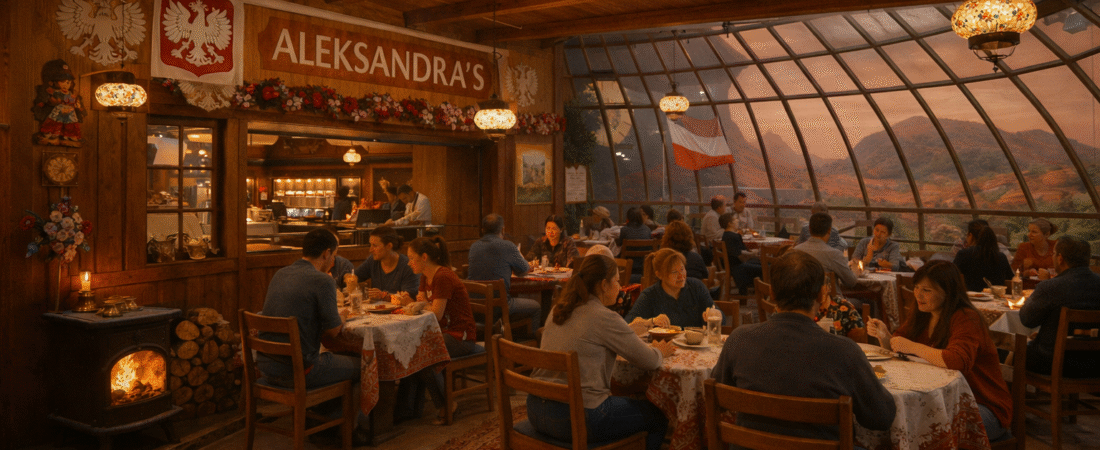
In New Recife, once the sun has risen above the salmon-colored horizon and the city enters full academic activity, the planetarium district awakens with a quieter energy than the central entertainment sector. There, only a few doors away from the stellar dome where students and scientists rehearse orbital simulations, stands Aleksandra’s.
There are no extravagant forms or playful architectural gestures. The façade is restrained: treated wood, polished steel, and large windows overlooking the interior gardens of the dome. Above the entrance, a simple sign reads:
Aleksandra’s
Beneath it, in smaller lettering:
Polish Cuisine Adapted to Mars
At 05:30 decisol, Aleksandra Gorski is already in the kitchen.
Born in Poland, in the First Cradle, and trained in nutrition and dietetics, Aleksandra does not view cooking as performance, but as system design. Every ingredient is a variable. Every recipe, a cultural equation that must be solved under new gravitational conditions.
Her first task is not tasting the soup, but reviewing the day’s nutritional profiles.
Projected across the kitchen’s primary display is the recommended caloric balance for terraforming workers, laboratory researchers, and intermediate-level students. On Mars, no one ignores physiology. Reduced gravity alters muscle mass, mineral absorption, and metabolic efficiency. Menus must evolve accordingly.
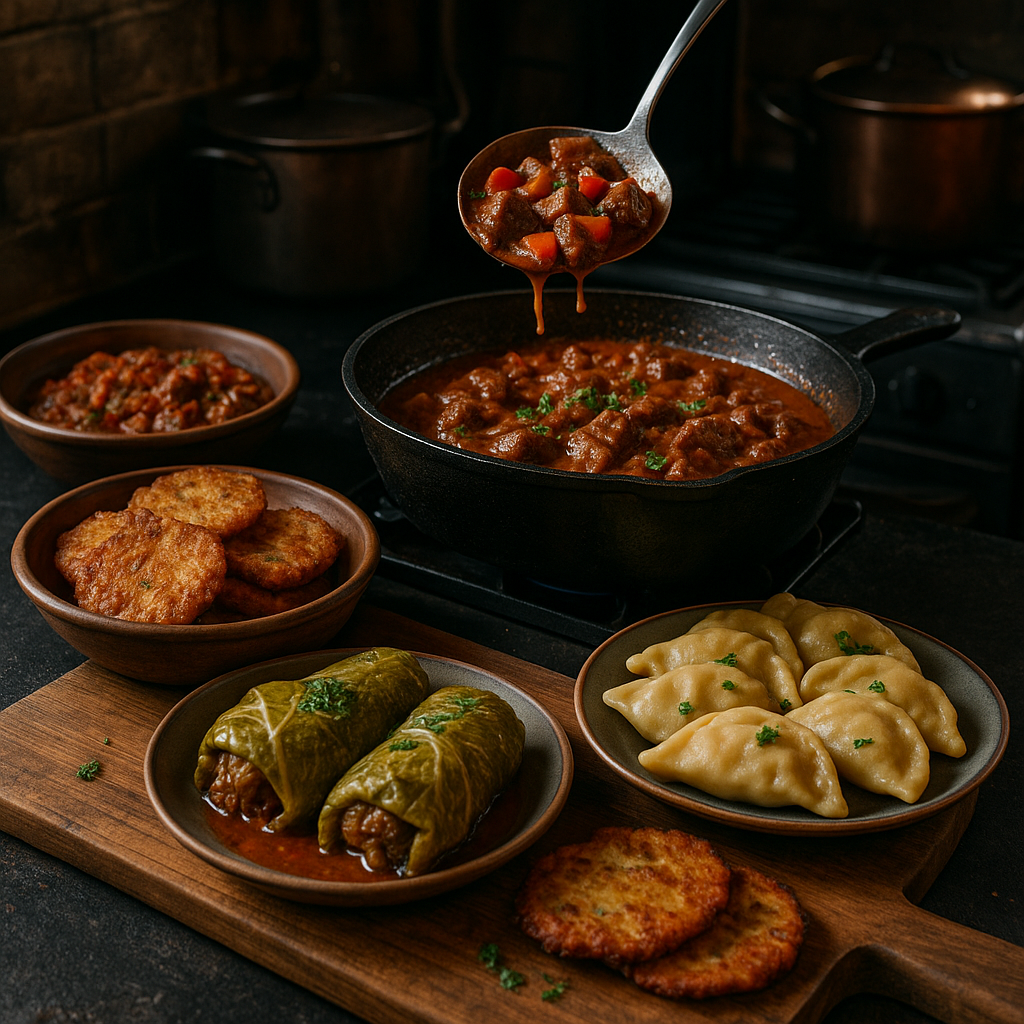
At one of the preparation stations, a culinary robot adjusts the internal pressure of a sealed cooking vessel where Crulasz simmers — the Martian reinterpretation of traditional Polish goulash. There is no beef; instead, extruded Crickey protein marinates in a blend of vegetable oils from New Recife and moderate spices imported from Saint Maroun. The aroma is deep but never overwhelming. On Mars, excess is not considered a virtue.
Nearby, potato pancakes crackle softly on an induction surface enclosed within a sealed frying module. The locally produced oil bubbles differently than it would on Earth — larger spheres forming under reduced gravity. Aleksandra adjusts the cooking time with near-surgical precision. Too long, and the texture changes. Too short, and the structure fails to hold.
Unlike other restaurants, there are no holograms here, no immersive music drifting through the room. The atmosphere is warm but restrained: solid wooden tables, embroidered traditional fabrics, and an encapsulated biomass stove — decorative rather than functional — evoking memories of Earth without violating Martian safety regulations.
At 08:00 decisol, the first customers begin to arrive: planetarium professors, students reviewing notes on translucent displays, and families seeking a balanced meal before beginning their daily activities.
Many are regulars.
Aleksandra knows them by name, though she rarely interrupts the choreography of the system. Two service androids assist with repetitive tasks: carrying dishes, registering orders, cleaning surfaces. Yet the final touch always remains human. The plating of the Crulasz, the recommendation of the day, the explanation of how sodium levels were adjusted to compensate for the average Martian diet — those details belong to her team.
Near one of the windows, a group of students debates thermal transfer equations while sharing a thick soup enriched with Golden Rice from Huǒ Xīng. At another table, a family quietly celebrates their daughter’s transition to the next academic competency level.
Aleksandra observes.
She does not seek applause or spectacle. She seeks consistency.
In an environment where most essential resources are stabilized through public infrastructure and where consumers understand supply chains intimately, competitive advantage no longer resides in excess, but in coherence.
By 12:00 decisol, as the third decisol begins, the restaurant is full but never chaotic. Turnover remains efficient. Waiting times are minimal. Costs are controlled. Portions are carefully calibrated.
Before ending her shift, Aleksandra updates her digital logbook:
- Imported spice consumption: within acceptable range.
- Oil utilization: optimized.
- Customer satisfaction (automated survey): 94%.
- Average nutritional balance per dish: aligned with recommended standards.
Outside the dome, the Martian sky has deepened into darker tones. Phobos crosses rapidly overhead, nearly imperceptible to anyone not searching for it.
Aleksandra closes the kitchen with the serenity of someone who understands that feeding a colony is neither a romantic nor heroic act, but a systemic responsibility.
In New Recife, some restaurants sell experience.
Aleksandra’s sustains continuity.
And on Mars, continuity is survival.