
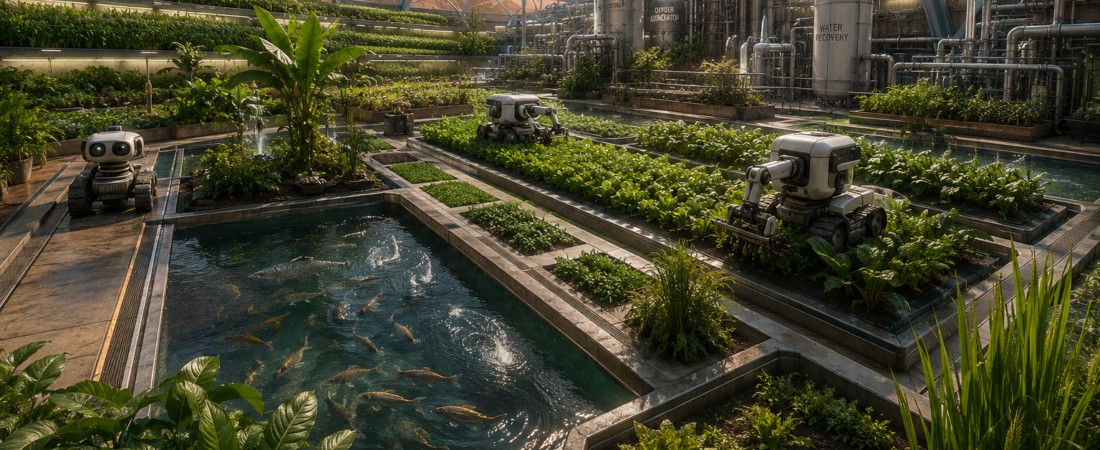
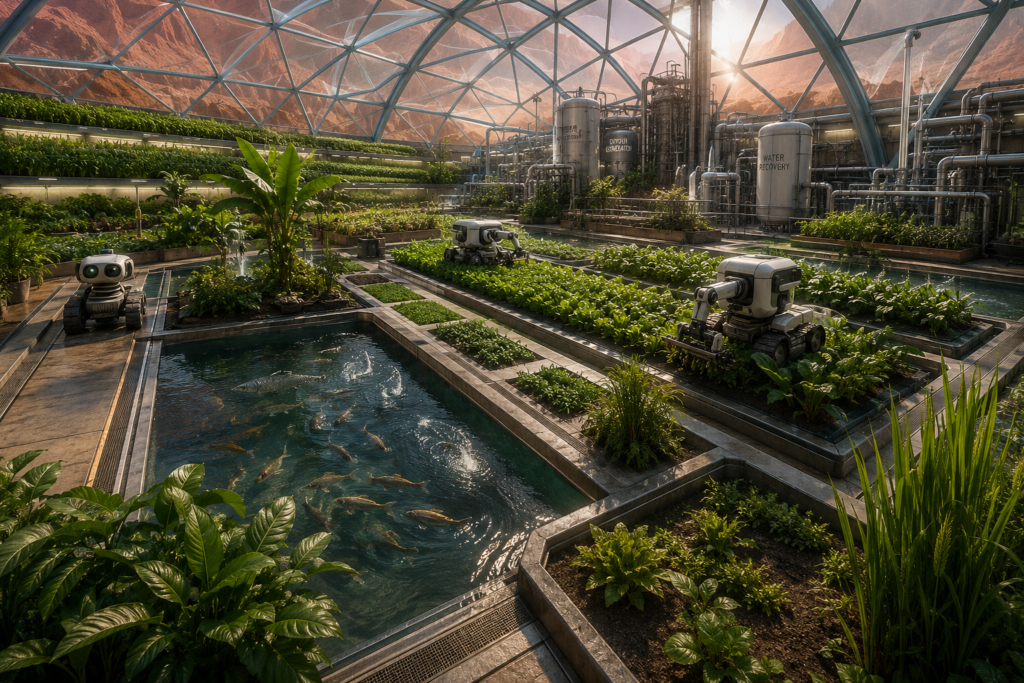
On the Red Planet, agriculture evolved into far more than food production. Martian gastronomy blends biotechnology, sustainability, and cultural heritage into a living ecosystem where every organism plays multiple roles. Signature dishes include Crickey kibbeh (cricket-based kibbeh), giant sweet corn, and vegetables grown to extraordinary sizes under low-gravity conditions. Lettuce heads exceeding one meter in diameter and bullfrogs nearly half a meter long are not uncommon inside the agricultural domes of Mars.
Martian agriculture relies on highly integrated mixed-cultivation systems that combine plants, fish, crustaceans, amphibians, insects, microorganisms, and automated recycling infrastructure into closed ecological networks. These organisms serve not only as efficient protein sources, but also as critical components of biological recycling systems designed to maximize resource efficiency.
Compared to birds or mammals, aquatic and invertebrate species require significantly less water, oxygen, feed, and living space per kilogram of edible biomass. Bullfrogs, for example, provide an excellent nutritional ratio by weight and volume, adapt well to controlled environments, and contribute to ecological balance through natural insect control. Crustaceans such as shrimp, along with small fish species like tilapia, are cultivated within interconnected aquaponic modules linked to advanced biological water-recycling systems.
Insects also became a cornerstone of Martian food production. Crickets provide exceptionally high protein yields while consuming minimal resources, producing negligible methane emissions, and reproducing rapidly in compact controlled habitats. Their efficiency made them one of the first truly sustainable protein sources adopted across multiple colonies.
Beyond efficiency, Martian agriculture is deeply tied to cultural adaptation. Certain food sources gained acceptance because they aligned more easily with diverse dietary traditions and religious interpretations. Some vegetarian communities, for example, accepted the consumption of fish and crustaceans under interpretations that classified them as aquatic life forms distinct from terrestrial animals. Such cultural flexibility became essential in maintaining harmony within multicultural space settlements.
However, agriculture on Mars serves a far greater purpose than nutrition alone. Agricultural ecosystems form an essential component of the planetary life-support infrastructure. Every greenhouse, aquaponic reservoir, fungal bioreactor, and algae pond participates in the continuous recycling of matter, water, and atmospheric gases within the colony.
Gray water and brown water generated by human activity are biologically processed through multiple ecological stages involving algae, bacteria, fungi, plants, and engineered microbial systems. These organisms break down organic waste, remove contaminants, recycle nutrients, and convert waste streams into usable agricultural resources. Nutrient-rich reclaimed water then becomes the foundation for aquaculture systems and hydroponic farming.
Following biological treatment and advanced purification, water is evaporated, condensed, sterilized, and reintroduced into the white-water (drinking water) system. While Martian colonies recycle the overwhelming majority of their water internally, additional reserves are obtained from subsurface ice deposits, underground aquifers, and polar extraction operations when necessary.
Plants themselves are indispensable atmospheric processors. Beyond producing food, Martian vegetation absorbs carbon dioxide generated by both humans and industrial systems. Some colonies also directly extract CO₂ from the thin Martian atmosphere and channel it into agricultural domes to stimulate photosynthesis. Through this process, plants generate oxygen for humans and animals while simultaneously helping regulate humidity, air quality, and thermal stability inside the habitats.
These interconnected ecological systems are descendants of early closed-environment experiments conducted on Earth, including NASA bioregenerative life-support research and projects such as Biosphere 2. Although Biosphere 2 encountered major technical and ecological challenges during the 1990s, it demonstrated both the promise and the extraordinary complexity of maintaining self-contained ecosystems capable of supporting human life. Martian engineers, ecologists, and biotechnologists learned extensively from those experiments, eventually developing far more stable and adaptive closed-loop environments for long-duration habitation.
Modern Martian biospheres therefore operate as hybrid ecological-machinery systems: part farm, part atmospheric processor, part water-treatment facility, and part living ecosystem. Nothing is considered waste. Every output from one organism or process becomes the input for another.
These agricultural decisions are guided by the central logic of space sustainability: every molecule of water, every liter of oxygen, every gram of biomass, and every unit of energy must be optimized without compromising human health, biodiversity, or the long-term stability of the artificial ecosystem.
Comparative Analysis of Protein Sources for Martian Colonies
| Species | Maturity / Growth Time | Resource Consumption per kg Edible Mass | Usable Biomass Percentage | Co-Cultivation Potential | Additional Notes |
|---|---|---|---|---|---|
| Shrimp | 2–3 months | Low | Medium–High (meat + chitin) | High (aquaponics) | Chitin useful for bioplastics and pharmaceuticals |
| Crickets | 5–8 weeks | Very Low | Very High (>80%) | High (controlled habitats) | Extremely efficient, protein-rich |
| Bullfrogs | 3–4 months | Low | High (>70%) | Medium | Low methane emissions, low oxygen demand |
| Tilapia | 6–9 months | Medium | Medium–High | High (aquaponics) | Excellent source of omega-3 fatty acids |
| Chickens | 5–6 months | High | Medium | Low | Require heating, dry habitats, and large water inputs |
| Goats | 5-month gestation, ~1 year for meat production | Very High | Medium | Very Low | Require extensive oxygen, space, and plant biomass |
The table clearly illustrates why birds and mammals are rarely used as primary protein sources in Martian and deep-space colonies. Aquatic and invertebrate organisms offer dramatically higher sustainability while integrating more efficiently into closed-loop ecosystems.
Historical Foundations of Space Agriculture
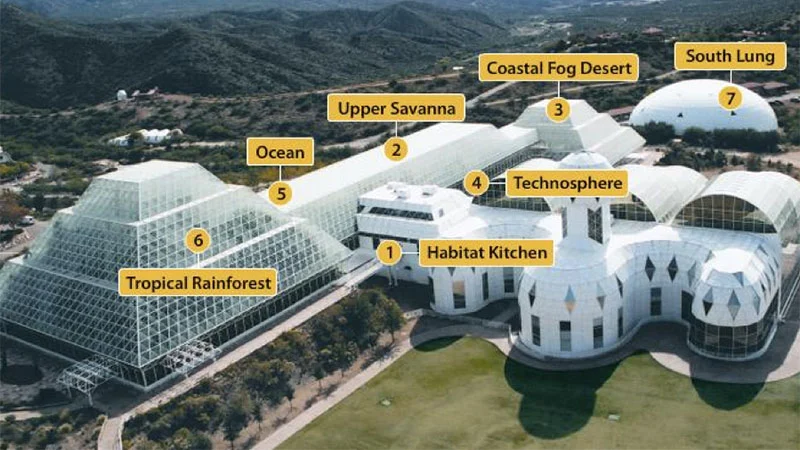
Many of the agricultural and ecological concepts later adopted by Martian colonies originated from experimental sustainability projects developed on Earth during the late twentieth and early twenty-first centuries.
Projects such as Biosphere 2, NASA’s bioregenerative life-support research programs, and even public educational initiatives like EPCOT’s The Land Pavilion explored controlled-environment agriculture, hydroponics, aquaponics, water recycling, and sustainable food production decades before permanent extraterrestrial settlements became possible.
Although originally designed for Earth-based sustainability and education, these systems demonstrated many of the principles that would later become essential for long-duration space habitation: resource circularity, biological recycling, atmospheric management, and high-efficiency food production within enclosed ecosystems.
In this sense, the agricultural domes of Mars were not invented overnight. They evolved from generations of ecological experimentation, engineering innovation, and humanity’s growing understanding that survival beyond Earth would require learning to live as part of tightly interconnected ecosystems.
On Mars, agriculture is not merely farming. It is life support, environmental engineering, ecology, culture, and survival woven into a single interconnected system.