
Medicine as a Second Skin
In extraterrestrial environments, medicine is not always found in hospitals.
In many cases, it is worn.
Biosuits represent a critical evolution in the relationship between the human body and its environment. More than simple protective garments, they function as integrated platforms for physiological support, continuous monitoring, environmental adaptation, and human-machine interaction.
Their design begins with a fundamental premise:
every body is different, and in extreme environments, those differences matter.
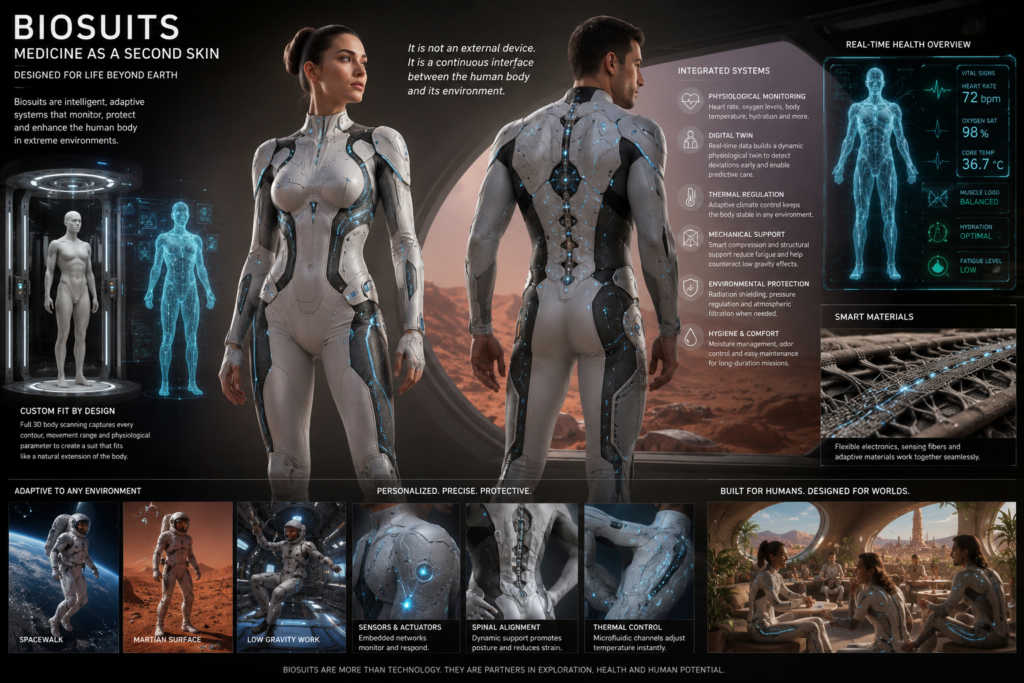
For this reason, biosuits are manufactured using full three-dimensional body scans capable of capturing each contour, proportion, posture, and range of motion with extraordinary precision. Using these data, advanced computer-assisted engineering systems generate fully personalized suits in which every structural and biomechanical component adapts harmoniously to the individual wearer.
But the true innovation lies not only in the physical fit.
It lies in their ability to observe.
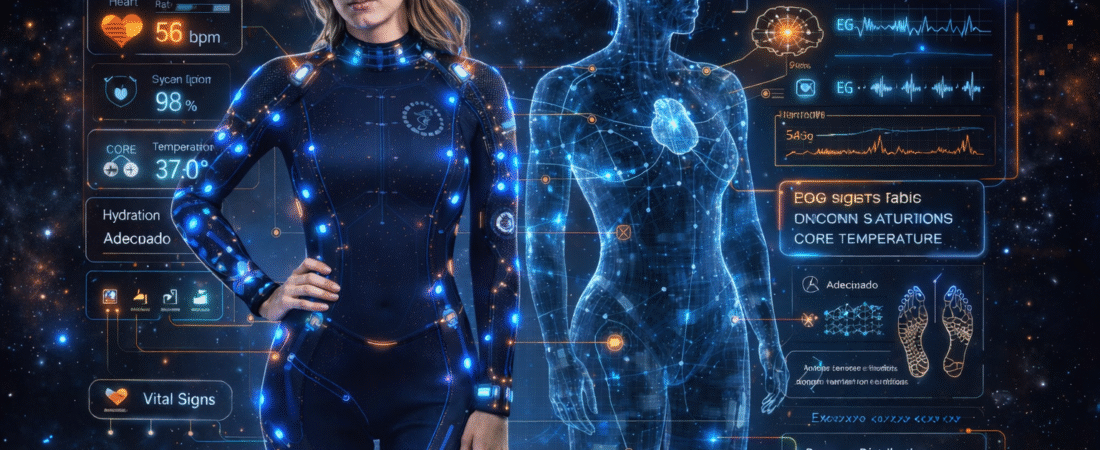
Biosuits incorporate dense networks of embedded sensors capable of continuously monitoring vital physiological variables such as:
- heart rate,
- body temperature,
- hydration,
- oxygen saturation,
- muscular fatigue,
- stress indicators,
- and metabolic activity.
This information is not merely recorded. It is processed in real time to construct what is known as a physiological digital twin: a dynamic computational representation of the wearer’s metabolic state.
This digital model continuously compares the body’s current condition against a previously calibrated baseline. Even the smallest deviations can be detected early, enabling preventive intervention before clinical symptoms appear.
In this sense, the biosuit transcends its protective role:
it becomes a distributed medical system.
Advanced smart-fabric technologies allow the suit to interact directly with the body itself. Three-dimensional woven structures incorporate adaptive compression systems, flexible electronics, and biomechanical support elements capable of reducing fatigue and compensating for the effects of low-gravity environments.
Thermal regulation systems stabilize body temperature under conditions ranging from deep-space cold to planetary surface exposure. Thermal stability no longer depends entirely on the environment—it becomes actively managed by the suit itself.
In microgravity and partial-gravity environments, biosuits may also apply carefully distributed mechanical pressures that simulate gravitational loading on muscles and bones, helping mitigate long-term musculoskeletal deterioration.
Beyond physiology, biosuits also address fundamental aspects of human well-being during extended missions:
- hygiene,
- comfort,
- mobility,
- emotional stability,
- privacy,
- and interpersonal connection.
Over time, biosuits evolved from purely medical and survival technologies into cultural and social interfaces. Civilian biosuits became lighter, more elegant, and increasingly integrated into daily life beneath the domes of Mars and other extraterrestrial colonies. Fashion, identity, and personal expression merged with biotechnology and wearable medicine.
This evolution also transformed intimacy in space.
In microgravity environments, human contact introduces unique physiological and mechanical challenges. Specialized dual-user biosuit configurations were therefore developed to facilitate safe physical interaction during prolonged missions. These systems incorporate:
- coordinated stabilization harnesses,
- dynamic attachment points,
- thermal synchronization,
- pressure balancing,
- biometric feedback,
- and assisted positioning systems
designed to improve comfort, reduce accidental injury, and maintain stability in zero-gravity conditions.
In long-duration missions, these features became recognized not as luxuries, but as essential aspects of psychological health, emotional bonding, and human well-being.
Biosuits therefore redefine the concept of healthcare itself:
They are not external devices.
They are continuous interfaces between the human body and its environment.
In the Comet Surfer universe, biosuits are not optional technologies.
They are one of the fundamental conditions that make life beyond Earth possible.
→ Explore Health & Human Adaptation
→ Explore Fashion on Mars
→ Explore Relationships & Intimacy in Space