
Martian Academic System
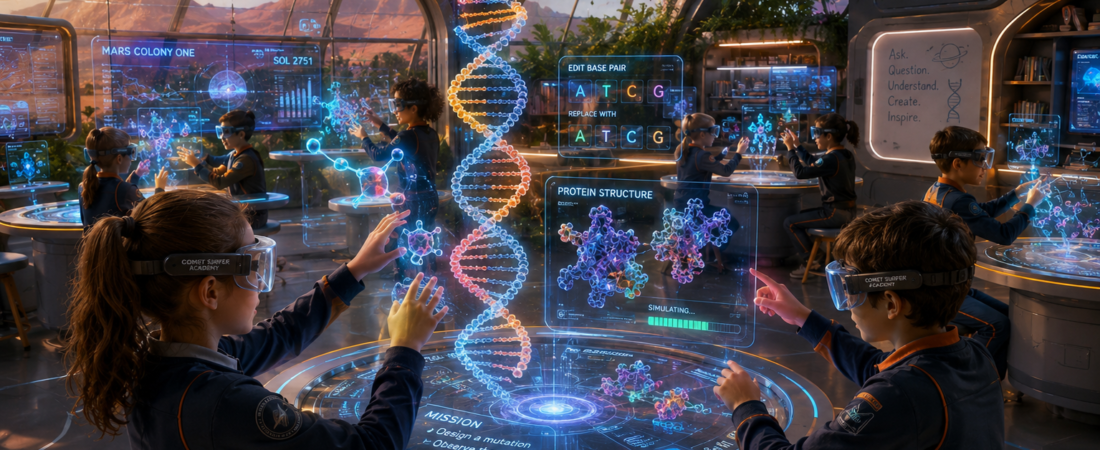
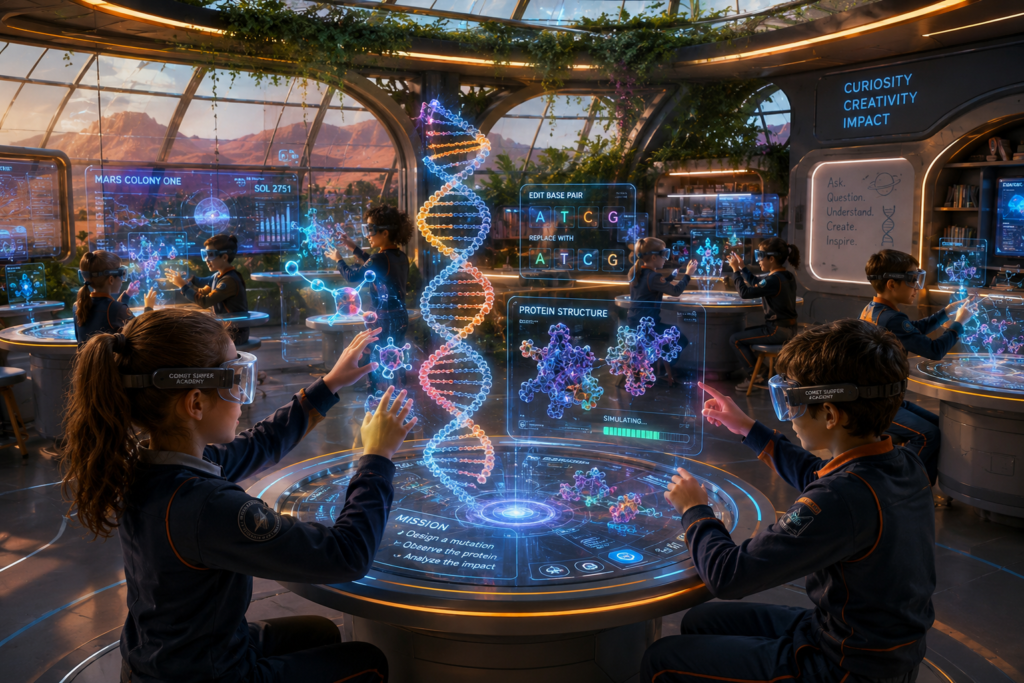
The Martian academic system, deeply rooted in the values of education and lifelong learning, represents an extraordinary model designed to shape young minds from a very early age. As Martian children grow, they embark on a journey of discovery structured around a precise yet flexible educational framework.
Triad-Based Education
Formal education begins shortly after the celebration of a child’s first sol of birth, typically when a Martian child is around two Earth years old. The educational system is organized around three-month intervals known as triads. Each triad represents a distinct educational cycle, allowing students to explore subjects in depth while continuously building upon prior knowledge and skills.
Every new triad introduces fresh intellectual and practical challenges, fostering gradual mastery rather than fragmented memorization.
Competency Levels
Triads are grouped into broader competency levels, each lasting approximately two mirs. These levels progress through:
- Initial
- Basic
- Intermediate
- Advanced (equivalent to secondary education on Earth)
- Professional
- Master
The ultimate aspiration of every Martian citizen is the attainment of mastery within one or more domains of:
- art,
- science,
- technology,
- or the humanities.
The pursuit of expertise is considered a lifelong endeavor. Doctoral-level studies remain highly respected and are often pursued by individuals seeking leadership, research, or governance roles within Martian society.
Practical Experience and Applied Learning
Beginning at the intermediate level, students are encouraged to pursue practical experience in disciplines of personal interest. Martians may dedicate two triads per sol—similar in concept to Earth’s summer breaks—to immersive practical training, apprenticeships, research programs, or fieldwork.
This emphasis on experiential learning ensures that theoretical education is continuously reinforced through real-world application, producing highly adaptable and interdisciplinary citizens.
Mastery of Communication Systems
As students progress academically, they are expected to master at least three communication systems.
The primary system typically corresponds to their regional language, while the additional systems may be selected from a broad spectrum of communicative disciplines, including:
- living languages,
- ancient languages such as Latin or Sanskrit,
- sign language,
- mathematical notation,
- musical language,
- programming languages,
- logic systems,
- symbolic systems,
- body language,
- and advanced human-machine communication protocols.
This educational philosophy broadens intellectual flexibility while fostering deep appreciation for multiple forms of expression and cognition.
Holistic Development
Martian education extends far beyond academic achievement. The system promotes holistic development by integrating:
- theoretical knowledge,
- practical competence,
- emotional intelligence,
- creativity,
- collaboration,
- and communication.
The objective is not merely to produce specialists, but resilient lifelong learners capable of navigating the complex realities of an interplanetary civilization.
Martian Cognitive Anthropogogy (MCA)
One of the most influential educational frameworks on Mars is the Martian Cognitive Anthropogogy (MCA), developed by Izabel Ferreira.
MCA is an educational philosophy centered on:
- emotional stimulation,
- positive identity formation,
- and cultural adaptation.
Implemented from early childhood, the system prioritizes the emotional connection between children and Mars as their adopted homeworld. Through holographic storytelling, sensory simulations, historical narratives, and immersive learning environments, young Martians are introduced to Earth’s legacy while simultaneously cultivating pride in Martian civilization and identity.
Human–Machine Integration
Human-machine interaction forms an integral part of Martian society and education.
Artificial intelligences such as ANNIE are not perceived merely as tools, but as emotionally present entities that participate actively in daily life. Many Martians develop deeply personal and almost symbiotic relationships with their AI companions, which may assist with:
- education,
- emotional support,
- professional planning,
- family dynamics,
- creative collaboration,
- and scientific exploration.
As a result, artificial intelligence becomes woven directly into the cultural and emotional fabric of Martian civilization.
Toward a New Civilization
Together, these elements contribute to the emergence of a distinctly Martian civilization.
Mars is not a mere extension of Earth.
It is an original synthesis of:
- science,
- memory,
- adaptation,
- sustainability,
- and exploration.
Through their educational systems and cultural institutions, Martians affirm their autonomy and forge a unique path into the cosmos—guided by collaboration, resilience, and the continuous pursuit of knowledge.