
Martian Sports: Earth Games Under a Different Gravity
Sports on Mars remain deeply connected to their terrestrial origins. Football, tennis, basketball, swimming, athletics, and countless recreational disciplines continue to serve as cultural anchors for settlers living millions of kilometers from Earth. Yet the reduced Martian gravity — approximately 38% that of Terra — has transformed the way these sports are played, designed, and experienced.
Inside pressurized domes and enclosed arenas with Earth-normal atmospheric pressure, athletes can run faster, jump higher, and cover greater distances with less fatigue. As a result, many traditional sports required structural adaptations to preserve balance, competitiveness, and athletic challenge.
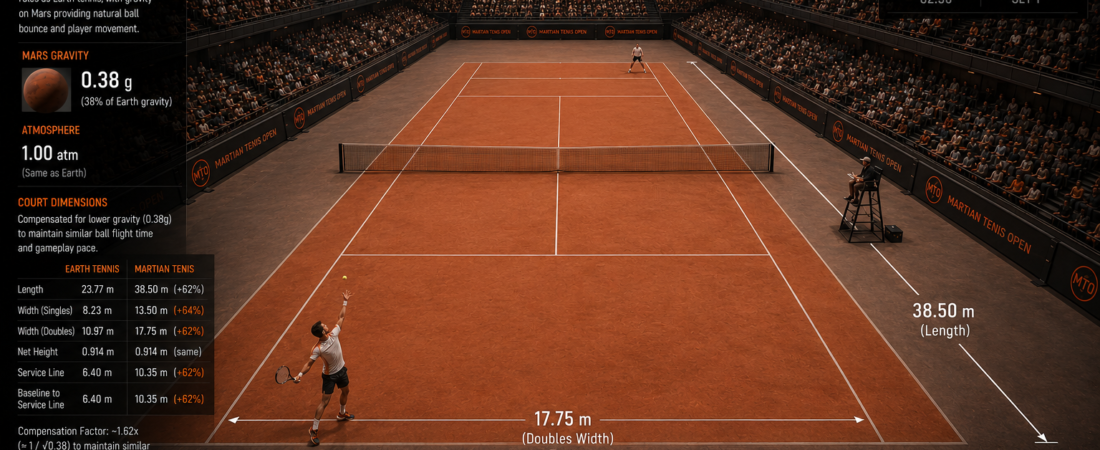
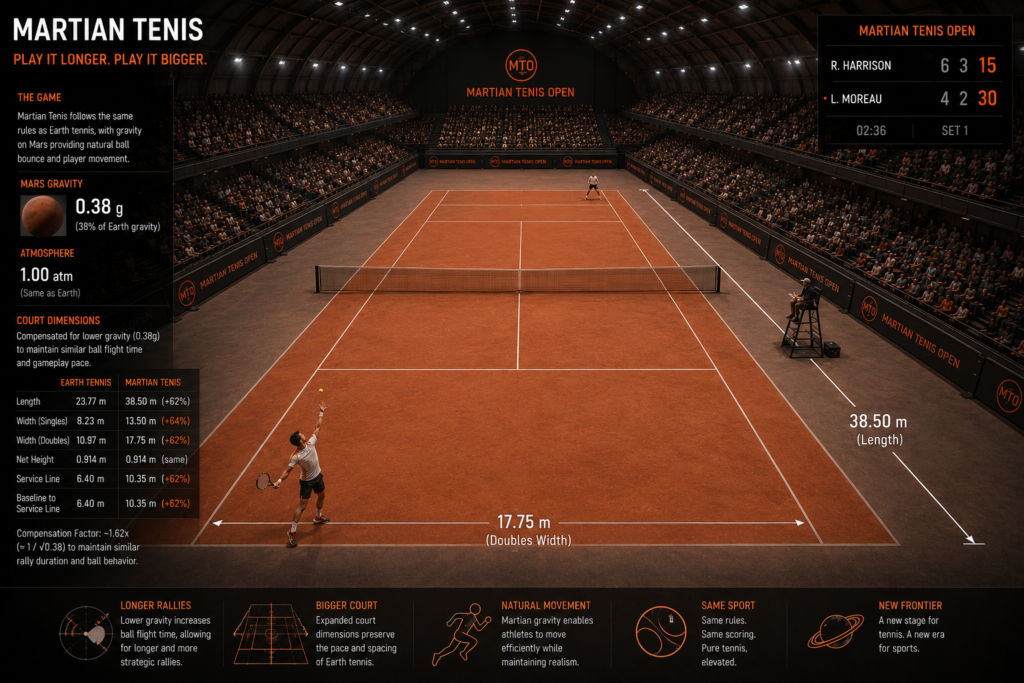
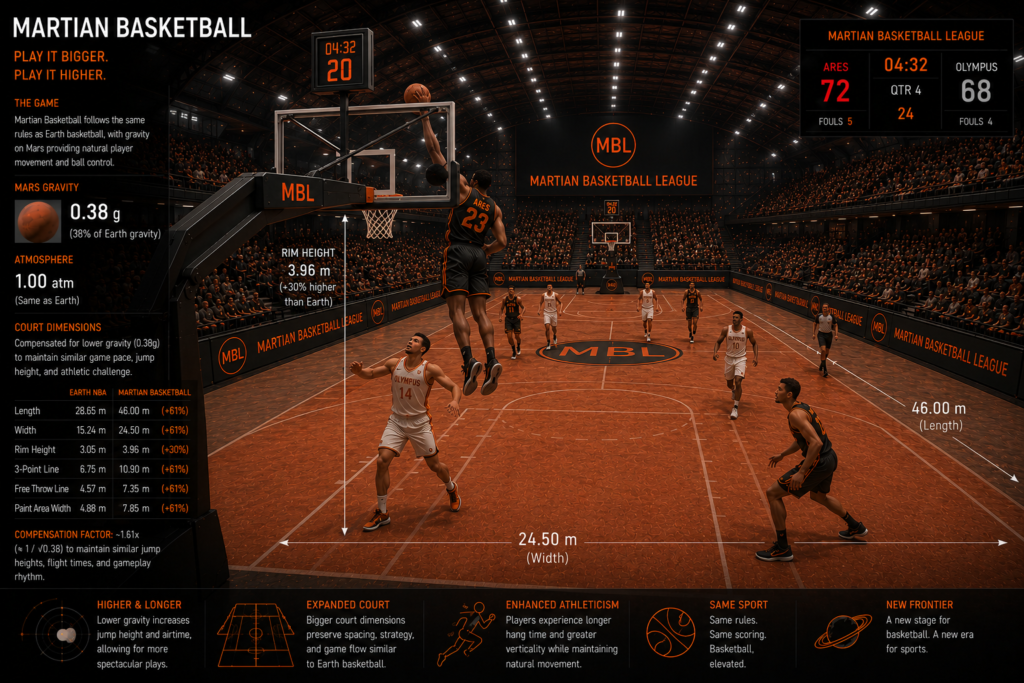
Martian tennis courts, for example, are significantly larger than their terrestrial counterparts. Longer strides and reduced body weight allow players to reach balls that would be impossible on Earth, forcing courts to expand both in width and length. Basketball evolved similarly: courts became wider, player spacing increased, and the height of the rim was raised substantially to compensate for extraordinary vertical leaps. Over generations, the average Martian citizen also became taller and leaner due to the effects of partial gravity, further influencing athletic design.
Comparative Dimensions: Earth vs. Mars
Martian Tennis
| Feature | Earth Standard | Martian Version |
|---|---|---|
| Court Length | 23.77 m | 30–32 m |
| Singles Width | 8.23 m | 11–12 m |
| Doubles Width | 10.97 m | 14–16 m |
| Net Height | 0.91 m | 1.2–1.4 m |
| Average Player Height | ~1.8 m | ~2.0–2.2 m |
The larger dimensions compensate for enhanced reach, longer aerial trajectories, and reduced fatigue under Martian gravity while preserving the strategic pace of the game.
Martian Basketball
| Feature | Earth NBA Standard | Martian Version |
|---|---|---|
| Court Length | 28.65 m | 36–40 m |
| Court Width | 15.24 m | 20–22 m |
| Rim Height | 3.05 m | 4.5–5 m |
| Three-Point Line | 7.24 m | 10–12 m |
| Average Player Height | ~2.0 m | ~2.3–2.5 m |
The elevated rim prevents dunking from becoming trivial in low gravity, while expanded court dimensions preserve tactical spacing and movement dynamics.
Architecture plays a central role in Martian sports culture. Most competitions occur inside massive transparent domes or enclosed pressure-regulated arenas integrated directly into urban centers. These structures provide controlled environmental conditions while preserving panoramic views of the Martian landscape beyond.
Sports medicine and biosuit technology are also tightly integrated into professional athletics. Advanced physiological monitoring systems track hydration, oxygen consumption, muscle stress, and bone loading in real time, helping athletes adapt safely to the unique biomechanical demands of Mars.
Despite these modifications, Martian sports remain emotionally familiar. Fans still gather in crowded arenas, rivalries still ignite passions, and championships still unite entire cities. The essence of competition survives unchanged — only the physics evolved.
As Martian civilization matured, however, entirely new forms of athletic competition also emerged beyond planetary gravity itself. In orbital habitats and deep-space stations, humans developed a new generation of games designed specifically for microgravity environments — disciplines impossible to reproduce on Earth or Mars.
➡️ See also: Space Sports and Microgravity Athletics
➡️ Related: Biosuits and Human Adaptation