
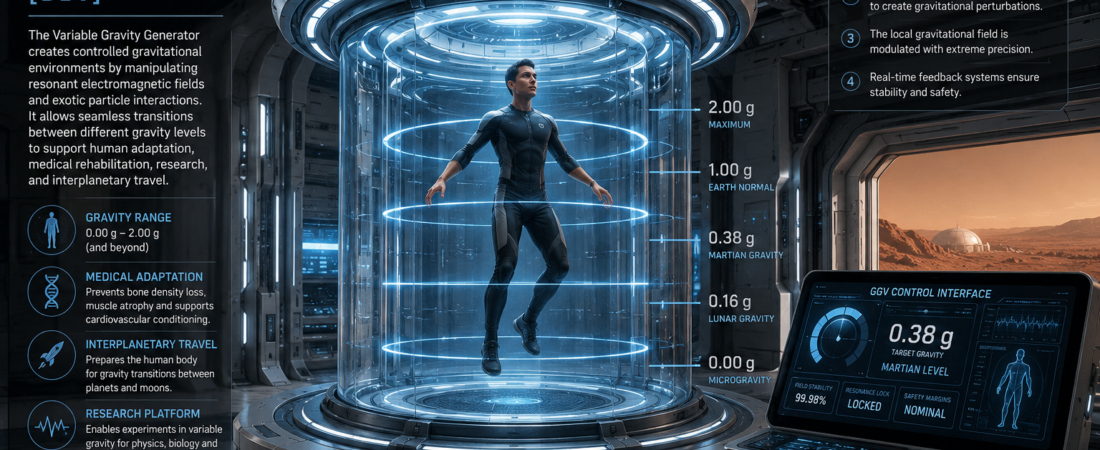
Among the many technological breakthroughs that shaped the civilization of the Comet Surfer Universe, few proved more transformative than the:
Variable Gravity Generator (GGV)
Part medical device, part transportation technology, part gravitational research platform, the GGV fundamentally changed humanity’s relationship with gravity itself.
Within the lore of the series, the development of variable gravity technologies became one of the defining scientific revolutions separating early space colonization from true interplanetary civilization.
Why Gravity Matters
Human beings evolved under the constant pull of Earth’s gravity.
Every aspect of human physiology depends on it:
- bones,
- muscles,
- circulation,
- posture,
- balance,
- cellular growth,
- and even neurological development.
When humanity expanded into space, gravity immediately became one of the greatest biological barriers to long-term survival.
On Mars, where gravity is only approximately:
0.38 g
human beings gradually adapted into taller, thinner, and less mechanically dense versions of themselves. Muscle mass decreased. Bone structures elongated. Cardiovascular systems adapted to reduced physical loading.
These changes allowed Martians to thrive on Mars.
But they created a serious problem:
returning to Earth became increasingly difficult.
For second-generation Martians, Earth’s gravity could become physically overwhelming, placing dangerous stress on:
- bones,
- joints,
- muscles,
- circulation,
- and internal organs.
Humanity faced a growing risk of gravitational divergence between worlds.
The Discovery
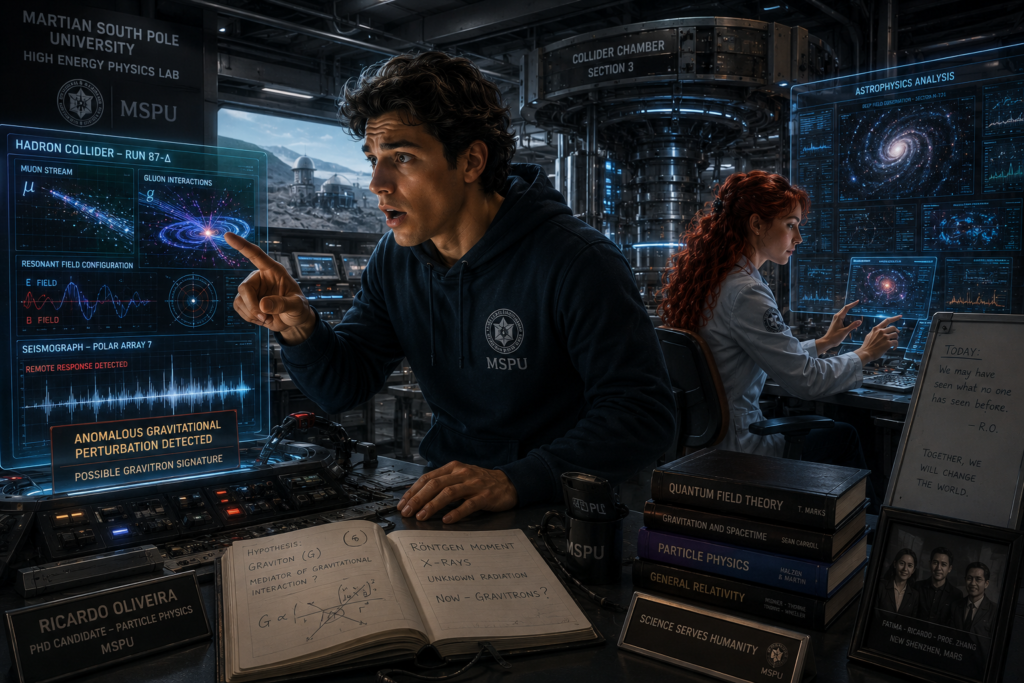
According to the narrative of The Seduction of Nadeah, the origins of the GGV trace back to an unexpected experimental anomaly observed at the Martian South Pole University (MSPU) in New Shenzhen.
While conducting electromagnetic field experiments within a hadron collider, Ricardo Oliveira — then a young particle-physics researcher — noticed strange oscillations appearing in a nearby seismograph under highly specific resonant conditions.
The phenomenon reminded him of the accidental discovery of X-rays by Wilhelm Conrad Röntgen.
Just as Röntgen had unknowingly revealed invisible radiation while studying cathode-ray tubes, Ricardo suspected that his collider experiments were interacting with an unknown gravitational phenomenon.
Working alongside astrophysicist Fátima Ferreira and Professor Zhang Wei, the team eventually demonstrated that under highly specialized electromagnetic resonance conditions, particle interactions could generate measurable gravitational perturbations.
The discovery would revolutionize:
- particle physics,
- gravitational engineering,
- aerospace medicine,
- and interplanetary transportation.
Their work ultimately earned Ricardo Oliveira and Fátima Al-Fayed international recognition, including the Nobel Prize in Physics.
For those who want to experience the moment of discovery as it unfolds within the story itself, you can read the full narrative in Chapter One of The Seduction of Nadeah.
👉 https://cometsurfer.net/the-seduction-of-nadeah/
Gravity as Information
The GGV emerged from a profound realization:
gravity is not merely force.
It is biological information.
Cells constantly respond to mechanical stress and gravitational loading. These physical signals influence:
- tissue growth,
- metabolism,
- bone density,
- muscle development,
- and organ function.
Different gravitational environments gradually shape entirely different biomechanical realities.
The GGV was designed to manipulate those conditions artificially.
How the GGV Works (Fictional Science)
Within the fictional framework of the Comet Surfer Universe, the Variable Gravity Generator uses controlled resonant electromagnetic fields interacting with exotic particle phenomena to create localized gravitational distortions.
Unlike rotational artificial gravity systems, which rely on centrifugal force, the GGV directly manipulates gravitational conditions within a controlled volume of space.
This allows:
- gradual gravity transitions,
- adaptive rehabilitation,
- variable-gravity environments,
- and biomechanical conditioning impossible through conventional methods.
Although fictional, the concept draws inspiration from:
- quantum field theory,
- graviton hypotheses,
- particle physics,
- resonance phenomena,
- and speculative gravitational engineering research.
Medical Applications
The first widespread use of GGV systems was medical.
Martian-born humans preparing to visit Earth could undergo progressive gravitational conditioning, allowing their bodies to slowly adapt to increasing mechanical stress.
GGV rehabilitation centers became common throughout:
- Mars,
- lunar settlements,
- orbital stations,
- and long-duration spacecraft.
These facilities were used to:
- maintain bone density,
- strengthen musculature,
- retrain cardiovascular systems,
- and reduce the physiological risks of interplanetary travel.
Without the GGV, humanity risked fragmenting into populations physically incapable of visiting one another’s worlds.
Civilizational Impact
The GGV transformed more than medicine.
Variable-gravity technologies influenced:
- architecture,
- sports,
- industrial manufacturing,
- aerospace engineering,
- education,
- transportation,
- and military systems.
Entire recreational industries emerged around:
- adaptive gravity arenas,
- three-dimensional athletics,
- and gravity-variable performance training.
Some orbital habitats incorporated dynamic gravity sectors where inhabitants could experience:
- Earth-normal gravity,
- Martian gravity,
- lunar gravity,
- or transitional environments.
The technology reshaped the psychology of human space habitation.
The Variable Gravity Lens
By the later books of the Comet Surfer series, GGV technology evolves beyond medicine and adaptation into more advanced applications, including the theoretical concept of the:
Variable Gravity Lens.
This extension of gravitational engineering opens entirely new possibilities involving:
- navigation,
- propulsion,
- energy manipulation,
- and large-scale space infrastructure.
The deeper implications of these technologies become central to the later evolution of the story universe.
Beyond Technology
Within the Comet Surfer Universe, the GGV symbolizes something larger than scientific progress.
It represents humanity’s refusal to allow distance, biology, or gravity itself to permanently divide civilization.
Mars changed the human body.
The GGV allowed humanity to remain connected despite those changes.
In this sense, the Variable Gravity Generator became more than a machine.
It became a bridge between worlds.