
Exploring the outer reaches of the Solar System demands more than courage, ingenuity, and advanced spacecraft. It requires a source of energy capable of sustaining a crew for years while simultaneously powering propulsion systems powerful enough to cross millions of kilometers of space.
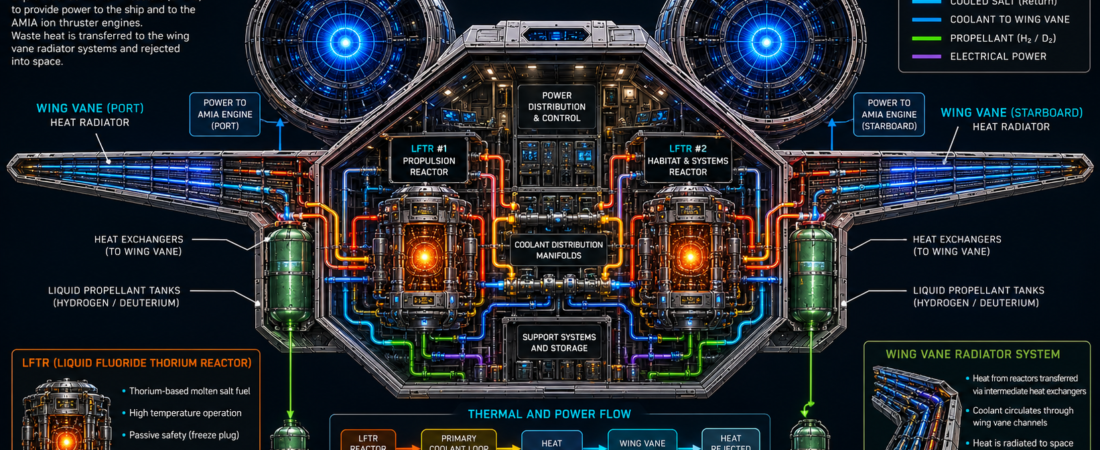
At the heart of the Comet Surfer are two Liquid Fluoride Thorium Reactors (LFTRs), advanced molten-salt nuclear reactors that provide the energy necessary for life, navigation, communication, scientific exploration, and high-performance propulsion. Together, they form the technological foundation that makes the mission possible.
Why Thorium?
The reactors aboard the Comet Surfer are based on the thorium fuel cycle, a technology long considered one of the most promising approaches to advanced nuclear power.
Unlike conventional reactors that use solid fuel rods, LFTRs dissolve their nuclear fuel directly into a molten fluoride salt mixture. The liquid fuel serves simultaneously as both fuel and coolant, allowing the reactor to operate efficiently at high temperatures while incorporating several passive safety features.
Within the Comet Surfer universe, decades of technological advancement have transformed LFTRs into mature, highly reliable systems suitable for deep-space operations.
Their advantages include:
- Extremely high energy density
- Long operational life
- Minimal refueling requirements
- High thermal efficiency
- Reduced radioactive waste
- Strong passive safety characteristics
- Continuous power generation independent of sunlight
These attributes make LFTRs particularly attractive for missions operating far beyond the orbit of Mars, where solar energy becomes increasingly scarce.
Two Reactors, One Mission
The Comet Surfer carries two LFTRs of identical design and capacity.
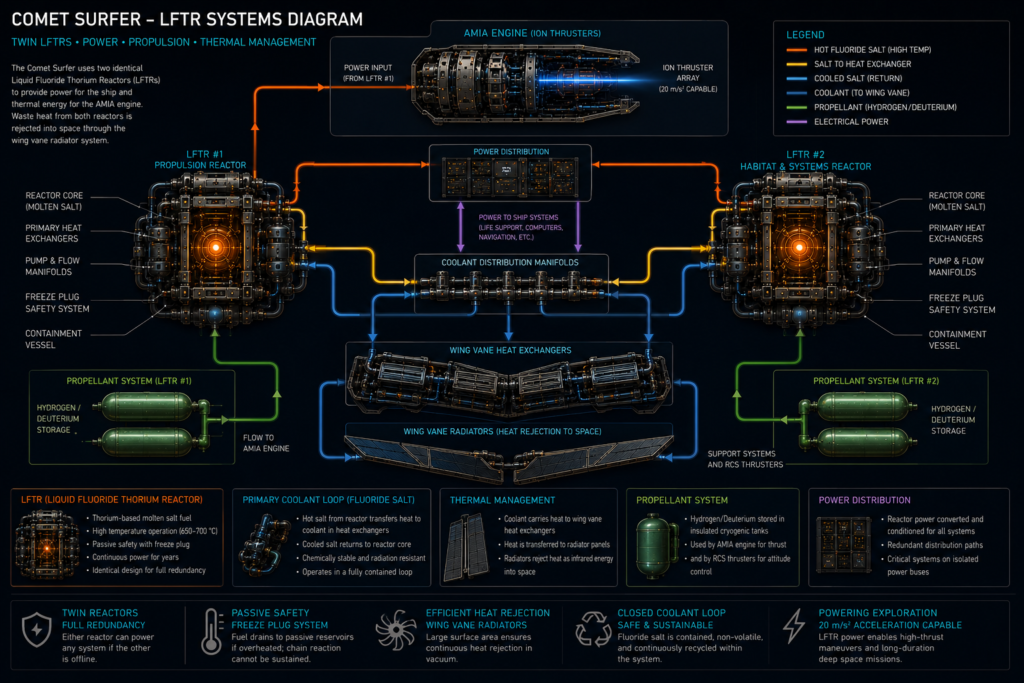
Rather than employing a large propulsion reactor and a smaller auxiliary reactor, the vessel uses twin units capable of supporting either mission function. This architecture provides operational flexibility and redundancy, ensuring that critical spacecraft systems can continue functioning even if one reactor becomes unavailable.
Under normal operations, the responsibilities are divided.
Propulsion Reactor
One reactor is typically dedicated to the spacecraft’s AMIA propulsion system.
The reactor generates the immense electrical power required to operate the drive’s magnetic systems and particle acceleration technologies. Through this energy source, the Comet Surfer can sustain accelerations approaching 20 meters per second squared, nearly twice Earth’s gravitational acceleration.
Such performance dramatically reduces travel times between planets and enables rapid maneuvering during critical mission phases.
Habitat and Systems Reactor
The second reactor normally powers the spacecraft itself, including:
- Life-support systems
- Environmental control systems
- Water recycling
- Hydroponic food production
- Navigation computers
- Communication arrays
- Scientific instruments
- Artificial intelligence systems
- Guidance and control functions
Together, the twin reactors provide the reliability required for voyages lasting years and spanning billions of kilometers.
The Challenge of Heat in Space
Producing power is only part of the challenge.
Every watt of energy used by a spacecraft ultimately becomes heat. On Earth, excess heat can be removed through air or water cooling. In the vacuum of space, neither option exists.
A spacecraft can only reject heat by radiating it away as infrared energy.
For this reason, one of the most distinctive features of the Comet Surfer is its set of large wing-like structures extending from the hull.
Although they resemble wings, they serve an entirely different purpose.
These structures are high-capacity thermal radiator vanes.
Heat generated by both LFTRs is transported through advanced coolant loops into the vanes, where it is emitted into space as thermal radiation. The system continuously removes waste heat from the reactors, propulsion equipment, electronics, and habitat modules.
Without these radiators, the spacecraft would quickly overheat despite being surrounded by the cold vacuum of space.
In many respects, the radiator vanes are as essential to the mission as the engines themselves.
The Freeze Plug: A Passive Safety System
One of the most innovative safety features of LFTR technology is the freeze plug.
A freeze plug is a carefully engineered section of solidified salt maintained below its melting point by a dedicated cooling system. Under normal conditions, this frozen barrier seals the reactor’s fuel within the primary circulation loop.
Unlike many reactor safety systems, the freeze plug does not depend on complex mechanical components.
In fact, its purpose is to fail safely.
A small electrically powered cooling fan continuously removes heat from the plug. If that cooling ceases for any reason, the frozen salt naturally melts.
When the plug melts, the liquid fuel is no longer confined within the reactor core.
Instead, it flows into specially designed storage reservoirs where the geometry prevents the continuation of a nuclear chain reaction. The fuel spreads out, cools, and safely shuts itself down without requiring operator intervention.
The reactor does not explode.
It simply stops being a reactor.
Adapting LFTRs for Deep Space
Terrestrial LFTR designs rely on gravity to drain fuel into passive storage tanks.
Spacecraft reactors must solve the same problem in a microgravity environment.
The Comet Surfer’s reactors therefore employ specially engineered containment reservoirs and fuel-management systems capable of safely collecting and storing molten fuel even when conventional gravity is absent.
Should the freeze plug melt, the fuel salt is automatically directed away from the reactor core and into secure storage volumes where it can no longer sustain criticality.
The result is a reactor system designed around one of the most important principles of space engineering:
When help may be months away, safety systems must be capable of protecting the crew without human intervention.
Powering Humanity’s Expansion
The LFTRs aboard the Comet Surfer represent more than a source of energy.
They embody a philosophy of exploration—one that combines performance, efficiency, redundancy, and safety.
Their power enables the operation of AMIA drives, sustains life far from Earth, supports advanced artificial intelligence systems, and makes possible journeys to destinations that once existed only in dreams.
As humanity reaches outward into the Solar System, technologies like these become more than machines.
They become the infrastructure of civilization itself.
Technical Specifications
| Parameter | LFTR Unit 1 | LFTR Unit 2 |
|---|---|---|
| Design | Identical | Identical |
| Fuel Cycle | Thorium Molten Salt | Thorium Molten Salt |
| Primary Assignment | AMIA Propulsion | Ship Systems |
| Backup Capability | Full Redundancy | Full Redundancy |
| Safety System | Passive Freeze Plug | Passive Freeze Plug |
| Cooling Method | Radiator Vanes | Radiator Vanes |
| Operational Duration | Multi-Year | Multi-Year |
| Emergency Shutdown | Automatic Fuel Drain | Automatic Fuel Drain |
“The farther humanity ventures from Earth, the less it can depend on rescue. The most reliable technologies are those capable of making the safe choice on their own.”
— Comet Surfer Technical Archive