
Communication Beyond Distance
Unlike many other technologies in the Comet Surfer Universe, SPARC does not have a single origin story.
It was not invented during a dramatic mission.
It was not discovered by accident in a remote laboratory.
By the time humanity began expanding beyond Earth, SPARC already existed.
And it needed to.
As human civilization moved into the Solar System, one constraint quickly became dominant:
👉 Distance is not just physical—it is informational.
Communication between planets, even at the speed of light, becomes impractical at scale:
- Earth ↔ Mars: delays ranging from minutes to over 20 minutes
- Earth ↔ outer planets: delays measured in hours
Under such conditions, real-time coordination becomes impossible.
Autonomy increases—but coherence decreases.
Without a solution, civilization risks fragmenting into isolated informational islands.
SPARC emerges as the system that prevents this fragmentation.
From Signal Transmission to Structure Preservation
Traditional communication systems are based on a simple assumption:
Information must travel from a source to a receiver.
Signals are encoded, transmitted, and decoded across space.
SPARC challenges this assumption.
Instead of transmitting signals, SPARC operates on a different principle:
Information is preserved, not sent.
The Role of Spin
At its core, SPARC utilizes one of the most fundamental properties of matter:
👉 Spin
Spin is an intrinsic form of angular momentum carried by elementary particles. Unlike classical rotation, it is quantized, stable, and measurable—a property famously demonstrated by the Stern–Gerlach experiment.
This makes spin an ideal candidate for:
- discrete encoding
- stable state definition
- high-fidelity measurement
But SPARC does not rely on spin alone.
Entanglement as a Shared State
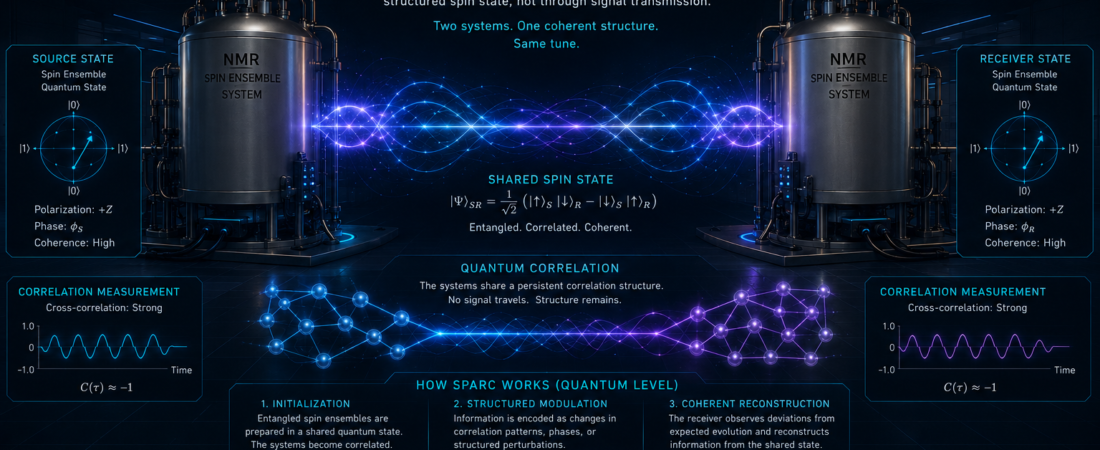
SPARC systems are initialized through the creation of entangled spin ensembles.
Rather than isolated particles, these systems consist of structured collections of spin-aligned elements—conceptually similar to highly controlled NMR/MRI systems in which proton populations are coherently organized.
Once initialized, these systems form a shared quantum structure between distant locations.
This structure is not a channel.
It is a relationship.
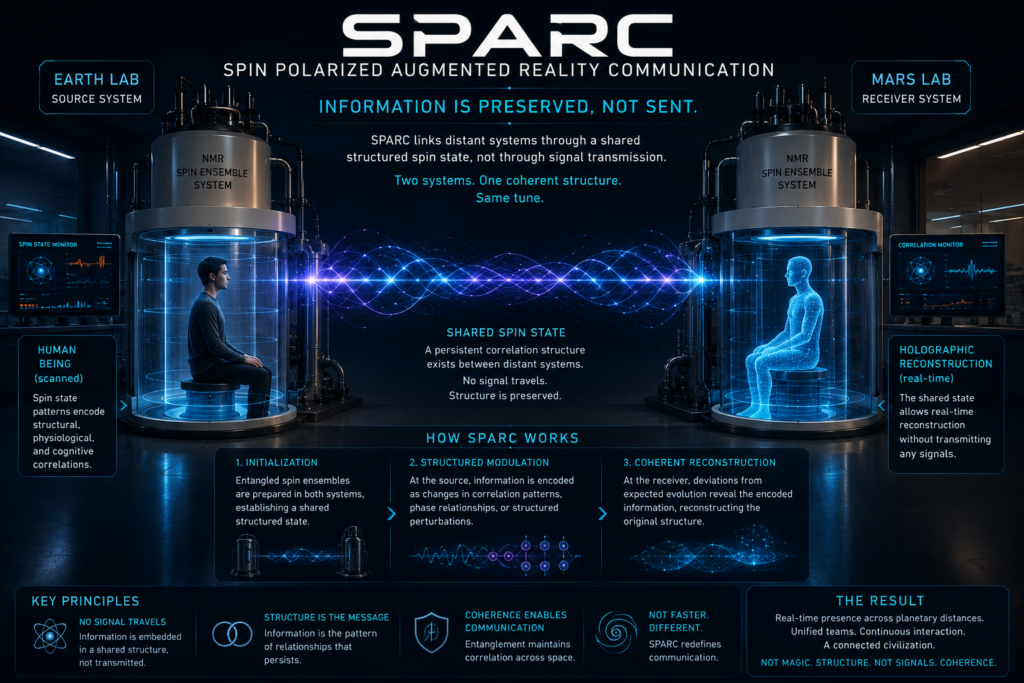
How SPARC Works (Conceptual Model)
SPARC does not transmit messages in the traditional sense.
Instead, it operates through three stages:
1. Initialization
A shared structured state is created across two or more systems using entangled spin configurations.
These systems are:
- synchronized
- structurally correlated
- dynamically constrained to evolve under comparable conditions
2. Structured Modulation
At the source, information is encoded not as individual signals, but as:
- changes in correlation patterns
- phase relationships
- structured perturbations of the spin system
This does not “send” information.
It reshapes the shared structure.
3. Coherent Reconstruction
At the receiver, the system does not detect a transmitted signal.
Instead, it observes:
- deviations from expected evolution
- shifts in correlation structure
- emergent patterns within the shared state
From these deviations, information is reconstructed.
Causality and Interpretation
From the perspective of classical communication, SPARC appears to operate instantaneously.
However, within its own framework, no signal is traveling between systems.
Instead:
The system behaves as if informational structure remains coherent across spatial separation.
This distinction is subtle—but fundamental.
SPARC does not violate causality by accelerating signals.
It redefines communication by removing the need for signal propagation as the primary mechanism.
Structure as Information
While early researchers initially interpreted SPARC through the language of quantum entanglement, later work revealed that entanglement was only a special case of a broader phenomenon involving persistent organizational correlations across distributed systems. The deeper implication of SPARC lies in its conceptual foundation:
👉 Information is not a sequence of transmitted symbols.
👉 Information is the structure that persists through transformation.
Spin becomes the medium.
Entanglement becomes the linkage.
Structure becomes the message.
Role in the Comet Surfer Universe
SPARC is foundational to interplanetary civilization.
It enables:
- Real-time coordination between Earth and Mars
- Distributed scientific collaboration across vast distances
- Effective governance and synchronized decision-making
- Continuous interaction between individuals separated by planetary space
Without SPARC, the Solar System becomes fragmented.
With SPARC, it becomes a connected system. However, SPARC systems are not unlimited. Shared structures gradually deorganize due to environmental interactions, requiring periodic re-synchronization and organizational reinforcement. Long-range SPARC networks therefore depend on a hierarchy of synchronization nodes distributed throughout the Solar System.
Narrative Presence
Throughout the series, SPARC operates quietly in the background—but its importance is constant.
It is present:
- when mission-critical decisions must be made across planets
- when scientific teams collaborate across vast distances
- when individuals remain connected despite separation
SPARC is rarely explained in dialogue.
It is simply assumed.
Because for those who depend on it—
👉 it is no longer extraordinary.
It is infrastructure.
Open Questions
SPARC, as currently understood, raises deeper questions that extend beyond engineering:
- Can structure be preserved independently of medium?
- Is communication fundamentally about transmission—or coherence?
- What limits exist on shared state stability across space?
- Does information require motion, or only persistence?
These questions remain open.
Beyond Fiction
Within the Comet Surfer framework, SPARC is fictional.
But the ideas it explores are not arbitrary.
They intersect with real areas of inquiry:
- quantum correlation
- spin-based systems
- distributed coherence
- the nature of information itself
SPARC exists at the boundary between:
- narrative necessity
- conceptual exploration
- and emerging theoretical possibility
Closing Thought
The expansion of humanity into space introduces many challenges:
But perhaps the most subtle challenge is this:
👉 How do we remain connected when distance becomes fundamental?
SPARC offers one answer:
Not by sending information faster…
but by ensuring it never becomes disconnected in the first place.