
Astrobiological Pseudopersona & Mixotrophic Biofilm Entity
1. Header & Core Identity
- Full Scientific Designation: Nitrosphera nadeahhensis
- Common Name / Alias: Nina, The Green Slime, The Acrylic Eater, The Undoer of Man1more_horiz
- Classification: Pseudopersona / Archaea-like Extremophile / Mixotrophic Biofilm [53–54, 127]
- Origin / Native Habitat: Carbon-ice sublimating fissures on Comet Nadeah [27–28, 442–444]
- Primary Discoverers: Dr. Layia Chandra, Biyu Jiàn, and Peter Gorski [25, 442–444]
- Key Researchers: Dr. Layia Chandra, Dr. Aarya Chandra, Dr. Roberto “Bob” Oliveira, Prof. Dong Huang, Rahul Oliveira [49–51, 70–71, 73–76]
2. Quick Facts
| Metric / Attribute | Specification |
|---|---|
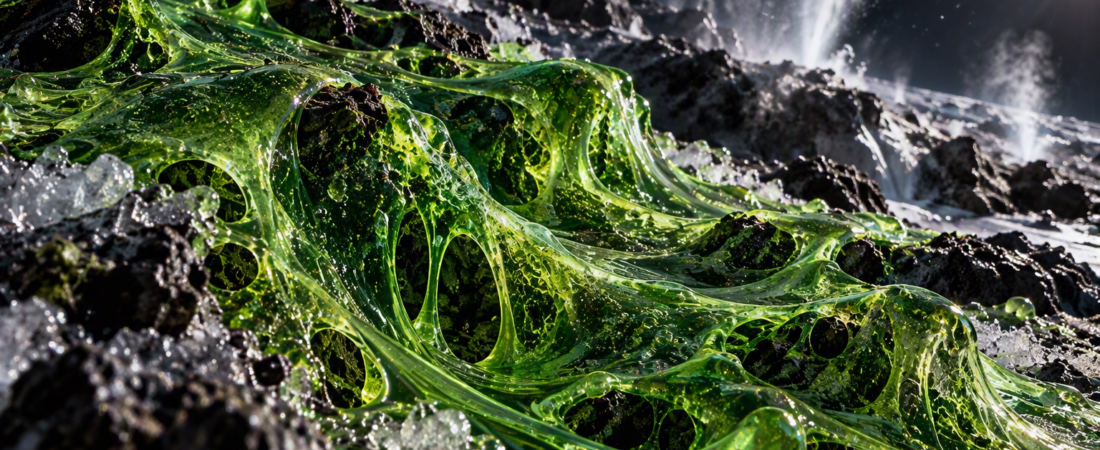
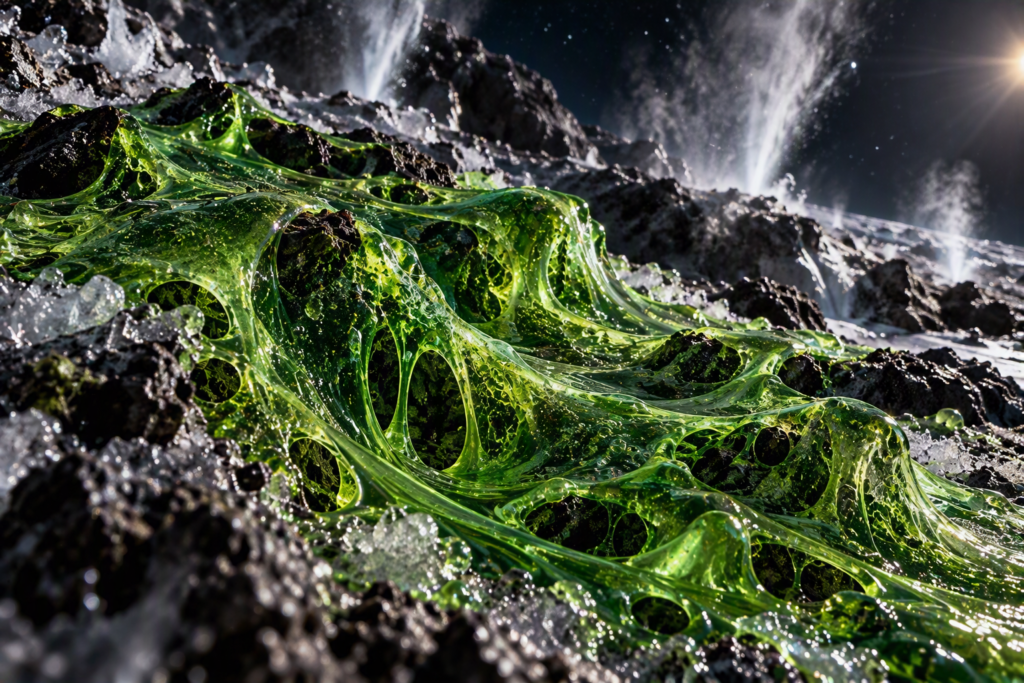
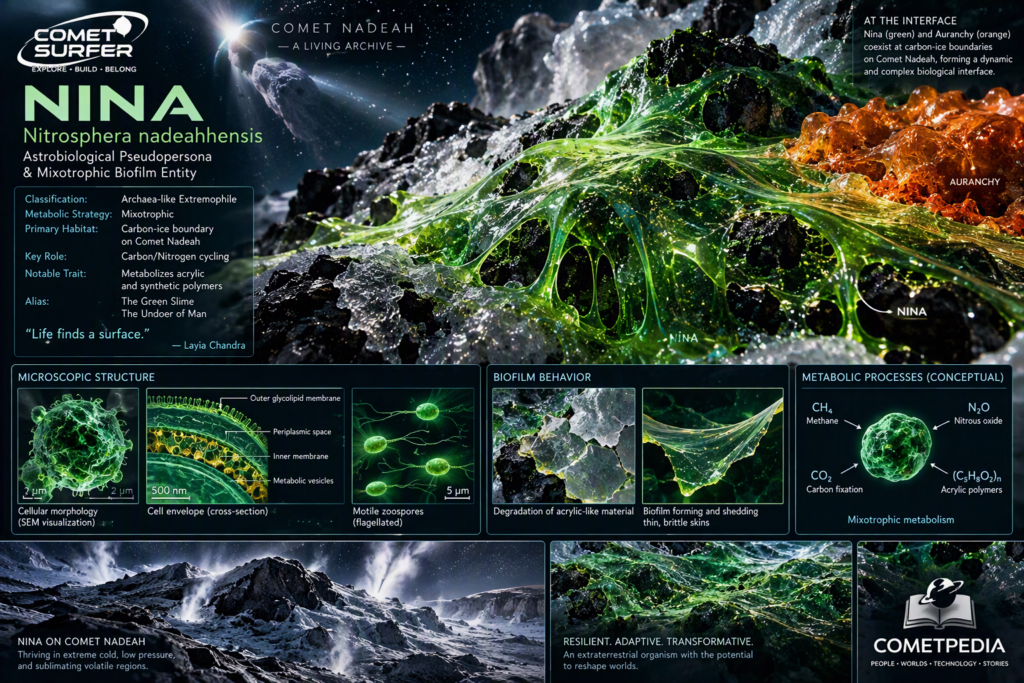
| Physical Appearance | Iridescent green slime forming translucent biofilms that shed thin, brittle skins on acrylic surfaces4more_horiz |
| Cellular Structure | Double cell wall (gram-negative-like) with a resilient outer glycolipid membrane7 |
| Metabolic Strategy | Mixotrophic (oxidizes methane, produces N₂O, fixes CO₂ at ultra-high efficiency, digests synthetic polymers like acrylic) [53–54, 127] |
| Key Ecological Role | Invasive planetary biofilm; mixotrophic engine of carbon/nitrogen cycling in Mars’s new atmosphere; partner in the Nina–Auranchy–Synechy triad [53–55, 97–100, 127] |
| Threat Level & Control | High structural compromise of geodesic domes, greenhouses, and agricultural water ponds; controlled via soap surfactants, microencapsulated Bordeaux mixture, and the Synechy–Auranchy bio-stabilization system [46–48, 70–71, 98–100, 105–114] |
3. Astrobiological Architecture: The Science of Nitrosphera nadeahhensis
Discovery on Comet Nadeah
Nitrosphera nadeahhensis was first encountered during an extravehicular activity (EVA) on Comet Nadeah [25, 27, 442–444]. Layia Chandra, Biyu Jiàn, and Peter Gorski identified an iridescent green slime thriving right at the interface where carbon ice met the orange gelatinous mats of Auranchy (Aurantifungus prochytridialis) [243–244]. Secured in bio-containment canisters just prior to a catastrophic vapor eruption, the organism was brought back for study aboard the Comet Surfer [27–28, 235, 244].
Genomic Novelty & Metabolic Versatility
When Layia compared the genomic architecture of Nina against DNA from Earth, Mars, Titan, and Nadeah, she discovered that the classic terrestrial division between Bacteria and Archaea did not apply8. Nina represented an independent evolutionary lineage8:
- Metabolic Cycle: Nina oxidizes methane and generates nitrous oxide ($\text{N}_2\text{O}$), utilizing a specialized metabolic pathway reminiscent of Earth’s Nitrososphaerota9.
- Hyper-Efficient CO₂ Fixation: Possesses an autotrophic $\text{CO}_2$-fixation pathway that surpasses any known terrestrial autotroph, allowing rapid growth even in nutrient-poor environments9.
- Mixotrophy & Polymer Biodegradation: As a mixotroph, Nina can extract energy from both inorganic carbon and synthetic organic polymers—specifically acrylic (methyl methacrylate) [46, 53–54].
Exponential Proliferation on Mars
On Comet Nadeah, Nina’s life cycle was constrained by scarcity—proliferating briefly during coma activity before returning to cryogenic dormancy10. However, when introduced to Mars following Nadeah’s atmospheric incorporation, those evolutionary constraints disappeared10. The thickened atmosphere, continuous gas exchange, and dust storms fragmented the biofilm into microscopic, airborne flakes [47–48, 55]. Nina spread planet-wide, establishing colonies on dome seals, greenhouse vaults, and food production ponds [46–48].
4. The Planetary Crisis & Symbiotic Balance
The Structural Threat to Martian Cities
Unlike dramatic mechanical destruction, Nina’s danger lay in its quiet compromise of infrastructure1. The biofilm metabolized the acrylic sheets of transparent geodesic domes and greenhouses without touching structural metals1. When the slime invaded the agricultural ponds of Huǒ Xīng—Mars’s primary food hub—it threatened to trigger cascading infrastructure failures across planetary settlements [47, 57–58].
Political Tension & Symbolic Weaponization
Political factions and insurgents capitalized on the outbreak [56, 83–84]. Pirate leader Bilan exploited the Somali etymology of the name:
- Nin = Somali for “man”3
- Nin-ka = “the man”3
- Nin-a = “the undoer of man” / “destroyer of Bob” [83–84]
Opponents framed Nina as “Bob Oliveira’s biological time-bomb,” accusing Martian leaders of reckless negligence11.
Multi-Pronged Scientific Countermeasures
Rather than relying on chemical annihilation, Martian scientists developed a multi-layered defense:
- The Surfactant Leverage (Bob’s Soap Hypothesis): Bob Oliveira realized that soap surfactants destabilize Nina’s outer glycolipid membrane [70–71]. While not lethal on its own, soap reduced Nina’s reproductive capacity and allowed the biofilm to detach from acrylic surfaces7.
- The Synechy–Auranchy Bio-Stabilization: Dr. Aarya Chandra co-cultured Nina with Synechococcus martianus (“Synechy”)—a hardened Terran cyanobacterium—and Auranchy [93–100]. Synechy generated localized oxygen that induced Reactive Oxygen Species (ROS) oxidative stress in Nina, while Auranchy moderated the reaction, turning explosive spread into manageable, stable coexistence [98–100].
- Drone Swarm Dispersal: Biyu Jiàn re-engineered food processor manufacturing lines into drone biodispersers [107–110]. Integrated with the USF’s DIANA AI swarm software, over 100 drones sprayed microencapsulated Bordeaux mixture and aqueous foam across city domes, cleanly lifting the dead biofilm away without damaging the underlying acrylic [105, 108, 112–114].
5. Philosophical & Sociopolitical Impact
From Eradication to Coexistence
The defeat of the Nina outbreak marked a turning point in Martian philosophy12more_horiz. It proved that planetary engineering creates living, evolving ecosystems that cannot be controlled through brute force or total annihilation1213.
By domesticating Nina through the Nina–Auranchy–Synechy triad, Martian civilization demonstrated its core principle: that survival on extreme worlds depends not on destruction, but on synechy—continuity through cooperation and balance12more_horiz.
6. Behind the Science & Real-World Inspirations
Fictional Nature of the Taxon
Nitrosphera nadeahhensis (“Nina”) is a fictional extraterrestrial microorganism created by Ricardo J. Silva for the Comet Surfer Saga [45, 52–54, 127]. It serves as a thought experiment in exobiology, polymer degradation, and ecological management.
Real-World Scientific Inspirations
- Nitrososphaerota (Thaumarchaeota): Nina’s methane-oxidizing and $\text{N}_2\text{O}$-producing metabolic cycles are inspired by real-world ammonia-oxidizing archaea (Nitrososphaerota), which play vital roles in terrestrial nitrogen and carbon cycles9.
- Plastic-Metabolizing Microbes: Nina’s ability to digest methyl methacrylate (acrylic) reflects cutting-edge research into polymer-degrading organisms, such as Ideonella sakaiensis (which metabolizes PET plastic) and specialized fungal strains that breakdown synthetic polymers [46, 53–54].
- Gram-Negative Bacterial Membranes & ROS: The double cell wall structure and vulnerability to Reactive Oxygen Species (ROS) draw directly from real-world bacterial membrane physiology and microaerophilic oxidative stress mechanics [71, 98–99].
- Martian Acrylic Chemistry: The Sabatier and BASF chemical processes described in the series—extracting ethylene from atmospheric $\text{CO}_2$ to synthesize methyl methacrylate (MMA)—are real-world chemical engineering pathways proposed for Martian manufacturing16.