
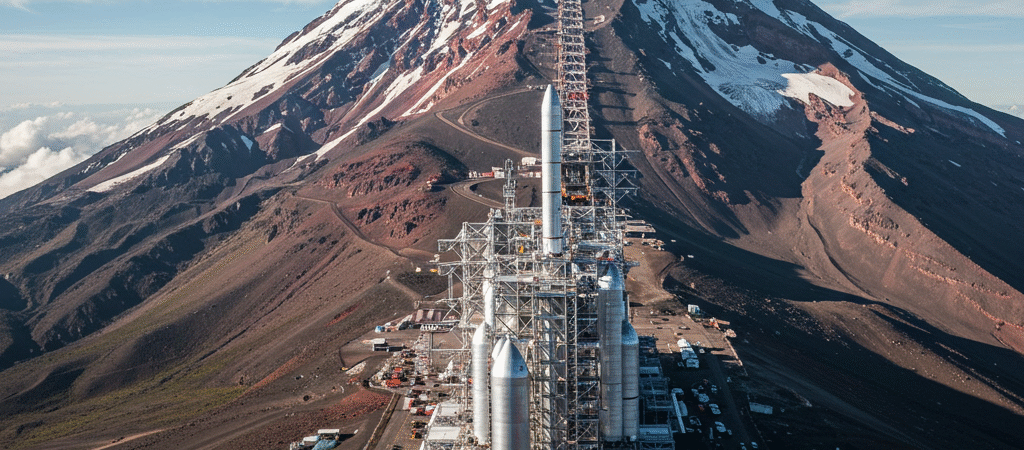
Kilimanjaro, Chimborazo, and Kinabalu as Gateways to Space
One of the questions readers occasionally ask is why so many launches in the Comet Surfer Universe take place from seemingly unusual locations such as Mount Kinabalu in Borneo, Chimborazo in Ecuador, and Mount Kilimanjaro in Tanzania.
The answer lies in a simple engineering principle: not all places on Earth are equally suited for reaching space.
Throughout the 21st century, humanity continued searching for ways to reduce the cost and environmental impact of accessing orbit. While conventional chemical rockets remained essential, aerospace engineers increasingly explored hybrid launch architectures that combined reusable spacecraft, electromagnetic acceleration systems, and air-breathing propulsion.
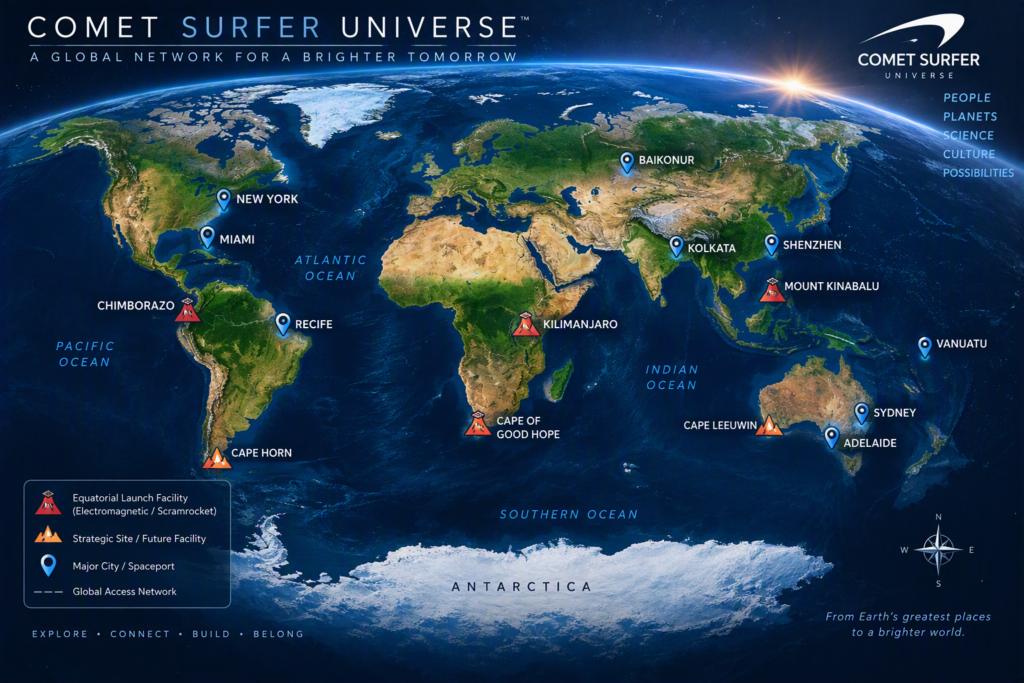
The result was the development of the Equatorial Electromagnetic Launch Network, a family of launch facilities strategically positioned near Earth’s equator.
Why Volcanoes?
At first glance, volcanoes might seem like an odd choice for a spaceport. However, high mountains provide several advantages.
Launching from high elevations reduces atmospheric density, lowering drag and thermal stress during the earliest and most energy-intensive phase of flight. Every kilometer above sea level means less atmosphere for a spacecraft to fight through.
Equatorial locations provide an additional benefit. Because Earth rotates eastward, launch vehicles departing from the equator receive the maximum possible boost from Earth’s rotational velocity. This effectively provides “free speed” and reduces the energy required to reach orbit.
In the Comet Surfer Universe, three volcanoes emerged as ideal anchor points for this transportation revolution:
- Mount Kinabalu in Borneo
- Chimborazo in Ecuador
- Mount Kilimanjaro in Tanzania
Together, they formed a global network capable of supporting rapid and frequent access to low Earth orbit.
The Launch Architecture
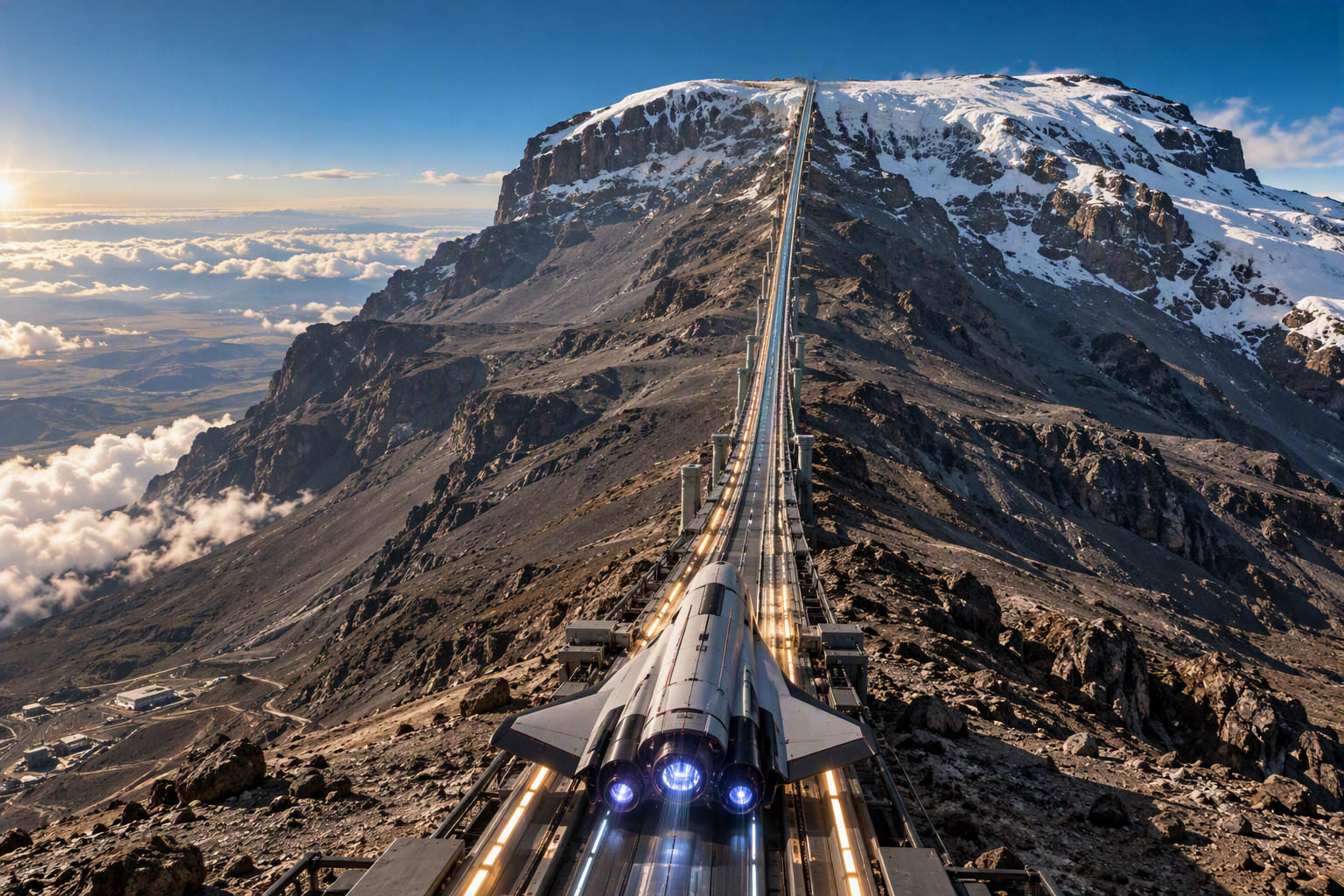
Unlike traditional vertical launch systems, these facilities employ massive electromagnetic acceleration tracks, commonly referred to as rail-guns or launch catapults.
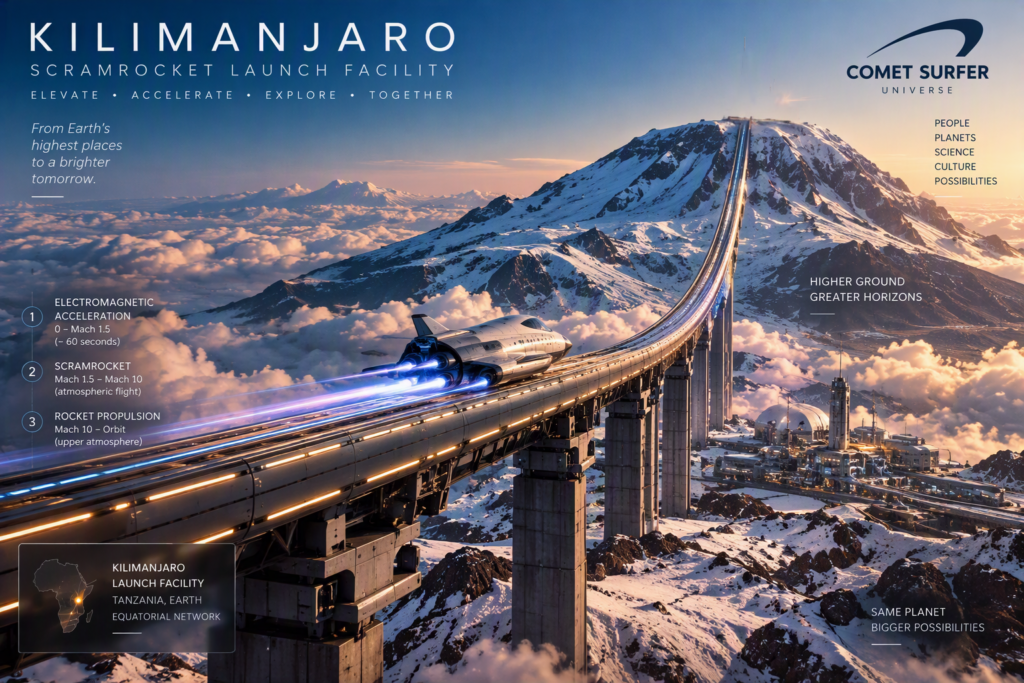
Spacecraft are accelerated along multi-kilometer guideways to approximately Mach 1.5 before leaving the track.
Once airborne, advanced scramrocket engines ignite, using atmospheric oxygen to continue accelerating the vehicle at hypersonic speeds. Only after reaching the upper atmosphere does the spacecraft transition to pure rocket propulsion for orbital insertion.
This approach dramatically reduces onboard propellant requirements while allowing the launch vehicle itself to be reused repeatedly.
The goal is not to eliminate rockets.
The goal is to use them more intelligently.
Kilimanjaro: Africa’s Stairway to Space
Among these facilities, the Kilimanjaro Scramrocket Terminal occupies a special place in The Rings of Mars.
Before departing for Mars, Ethan Brown and Biyu Jiàn travel through East Africa, passing Lake Victoria’s rich ecosystems and the wildlife-filled savannas surrounding the great mountain. Their final destination is the snow-capped summit region of Kilimanjaro, where one of humanity’s most advanced launch complexes awaits.
Like its counterparts on Kinabalu and Chimborazo, the Kilimanjaro launcher accelerates passengers to supersonic velocity before handing them off to the scramrocket phase of flight.
For travelers, the experience is unforgettable.
One moment they are seated comfortably on the launch platform.
The next, an immense electromagnetic surge hurls them skyward as the Earth falls away beneath them.
Moments later, rocket propulsion takes over and gravity gradually loosens its grip.
The journey to space begins not with a thunderous vertical ascent, but with a high-speed sprint toward the horizon.
Fiction Inspired by Engineering
Although the launch systems described in the Comet Surfer Saga are fictional, they are inspired by real aerospace concepts currently being explored by researchers around the world, including electromagnetic launch assistance, magnetic levitation systems, scramjet propulsion, reusable spacecraft, and alternative approaches to reducing launch costs.
As with much of the technology in the series, the goal is not to predict the future perfectly.
The goal is to imagine what becomes possible when engineering, imagination, and a desire to explore are allowed to work together.
After all, every journey to the stars begins by questioning whether there might be a better way to leave the ground.