
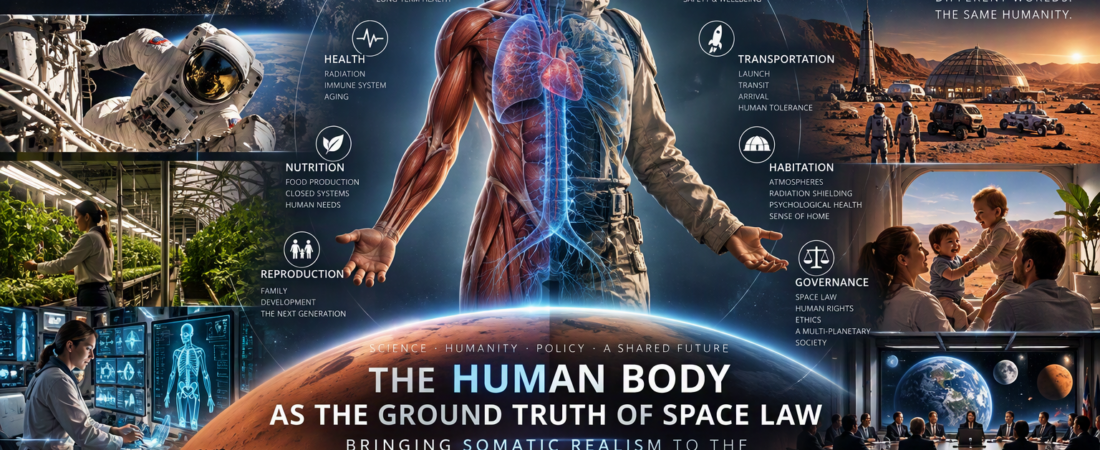
When space policy analysts, diplomats, and international legal scholars gather to debate the governance of the cosmos, the conversation almost inevitably gravitates toward abstractions: property rights under the 1967 Outer Space Treaty, frequency allocations via the ITU, the militarization of cislunar orbits, or GDP projections for asteroid mining.
It is easy to draft pristine treaties on paper. But as anyone who studies long-duration human spaceflight knows, the vacuum does not care about our legal fictions.
I recently had the privilege of presenting my framework of Somatic Realism at the Future of Space Policy Workshop, hosted by the EU-Asia Institute at ESSCA School of Management. The workshop brought together global experts to examine how governance, ethics, and geopolitical cooperation must evolve as humanity extends its permanent footprint beyond low Earth orbit.
My core thesis to the workshop was simple: If space policy is built only on macroeconomic extraction or geopolitical hegemony, it will fail the moment humans actually have to live inside it. Space governance must be built from the body outward.
1. The Policy Blind Spot: The Ghost in the Megastructure
Most space settlement roadmaps suffer from a dangerous intellectual trap: they treat humans as interchangeable economic units placed inside pressurized metal cans.
We design closed-loop life support systems, calculate caloric intake, and draft corporate charters. But we consistently ignore the somatic reality of biological adaptation:
- The profound neuro-vestibular disorientation of fluid shifts in microgravity.
- The chronic micro-cellular inflammation caused by cosmic radiation and unshielded solar particle events.
- The sensory deprivation and psychological toll of living years beneath artificial LED spectra without weather, open horizons, or terrestrial wind.
- The tactile hunger of human hands enclosed inside stiff, pressurized gloves where fine motor touch is severed.
When policy ignores biology, policy creates structural failure. You cannot regulate labor relations, workplace safety, or civil rights on a lunar base or Martian colony using terrestrial assumptions. On the frontier, biology is jurisdiction.

2. What is Somatic Realism in Space Governance?
In the Comet Surfer universe, Somatic Realism is the foundational philosophy that bridges physical thermodynamics with lived human experience. It rejects both the sterile, technocratic fantasies of effortless space utopias and the cynical fatalism of dystopian ruins.
Presented within an academic policy context, Somatic Realism demands three concrete shifts in how we formulate space doctrine:
A. Physical & Thermodynamic Ground Truth as Constitutional Law
In space, resource management is not merely an economic debate—it is an existential boundary. When the children of New Recife grew up in subterranean Martian caverns, their legal rights were directly tethered to the thermodynamic realities of their environment: atmospheric scrubbers, water recycling efficiency, and radiation shielding depth. Space treaties must recognize life-support infrastructure not as private property, but as public somatic commons.
B. Embodied Cybernetics & Haptic Agency
As humans partner with autonomous robotic systems (like the adaptive quadruped Silver or cognitive mentors like Boogie), technology must not alienate human agency. The cybernetic tools we send to Mars must provide direct, intuitive, real-time tactile and emotional feedback. Space labor policy must protect the biological integrity of the astronaut, ensuring technology enhances the human sensory apparatus rather than reducing workers to biological sub-processors.
C. Intimacy and Cultural Continuity as Survival Imperatives
Civilizations do not survive on calories and oxygen alone. They survive on touch, shared rituals, art, and intergenerational trust. Whether negotiating the delicate microgravity kinetics of the “wasp” interface or gathering beneath transparent acrylate domes to celebrate Sol Terris (the “Day of Earth”), human settlements require institutional space for grief, love, and cultural memory.
3. Bridging Science Fiction and Tangible Policy
Why bring narrative science fiction into an academic space policy symposium?
Because speculative fiction—when held to the highest standards of physics, biology, and ethical rigor—functions as an indispensable anticipatory laboratory.
Long before a United Space Force is chartered, or the first child takes their first steps in 0.38g gravity, science fiction allows us to stress-test the human consequences of our legal choices. It forces us to ask: What happens when a child born on Mars has never felt rain? How does an interplanetary treaty hold when communication lag is forty minutes round-trip? Who owns the air when life-support systems fail?
The discussions at ESSCA confirmed that the international space policy community is hungry for frameworks that transcend dry geopolitics and place human dignity, physiological reality, and long-term ethical stewardship at the center of humanity’s cosmic expansion.
Continue the Exploration:
- Read the Academic Context: Explore the workshop agenda and research themes at the ESSCA EU-Asia Institute.
- The Living Framework: Read our formal [Astropedia Entry on Somatic Realism]([suspicious link removed]) to see how these principles drive the 100-year arc of the Comet Surfer saga.
- The Fiction in Action: Experience how these policy tensions play out on the red planet in The Rings of Mars.