

The Comet Surfer universe has been made possible through the convergence of scientific knowledge, literary imagination, advanced technology, and human collaboration.
This space, introduced by the image of a Martian sunset, pays tribute to the resources, institutions, and individuals whose work helped make this adventure possible.
Technological and Visual Resources
Special thanks to the creators of Solar System Scope for their inspiring interactive astronomical simulator, which has served as both a scientific reference and an educational tool throughout the development of this project.
The interactive planetary visualizations featured throughout the website are powered by CesiumJS, whose geospatial 3D visualization engine enables detailed exploration of the Solar System and the geography of Mars.
Sketchfab has been an essential platform for accessing and sharing high-quality 3D models, including the Mars model developed by Thomas Flynn, which inspired portions of the visual exploration experience.
The Martian calendar used throughout the Comet Surfer universe is based on the system proposed by Thomas Gangale, combined with the utopian month nomenclature developed by Shaun Moss.
Readers interested in a comprehensive explanation of the calendar may consult: THE DARIAN SYSTEM
Special thanks to NASA for providing open-access scientific and visual resources that have been invaluable in the creation of the Interactive Mars Map and the representation of Comet Nadeah.
The University of Mars
The University of Mars and the Astroventure project occupy a special place in the history of Comet Surfer.
AstroVenture , developed at Penn State University under the leadership of Professor Jane Charlton and her collaborators, is an immersive educational environment designed to teach astronomy, planetary science, and space exploration. Thousands of students have used the platform to explore the challenges and opportunities of living beyond Earth.
My connection to this project extends beyond its educational value. While pursuing a Ph.D. at Penn State University, I enrolled in a NASA Space Grant-supported course titled Science, Technology, and Society: The Idea of Space Colonization (STS 497F), sponsored by the NASA Space Grant Consortium. The course, inspired in part by Kim Stanley Robinson’s Red Mars, explored the scientific, technical, social, and ethical challenges associated with establishing permanent human settlements beyond Earth.
When the original faculty member left the university, I was invited to serve as co-instructor of the course, a role I held for several years alongside Brock Pronko and a diverse group of space scientists and engineers.
As part of the program, we developed immersive colonization exercises in which students simulated the establishment of a settlement in a hostile environment. One such mission took place in a Pennsylvania cave system and was conducted with guidance from NASA-affiliated personnel. Participants faced challenges involving logistics, resource management, leadership, teamwork, and survival—many of the same themes that would later become central to the Comet Surfer universe.
Looking back, many of the ideas explored in those classrooms and field exercises would later find their way into the Comet Surfer universe. The themes of exploration, adaptation, cooperation, scientific discovery, and the human future among the stars remain at the heart of the series today..
Artificial Intelligence Tools

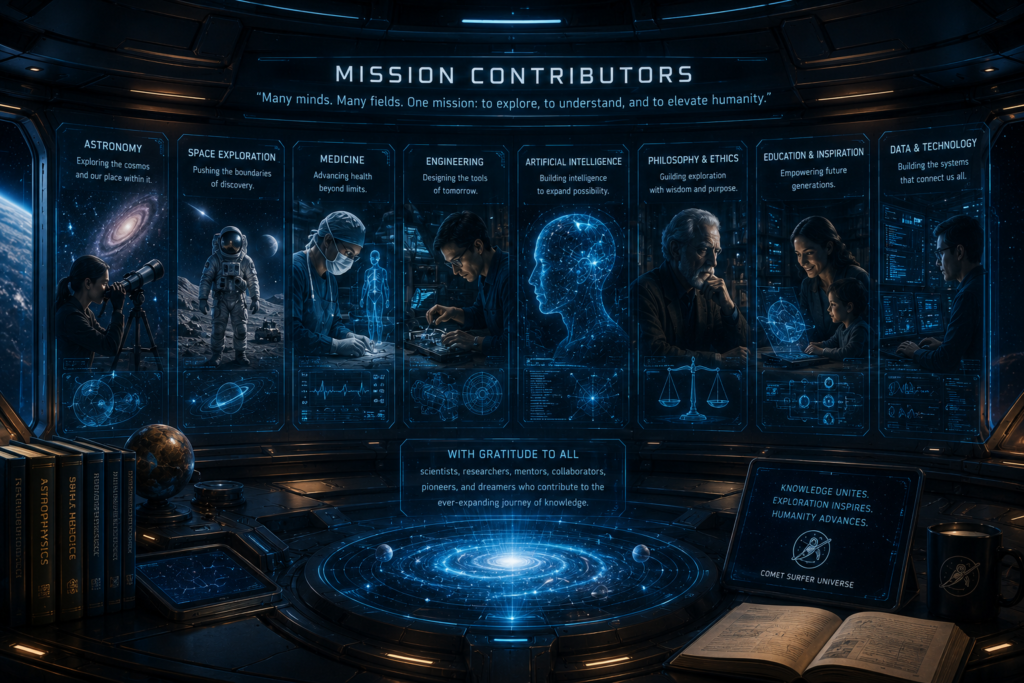
EThe Comet Surfer project has benefited significantly from the support of Artificial Intelligence technologies, which have complemented the creative, visual, and technical development process.
Google Gemini and ChatGPT
Both platforms contributed to:
- Idea generation
- Narrative development
- Technical problem solving
- Scientific exploration
- Content design and refinement
AI-Generated Visual Concepts
Several visual concepts featured throughout this website were developed with the assistance of AI image-generation systems, helping transform narrative ideas into visual representations.
WordPress AI Tools
Artificial intelligence features integrated into WordPress also contributed to:
- Content optimization
- Page organization
- Writing assistance
- User experience improvements
This acknowledgment highlights the value of human–machine collaboration when directed toward creativity, learning, and the pursuit of knowledge. de la colaboración humano-máquina cuando se orienta hacia la creatividad, la claridad y el conocimiento.
Publication and Recognition
Special thanks to Universo de Letras, part of the Editorial Planeta Group, for their editorial support during the publication of Comet Surfer: The Seduction of Nadeah.
The novel was awarded the prestigious Maestría Seal, a distinction granted to only a minority of works published under the imprint.
It is an honor to be included among the authors recognized for their literary excellence and commitment to quality storytelling.
