
What Is a Solar Sail?
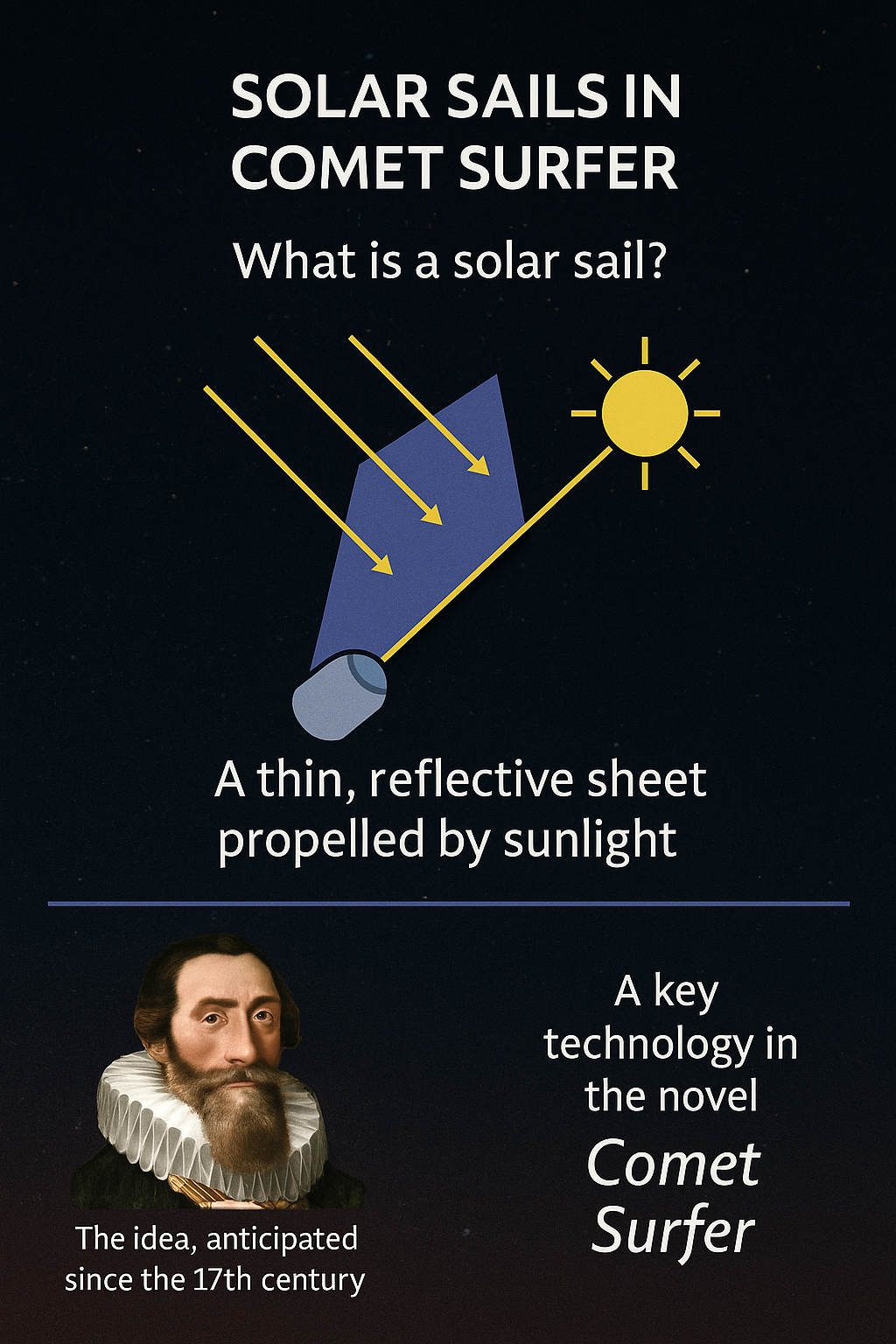
A solar sail, sometimes called a photon sail, is a spacecraft propulsion technology that uses the pressure exerted by sunlight to generate thrust.
The concept is deceptively simple.
Imagine an enormous, ultra-thin reflective sail deployed in the vacuum of space. Every second, billions upon billions of photons strike its surface. Although photons possess no rest mass, they carry momentum. When they reflect from the sail, they transfer a tiny amount of that momentum to the spacecraft.
The force is extraordinarily small.
Yet in the frictionless environment of space, where no atmosphere slows a vessel down, that tiny force can act continuously for months or even years, gradually accelerating a spacecraft to remarkable velocities without consuming fuel.
Unlike chemical rockets, which burn propellant rapidly and then coast, solar sails continue accelerating as long as they receive light.
In essence, they transform sunlight itself into propulsion.
From Kepler to the Space Age
The roots of the idea stretch back more than four centuries.
In the early seventeenth century, astronomer Johannes Kepler noticed that comet tails always pointed away from the Sun. He speculated that some kind of solar “wind” might be pushing them through space.
While his explanation was incomplete, the intuition proved remarkably insightful.
Centuries later, advances in physics revealed that sunlight itself exerts pressure.
The modern concept of solar sailing emerged during the twentieth century and was championed by scientists and visionaries such as Carl Sagan, who frequently promoted the idea as one of humanity’s most elegant methods of exploring the Solar System.
Sagan famously helped popularize the concept through television appearances, scientific publications, and public outreach, inspiring generations of engineers to transform the idea into reality.
Early Solar Sail Missions
The first practical demonstrations of solar sailing occurred during the early twenty-first century.
IKAROS (2010)
Launched by the Japan Aerospace Exploration Agency (JAXA), IKAROS became the world’s first successful solar sail spacecraft.
The mission demonstrated that sunlight alone could provide measurable propulsion and control.
LightSail 2 (2019)
Developed by The Planetary Society, LightSail 2 successfully demonstrated controlled orbital maneuvering using a solar sail.
The mission proved that solar sailing was not merely theoretical—it could become a practical tool for future exploration.
These pioneering missions laid the foundation for the solar sailing revolution that would follow.
Solar Sails in the Comet Surfer Universe

Within the Comet Surfer Universe, solar sails are more than a propulsion technology.
They are a symbol.
A symbol of a civilization that learned to navigate not by fighting nature, but by working with it.
Just as ancient mariners crossed Earth’s oceans by harnessing the wind, the pioneers of the Solar System learned to cross the void by harnessing sunlight.
The sight of a solar sail unfolding against the darkness became one of the defining images of the Martian Age.
To many people, it represented freedom itself.
The Inspiration of Amin Chandra
The origins of the Solar-Sail Corporation can be traced to a seemingly insignificant observation.
As a young engineer and entrepreneur, Amin Chandra watched an experimental satellite deploy a reflective sail to stabilize its orbit.
The technology worked.
But what captured Amin’s imagination was not what the sail was doing.
It was what it might do.
He asked a question that few others considered seriously:
What if a solar sail could move more than a satellite?
What if it could move cargo?
What if it could connect worlds?
The question would change the future of Mars.
The First Prototype
The earliest experiment was humble.
A repurposed cargo container equipped with:
- A lightweight sail structure
- A plasma-assisted guidance system
- A simple autonomous navigation robot
The mission’s objective was straightforward:
Move cargo through interplanetary space without relying on conventional propulsion.
The result exceeded expectations.
The vessel required little energy, almost no fuel, and demonstrated extraordinary reliability.
For the first time, transportation between worlds seemed capable of becoming both economical and sustainable.
From that experiment, Solar-Sail was born.
The Rise of Solar-Sail
Over the following decades, Solar-Sail evolved into the largest transportation company in the inner Solar System.
Its vessels became famous for their:
- Reliability
- Energy efficiency
- Low operating costs
- Long service lives
- Elegant design philosophy
Martian children grew up watching vast silver sails crossing the sky above orbital shipyards.
To them, these vessels were as familiar as cargo ships had once been on Earth.
Solar-Sail transformed commerce by linking:
- Mars
- Luna
- Earth orbit
- The Main Asteroid Belt
- The Trojan Colonies
- The outer exploration frontier
The company became one of the pillars of Martian economic independence.
Ethan Brown and the Next Generation
Under the engineering leadership of Ethan Brown, Solar-Sail entered a new era.
Ethan viewed solar sails not as isolated systems but as part of a larger ecosystem of propulsion technologies.
His designs combined:
- Solar sails
- Ion propulsion systems
- Autonomous navigation
- Adaptive smart materials
- Advanced AI assistance
This philosophy eventually led to the development of vessels capable of traversing enormous distances with unprecedented efficiency.
Among the materials that enabled this evolution was NEXUS, a programmable structural material capable of adapting its properties to changing mission requirements.
The combination of intelligent materials, AI-guided navigation, and sail-based propulsion pushed Solar-Sail far beyond its original concept.
ANNIE: The Navigator of Light
As Solar-Sail vessels grew more sophisticated, so did their navigation systems.
ANNIE, originally developed by Ethan Brown as a sailing assistant, became the ideal partner for solar sail operations.
She continuously analyzed:
- Solar intensity
- Orbital mechanics
- Space weather
- Sail geometry
- Traffic corridors
- Mission objectives
Because solar sailing depends on subtle adjustments rather than brute force, ANNIE’s predictive capabilities proved invaluable.
Many captains joked that ANNIE could “see the currents of space.”
In many ways, she could.
Cultural Significance
Solar sails transformed more than transportation.
They transformed how humanity thought about exploration.
Earlier generations viewed spaceflight as an act of conquest powered by enormous rockets and vast quantities of fuel.
Solar sailors viewed it differently.
To them, space was an ocean.
The Sun was the wind.
And every voyage became a conversation between technology and nature.
This philosophy deeply influenced Martian culture and eventually shaped the values of the Comet Surfer generation.
Legacy
By the twenty-second century, solar sails had become one of the defining technologies of human civilization.
They demonstrated that progress did not always require larger engines or greater consumption.
Sometimes the greatest advances came from learning how to use existing forces more intelligently.
The vast interplanetary fleets of Solar-Sail, the pioneering voyages of Ethan Brown, and the later achievements of the Comet Surfer mission all trace part of their heritage to a simple realization:
Light itself can carry us forward.e , Solar-Sail lidera el diseño de sistemas de propulsión híbridos que combinan velas solares, propulsores iónicos y materiales adaptativos como NEXUS.