

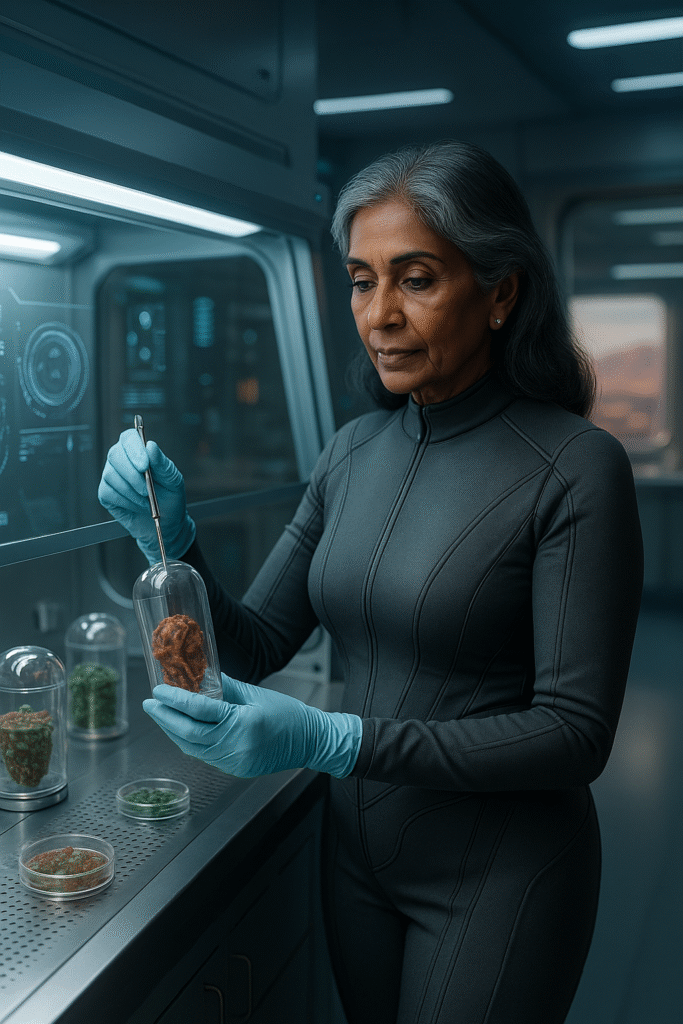
1. Header
Full Name: Aarya Chandra
Known As / Alias: Aarya
Pronouns: She / Her
Affiliations:
- University of Saint Maroun
- Solar-Sail
- Titan Research Mission
- Martian Exobiological Institute
2. Quick Facts
Place of Birth: Kolkata, India, Earth
Date of Birth: June 13, 2049 (Sol 18 of Centaurus, Mir 234)
Age in 2116: 67 years old
Occupation:
- Professor of Exobiology
- Panspermia Researcher
- Astrobiologist
- Scientific Educator
Education:
- Ph.D. in Planetary Biosciences
- University of Delhi
Languages Spoken:
- Bengali
- English
- Hindi
- Standard Martian
Marital Status: Married to Amin Chandra
Known Relatives:
- Layia Chandra
- Ravi Chandra
- Kiran Chandra
- Lakshmi Chandra
3. Narrative Biography
Childhood and Formation
Aarya Chandra was born in Kolkata, one of Earth’s great cultural and intellectual centers.
Growing up amid ancient traditions, scientific institutions, and a rapidly expanding space age, she developed a fascination with two questions that would define her life:
How does life emerge?
And how far does it extend into the universe?
As a child, she spent countless hours studying biology, astronomy, and the history of exploration. While many of her peers dreamed of traveling to other worlds, Aarya became interested in something even more fundamental:
The possibility that life itself might already connect them.
Her exceptional talent for both biology and astrophysics eventually led her toward the emerging field of exobiology.
Academic Career
Aarya specialized in the study of extremophiles—organisms capable of surviving under conditions once considered incompatible with life.
Her early research focused on understanding how biological systems adapt to:
- Radiation
- Extreme temperatures
- High pressure
- Chemical toxicity
- Vacuum exposure
These investigations gradually expanded into a larger scientific framework exploring the possibility that life could travel naturally between worlds.
Her work helped establish some of the first comprehensive models describing how microorganisms might survive interplanetary and even interstellar transport.
Over time, she became one of the leading proponents of modern panspermia theory.
Pioneer of Cosmic Biology
While many scientists viewed panspermia as an intriguing hypothesis, Aarya approached it as a testable scientific question.
Her research suggested that life might not be a local phenomenon tied to a single planet, but part of a broader cosmic process.
Rather than asking where life began, she encouraged her colleagues to ask:
How does life spread?
This shift in perspective transformed an entire generation of exobiological research.
Her publications became foundational texts throughout Martian universities and research institutions.
Students often joked that every exobiology course eventually became an Aarya Chandra course.
The Titan Discovery
Aarya’s most celebrated scientific achievement came during the exploration of Titan.
As part of a multinational research effort, she helped investigate the moon’s complex hydrocarbon ecosystems.
The mission resulted in the discovery of:
Pseudoeukaryota shangrilensis
A remarkably sophisticated organism exhibiting characteristics previously thought impossible in a non-water-based biological environment.
The discovery demonstrated that life could emerge and persist using radically different biochemical pathways than those found on Earth.
More importantly, comparative genetic analysis suggested deep structural similarities between Titanian biology and terrestrial life.
The findings provided some of the strongest evidence ever assembled in support of panspermia.
For many scientists, the discovery represented one of the most important biological breakthroughs in human history.
Teacher and Mentor
Although celebrated for her research, Aarya often described teaching as her most meaningful contribution.
At the University of Saint Maroun she trained generations of Martian scientists, emphasizing both scientific rigor and intellectual humility.
Her students were encouraged to challenge assumptions, question established theories, and approach the unknown with curiosity rather than certainty.
Among her most successful protégés was her daughter, Layia Chandra, whose discovery of Comet Nadeah would later reshape Martian history.
Aarya took great pride in seeing her students surpass her achievements.
To her, this represented the true purpose of education.
Family and Exploration
Aarya’s partnership with Amin Chandra became one of the most influential scientific and cultural alliances in Martian history.
While Amin focused on economic development and infrastructure, Aarya dedicated herself to expanding humanity’s scientific horizons.
Together they raised four children in an environment where learning, creativity, and exploration were considered daily responsibilities.
Even during long-duration missions, Aarya remained actively involved in their education, pioneering personalized learning approaches that combined family life with scientific discovery.
Her household often resembled a research institute, classroom, and cultural center simultaneously.
Philosophy of Life
Aarya’s scientific worldview was deeply informed by both evidence and wonder.
She believed that discovering life elsewhere should inspire humility rather than triumph.
For her, every organism represented a unique solution to the challenge of existence.
Whether found on Earth, Mars, Titan, or beyond, life deserved respect.
This perspective made her one of the strongest advocates for ethical exploration and biological preservation throughout the Solar System.
4. Key Quotes
“Life does not begin or end on a planet. It is a whisper that travels with the comets.”
“My home is wherever science flourishes and curiosity finds questions.”
“Every cell is a library written in a language older than civilizations.”
“Observe with respect. Each organism is a solution billions of years in the making.”
5. Role in the Saga
Aarya represents the scientific soul of the Comet Surfer universe.
Through her character, the saga explores:
- Exobiology
- Panspermia
- Scientific ethics
- Education
- Intergenerational knowledge
- Humanity’s place in the cosmos
Her work provides the intellectual foundation for many of the discoveries that shape Martian civilization.
As a scientist, mother, mentor, and explorer, she bridges Earth and Mars while helping humanity understand that life may be far more universal than previously imagined.
6. Timeline Events
2049
Born in Kolkata, India.
2071
Marries Amin Chandra in a lunar ceremony.
2073
Relocates to Saint Maroun, Mars.
2080s
Establishes herself as a leading researcher in extremophile biology and panspermia.
2090
Publishes the first comprehensive Martian Panspermia Model.
2106
Helps design the first educational framework for long-duration interplanetary missions.
2110s
Leads major exobiological research initiatives throughout the Solar System.
2116
Co-leads the discovery and characterization of complex life on Titan.
7. Trivia
Favorite Place:
The Solaria Bioexperimental Greenhouse.
Secret Hobby:
Designing miniature symbiotic gardens.
Favorite Instrument:
The LISA Microscope (Isotropic Lens for Adaptive Tuning).
Most Repeated Phrase:
“Observe with respect; every cell is a universe.”
Personal Interest:
Studying ancient human art and comparing its patterns to biological structures.
Favorite Scientific Question:
How many times has life begun?
Teaching Style:
Known for asking questions rather than giving answers.
Interesting Fact:
Several scientific discoveries attributed to her students originated from questions she casually asked during classroom discussions.
Unofficial Title:
“The Mother of Martian Exobiology.”
Historical Legacy:
Remembered as one of the scientists who transformed humanity’s understanding of life from a planetary phenomenon into a cosmic one.