
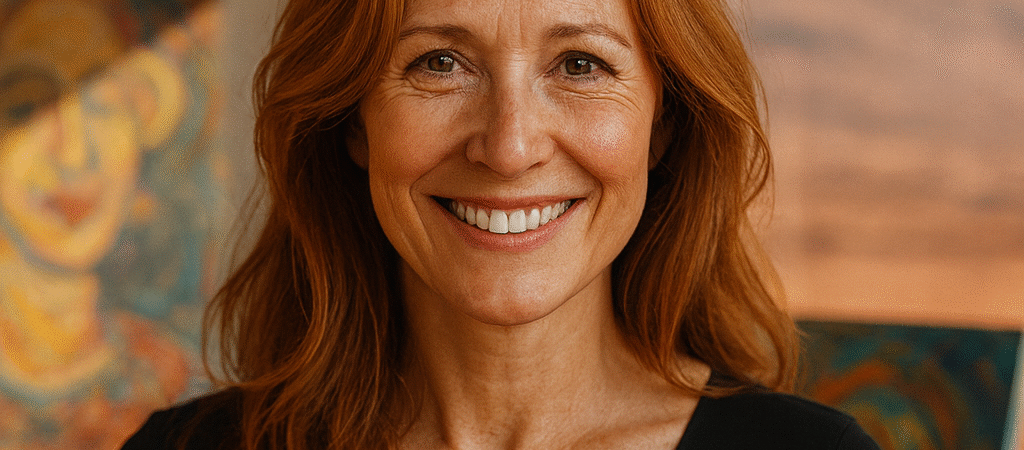

1. Header
Full Name: Lourdes Ferreira de Oliveira
Known As / Alias: Maestra
Pronouns: She / Her
Affiliations:
- New Recife Educational Community
- Martian Cultural Foundation
- Martian Academic System
- Atmospheric Painting Workshop
2. Quick Facts
Place of Birth: New Recife, Mars
Date of Birth: July 1, 2046 (Sol 26 of Corvus, Mir 232)
Age in 2116: 70 years old
Occupation:
- Educator
- Martian Historian
- Artist
- Designer of the Martian Academic System
Education:
- University of New Recife
- Bachelor’s Degree in Multicultural Pedagogy
Languages Spoken:
- Portuguese
- Spanish
- English
- Colloquial Martian
Marital Status: Married to Ricardo Oliveira
Known Relatives:
- Fátima Ferreira (Sister)
- Izabel Ferreira (Mother)
- Bob Oliveira (Son)
- Miguel Oliveira (Son)
- Alexandre Oliveira (Son)
- Camila Oliveira (Daughter)
3. Narrative Biography
Origins and Early Life
Lourdes Ferreira was born in New Recife during the formative decades of Martian settlement.
She grew up in a community where survival depended not only on engineering and science, but on cooperation, trust, and the transmission of knowledge between generations.
Her family played a central role in shaping Martian culture.
Her mother, Izabel Ferreira, developed the framework known as Martian Cognitive Anthropagogy (MCA), a pioneering approach to emotional and social education specifically adapted to life on Mars.
Her older sister, Fátima Ferreira, became one of the earliest chroniclers of Martian oral history, preserving the stories of the first settlers before they could be lost.
From both women, Lourdes inherited a conviction that civilizations survive because people remember who they are.
The Calling of a Teacher
From an early age, Lourdes recognized that Mars faced a challenge unlike any in human history.
The colony was creating new technologies, new institutions, and even new forms of government.
Yet no one had fully answered a more fundamental question:
How should Martians educate their children?
She dedicated her life to answering it.
While many educators focused on transferring information, Lourdes focused on developing complete human beings.
Her philosophy emphasized:
- Curiosity
- Communication
- Creativity
- Responsibility
- Lifelong learning
For Lourdes, education was not preparation for life.
Education was life itself.
Architect of the Martian Academic System
Lourdes’ greatest contribution was the creation of the Martian Academic System (MAS).
Designed specifically for Martian society, the system rejected rigid Earth-based educational models in favor of a flexible structure centered on mastery and practical experience.
Its key features included:
- Educational triads (three-month learning intervals)
- Competency levels spanning two mirs each
- Lifelong educational pathways
- Interdisciplinary learning
- Communication mastery
Students were encouraged to become fluent in up to three communication systems, including:
- Spoken languages
- Music
- Sign language
- Mathematical notation
- Computer programming
Beginning at intermediate levels, students devoted substantial portions of their education to real-world experiences, integrating theory with practical application.
The result was a generation of Martians uniquely prepared to thrive in a rapidly changing civilization.
Many historians consider the Martian Academic System one of the most successful educational reforms in human history.
Family and Home
Lourdes married Ricardo Oliveira during Mars’ transition from frontier settlement to emerging civilization.
Together they formed one of the most influential families in Martian history.
Their children—Bob, Miguel, Alexandre, and Camila—grew up in an environment where science, ethics, storytelling, and imagination were equally valued.
The Oliveira household became known as a gathering place for scientists, educators, artists, and public servants.
While Ricardo often worked on technologies that shaped the future of Mars, Lourdes ensured that future generations would possess the wisdom necessary to use those technologies responsibly.
Historian of Everyday Mars
Although often overshadowed by more visible political and scientific leaders, Lourdes became one of the most important custodians of Martian cultural memory.
She documented:
- Family histories
- Educational traditions
- Social customs
- Oral narratives
- Everyday life within the settlements
Her work preserved aspects of Martian civilization that might otherwise have disappeared beneath official histories.
She believed that understanding ordinary lives was just as important as recording extraordinary achievements.
The Artist of Mars
Following her partial retirement from formal education, Lourdes devoted increasing attention to the visual arts.
She became particularly known for her Martian Impressionist Paintings, which captured the subtle beauty of a world many still considered barren.
Her favorite subjects included:
- Rust-colored dunes
- Frost-covered valleys
- Sunrise over Olympus Mons
- Dust-filtered light within Martian domes
Using mineral pigments derived from local materials, she developed techniques that reflected the unique atmosphere and colors of Mars.
Her paintings became celebrated throughout the Solar System for their ability to convey not only landscapes, but emotions.
Tradition and Identity
As Martian culture evolved, families from dozens of Earth traditions sought common customs that could unite future generations.
One such tradition involved family names.
Although Brazilian naming customs traditionally emphasize maternal surnames, many Martian families adopted the paternal surname as a shared convention to simplify records across multiple cultural backgrounds.
The Oliveira family embraced this practice while continuing to honor both sides of their heritage.
For Lourdes, identity was never something inherited passively.
It was something consciously cultivated.
4. Key Quotes
“Education is not filling a void; it is igniting an orbit.”
“There is no brush more powerful than emotional memory.”
“A civilization survives when its children understand both where they came from and where they are going.”
“Knowledge teaches us how to live. Wisdom teaches us why.”
5. Role in the Saga
Lourdes represents the humanistic dimension of Martian civilization.
As educator, historian, artist, mother, and mentor, she provides the cultural foundation upon which scientific and technological progress rests.
Through her character, the saga explores:
- Education
- Cultural identity
- Historical memory
- Family
- Art
- Human development
Her influence extends far beyond her immediate family.
Entire generations of Martians were shaped by her educational philosophy.
If Ricardo helped Mars survive, Lourdes helped Mars become a civilization.
6. Timeline Events
2046
Born in New Recife, Mars.
2067
Begins teaching in the earliest Martian educational centers.
2070
Marries Ricardo Oliveira.
2072–2080
Raises Bob, Miguel, Alexandre, and Camila Oliveira.
2080s–2090s
Develops and implements the Martian Academic System.
2100
Retires from formal teaching and founds the Atmospheric Painting Workshop.
2100–2116
Produces some of the most celebrated works of Martian Impressionism.
2116
Lives in partial retirement within a low-exposure dome near New Recife.
7. Trivia
Favorite Place:
The iron-oxide dunes near Saint Maroun at sunset.
Artistic Habit:
Recites Fernando Pessoa poems softly while painting.
Painting Technique:
Mineral pigments suspended in filtered Martian water.
Most Famous Work:
The Silence of Olympus at Dawn.
Favorite Subject:
The emotional history of ordinary Martians.
Personal Philosophy:
Every child carries a future civilization within them.
Family Secret:
Keeps a collection of letters written by Fátima to Ricardo before his marriage.
Unofficial Title:
“The Teacher of Mars.”
Historical Legacy:
Remembered as the educator who taught Mars not merely how to learn, but how to think, feel, and remember.