
Class
Deep-Space Colonization, Construction, and Terraforming Vessel
Registry
OTM Exploration Vessel CS-01
Affiliation
Martian Terraforming Organization (MTO)
Overview
The Comet Surfer is an interplanetary exploration and construction vessel designed for long-duration missions beyond Mars. Measuring approximately 80 meters in length, 18 meters in beam, and 18 meters in height, the ship combines the compact efficiency of a research vessel with the industrial capacity required for deep-space engineering.
Its three-deck architecture supports a crew of six specialists and the advanced AI system ANNIE. The vessel includes command and navigation spaces, crew quarters, medical and science facilities, agricultural modules, advanced manufacturing, vehicle maintenance, cargo systems, manipulator capsules, and mission-support infrastructure.
Rather than serving as a passenger ship or military cruiser, the Comet Surfer functions as a self-sufficient expedition platform. It is built to travel across the Solar System, operate near comets and asteroids, deploy construction systems, support surface operations, and sustain its crew through years of uncertainty.
Its balanced 80 × 20 × 20 m configuration gives the ship a robust, stable profile suitable for both deep-space travel and complex field operations. Within the Comet Surfer universe, it represents the fusion of exploration, engineering, science, and human courage—the vessel that allows a small crew to attempt a planetary-scale mission.
The Comet Surfer is comparable in scale to the largest commercial aircraft of the early twenty-first century. Its central pressure hull measures approximately 18 meters wide and 18 meters high, while its paired thermal radiator and propellant vanes extend an additional 18 meters on each side, giving the vessel a total span of approximately 54 meters.
| Vehicle | Length | Wingspan / Total Span | Height |
|---|---|---|---|
| Comet Surfer | 80 m | 60 m | 20 m |
| Boeing 747-8 | 76.3 m | 68.4 m | 19.4 m |
| Airbus A380 | ~73 m | ~80 m | ~24 m |
Unlike the wings of a Boeing 747 or Airbus A380, these vanes do not provide aerodynamic lift. They are deep-space engineering surfaces: part propellant reservoir, part landing and anchoring system, and part thermal radiator. In profile, the Comet Surfer evokes the familiar scale of a jumbo jet, but its purpose is entirely different: not atmospheric flight, but years of autonomous exploration, construction, and survival across the Solar System.
General Characteristics
Length: Approximately 80 meters (middle deck)
Maximum Width: Approximately 20 meters
Configuration: Three-deck octagonal structure
Crew Capacity: Six permanent crew members
Mission Duration: Multi-year autonomous operations
Artificial Gravity: Selective Variable Gravity Generator (VGG) environments
Primary Energy Sources: LFTR and VHTR nuclear systems
Primary Propulsion: Dual AMIA Ion Acceleration Thrusters
Primary Mission Types:
- Deep-space exploration
- Comet and asteroid operations
- Infrastructure deployment
- Terraforming support
- Scientific research
- Autonomous construction
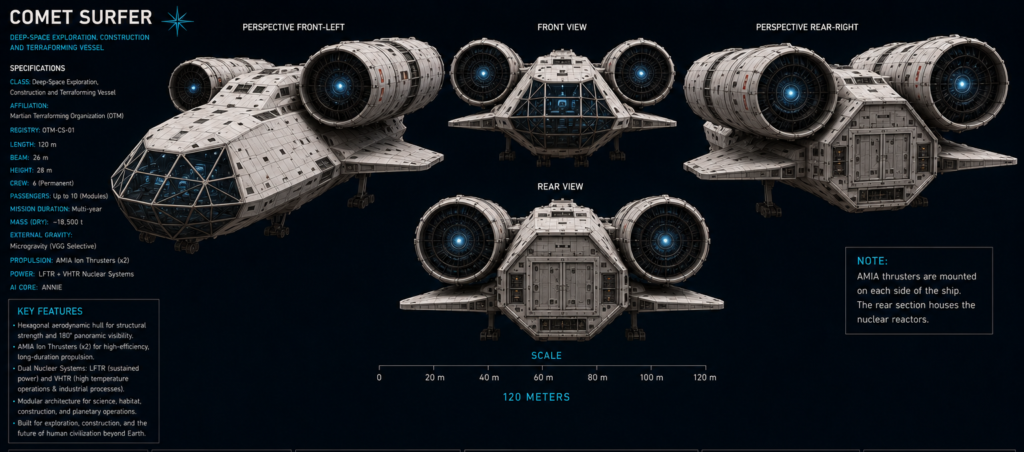
External Architecture
The Comet Surfer was designed to operate alongside asteroids, comets, and planetary surfaces rather than merely travel between them.
Its structure incorporates:
- Reinforced docking hardpoints
- External manipulation interfaces
- Habitat deployment ports
- Orbital capsule bays
- Long-range sensor arrays
- Construction attachment systems
- Surface operations support equipment
The vessel’s octagonal geometry maximizes structural efficiency while providing multiple attachment points for mission-specific modules.
At the bow, panoramic windows span all three decks, providing nearly 180 degrees of visibility and maintaining a continuous visual connection between the crew and their environment.
Two large external AMIA thrusters, mounted port and starboard, dominate the vessel’s silhouette and provide the distinctive profile for which the ship is known.
Maintenance wings extending toward the propulsion units allow external inspection, servicing, and docking operations.
Thermal Radiator and Propellant Vanes
One of the most distinctive features of the Comet Surfer is the pair of large wing-like structures extending from the vessel’s lower hull beneath the AMIA propulsion system.
Although they resemble aircraft wings, they serve an entirely different purpose. In the vacuum of space, aerodynamic lift is unnecessary. Instead, these structures function as multi-purpose thermal radiator and propellant vanes, integrating several critical spacecraft systems into a single engineering solution.
The interior of each vane contains insulated cryogenic tanks that store the propellant required to initiate the AMIA propulsion system, as well as fuel reserves for the ship’s attitude control and maneuvering thrusters. Their location away from the main habitat reduces operational risk and improves mass distribution throughout the vessel.
The vanes also house the Comet Surfer’s retractable landing systems, including shock-absorbing landing gear, anchoring mechanisms, and the harpoons used to secure the vessel to the surface of comets, asteroids, and other low-gravity bodies. During the Nadeah mission, these systems play a crucial role in establishing a stable connection between the spacecraft and the comet’s surface.
Perhaps their most important function, however, is thermal management.
Deep-space vessels generate enormous quantities of heat from life-support systems, manufacturing equipment, scientific instruments, computer systems, and the ship’s compact atomic power reactors. Because space is a vacuum, heat cannot be removed through convection as it is on Earth. Instead, it must be radiated away as infrared energy.
To accomplish this, the Comet Surfer employs a closed-loop liquid sodium cooling network. Heat generated throughout the vessel is transferred into circulating liquid sodium, which is pumped from the reactor compartments, engineering spaces, and habitat modules into the radiator vanes. The vanes contain extensive internal heat-exchange channels that distribute thermal energy across a large surface area. The absorbed heat is then emitted into space as infrared radiation.
When operating at full power, the vanes glow faintly in the infrared spectrum, silently shedding megawatts of waste heat into the darkness of space.
This elegant integration of propellant storage, landing systems, structural support, and thermal control makes the radiator vanes one of the most important engineering features of the Comet Surfer. Far from being decorative appendages, they are essential to the vessel’s survival and long-term operation throughout the Solar System.
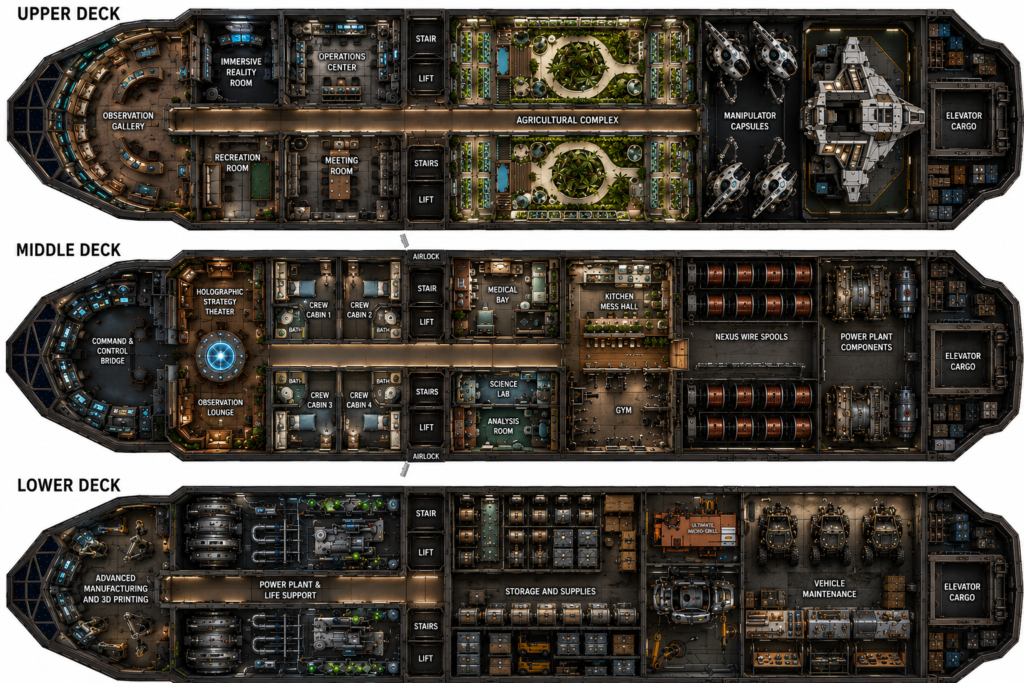
Internal Architecture
The vessel is organized around a single central circulation spine consisting of:
- One personnel stairwell
- One personnel elevator
- One heavy cargo elevator
- A central longitudinal corridor
All major spaces are designed to maximize usable volume while minimizing unnecessary circulation areas.
The cargo elevator extends through all three decks and terminates in a rear loading ramp that allows direct transfer of vehicles, construction equipment, and industrial components to planetary or cometary surfaces.
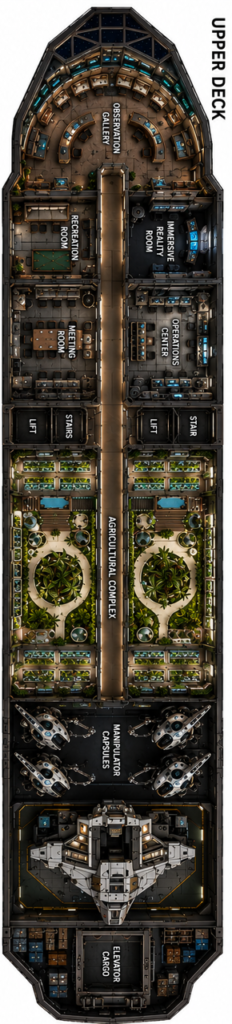
Upper Deck — Agriculture and Mission Operations
The upper deck combines strategic operations with life-support production.
Facilities
- Observation Gallery
- Holographic Mission Theater
- Secondary Operations Center
- Hydroponic Greenhouse Complex
- Aquaculture Systems
- Atmospheric Shuttle Bay
- Manipulator Capsule Hangars
- Vehicle Maintenance Workshop
The greenhouse occupies a substantial portion of the deck and forms the biological heart of the vessel.
Hydroponic and aquaculture systems produce vegetables, algae, fish, and shrimp while contributing to atmospheric regulation, water recycling, and crew well-being.
Manipulator capsules and atmospheric landing craft are deployed from the aft section of this deck.
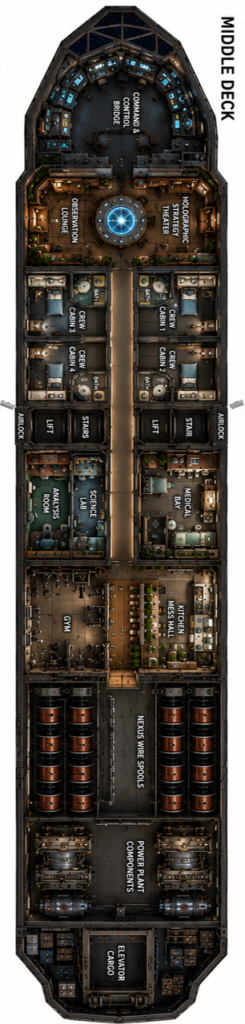
Middle Deck — Habitat and Command
The middle deck is the largest level and serves as the primary living and command environment.
Facilities
- Main Command Bridge
- Communications Center
- Observation Lounge
- Four Private Crew Quarters with Bathrooms
- Two Flexible Guest or Mission Specialist Cabins
- Kitchen
- Central Mess Hall
- Gymnasium
- Medical Bay
- Science Laboratory
- Analytical Laboratory
The design philosophy emphasizes habitability rather than mere survival.
The greenhouse above supplies fresh food directly to the galley and mess hall below, creating an integrated ecological system.
Large forward observation windows connect crew living spaces with the surrounding environment and reduce the psychological burden of prolonged deep-space missions.
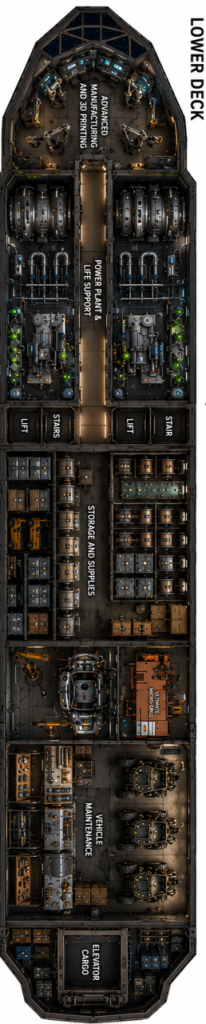
Lower Deck — Engineering and Industrial Operations
The lower deck contains the vessel’s industrial infrastructure.
Facilities
- Biotech Laboratory
- EVA Preparation Complex
- Biosuit Fabrication Facility
- Spacesuit Storage and Maintenance
- 3D Manufacturing Workshop
- Industrial Fabrication Hall
- Construction Equipment Storage
- Atmospheric Processing Systems
- Rover Maintenance Facility
- Rover Storage Bays
- AI Core Infrastructure
The central artificial intelligence system ANNIE resides within this deck, interfacing with every major subsystem aboard the ship.
ANNIE coordinates navigation, life support, maintenance, communications, mission planning, and crew support.
Cargo Complex
The aft third of the vessel spans all three decks and serves as a dedicated construction and logistics center.
Stored equipment includes:
- Multiple rover systems
- Manipulator capsules
- Atmospheric shuttle
- Four disassembled VHTR reactor systems
- Habitat deployment modules
- Construction machinery
- Atmospheric processing equipment
- Hundreds of thousands of kilometers of Nexus wire stored on heavy transport spools
- Structural components for navigation spires and industrial facilities
The cargo capacity reflects the vessel’s intended role as a builder of infrastructure rather than a conventional transport craft.
Propulsion Systems
AMIA Thrusters
The vessel is propelled by two external AMIA (Advanced Magnetized Ion Acceleration) thrusters.
These engines accelerate ionized gases to extremely high velocities, enabling efficient long-duration missions throughout the Solar System.
Initially designed to utilize dry-ice-derived propellants, the system later evolved to support gas capture from planetary atmospheres, comets, and the interplanetary medium.
This capability dramatically extends mission endurance and reduces logistical dependence on preloaded fuel reserves.
Power Systems
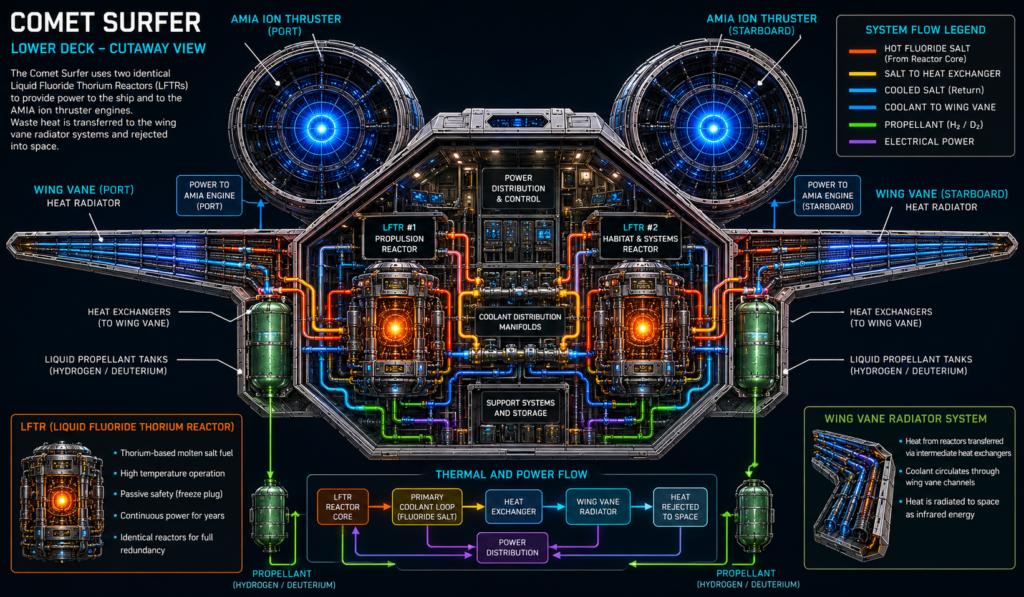
LFTR Reactors
Liquid Fluoride Thorium Reactors provide baseline electrical power and life-support energy.
Advantages include:
- High efficiency
- Long operational life
- Reduced waste generation
- Enhanced safety characteristics
Two primary LFTR reactor complexes are distributed fore and aft to improve redundancy and survivability.
VHTR Systems
For the Nadeah mission, the vessel carries four Very High Temperature Reactor modules capable of operating near 1000°C.
These systems support:
- Hydrogen production
- Industrial processing
- Large-scale construction
- Resource extraction
- High-power ion acceleration
- Terraforming infrastructure

ANNIE — Artificial Numerical Navigator, Integrator and Executor
The ship’s central intelligence, ANNIE, coordinates:
- Navigation
- Life support
- Communications
- Maintenance
- Mission planning
- Psychological support
Unlike traditional automation systems, ANNIE was designed as a collaborative intelligence, working alongside the crew rather than replacing them.
Her presence became inseparable from the identity of the vessel itself.
Construction and Terraforming Capabilities
The Comet Surfer was specifically designed to support large-scale engineering operations.
Capabilities include:
- Habitat deployment
- Atmospheric module delivery
- Autonomous construction support
- Spiral navigation structure assembly
- Resource extraction support
- Surface infrastructure deployment
These systems enabled operations far beyond those of a conventional exploration vessel.
Legacy
The Comet Surfer occupies a unique place in Comet Surfer Universe.
More than a spacecraft, it became a symbol of humanity’s transition from planetary civilization to true Solar System civilization.
Its voyages demonstrated that intelligence, cooperation, and perseverance could achieve what brute force could not.
The Comet Surfer did not merely travel through the Solar System.
It helped reshape it.