
1. Technological Classification
Designation: VHTR (Very High Temperature Reactor)
Type: Advanced Nuclear Power System
Primary Function: Electrical generation, thermal management, industrial processing, and habitat support
Canonical Applications:
- Interplanetary spacecraft
- Orbital stations
- Planetary settlements
- Industrial complexes
- Terraforming infrastructure
Within the Comet Surfer universe, the Very High Temperature Reactor (VHTR) represents one of the most important enabling technologies of the interplanetary era.
Without compact, reliable, and long-duration energy systems, humanity’s expansion beyond Earth would have remained limited to short expeditions and fragile outposts.
The VHTR changed that equation.
It provided not only electricity, but heat, industrial capability, and long-term autonomy.
2. Origins and Purpose
As human civilization expanded throughout the Solar System, energy requirements increased dramatically.
Habitats required:
- Electrical power
- Thermal regulation
- Water processing
- Atmospheric management
- Industrial manufacturing
Traditional solar systems proved insufficient in many environments, particularly:
- Deep space
- Shadowed craters
- Long-duration missions
- High-power industrial operations
The VHTR was developed to provide a compact and highly efficient solution capable of operating independently for extended periods.
Its introduction marked a turning point in off-world engineering.
3. Core Architecture
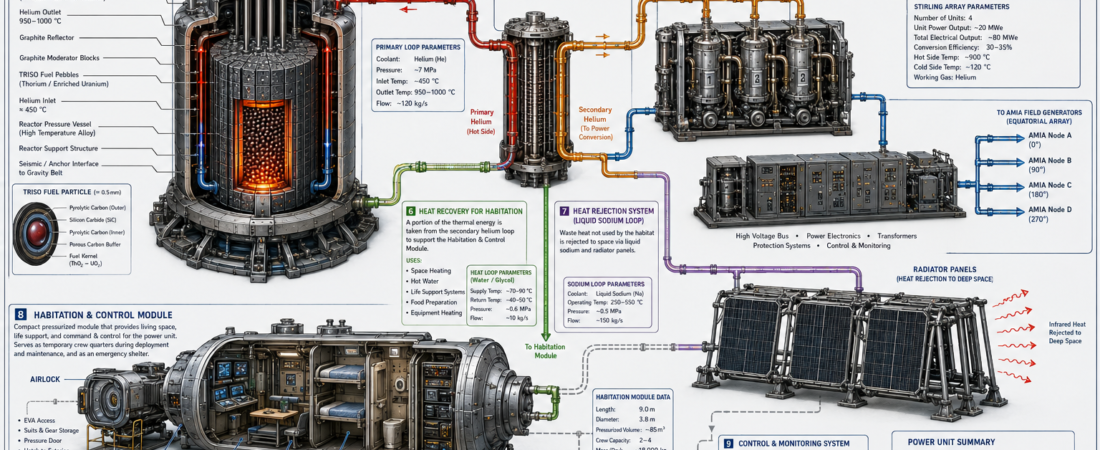
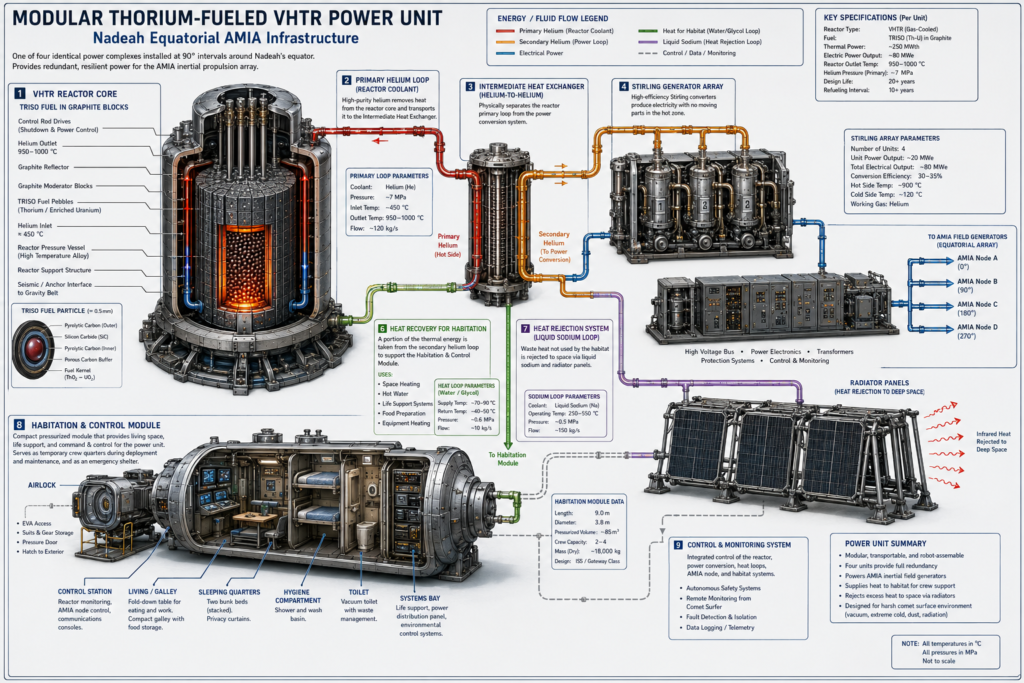
Each VHTR power module consists of three major subsystems:
Energy Conversion Vessel
The reactor core contains controlled nuclear reactions designed to generate extremely high temperatures while maintaining long-term operational stability.
The system prioritizes:
- Reliability
- Passive safety
- Thermal efficiency
- Extended service life
Hot Duct Assembly
Often referred to simply as the Hot Duct, this subsystem transfers thermal energy from the reactor core to the power conversion units.
Liquid sodium serves as the primary heat-transfer medium.
Its exceptional thermal conductivity allows efficient transport of energy while minimizing losses.
The Hot Duct acts as the circulatory system of the reactor.
Habitat Interface Module
Unlike conventional terrestrial reactors, the VHTR was designed from the beginning to function as part of a larger ecosystem.
Residual heat that would normally be discarded is redirected to:
- Environmental control systems
- Water processing units
- Habitat heating
- Agricultural facilities
The reactor therefore supports both technological and biological systems simultaneously.
4. Power Generation Process
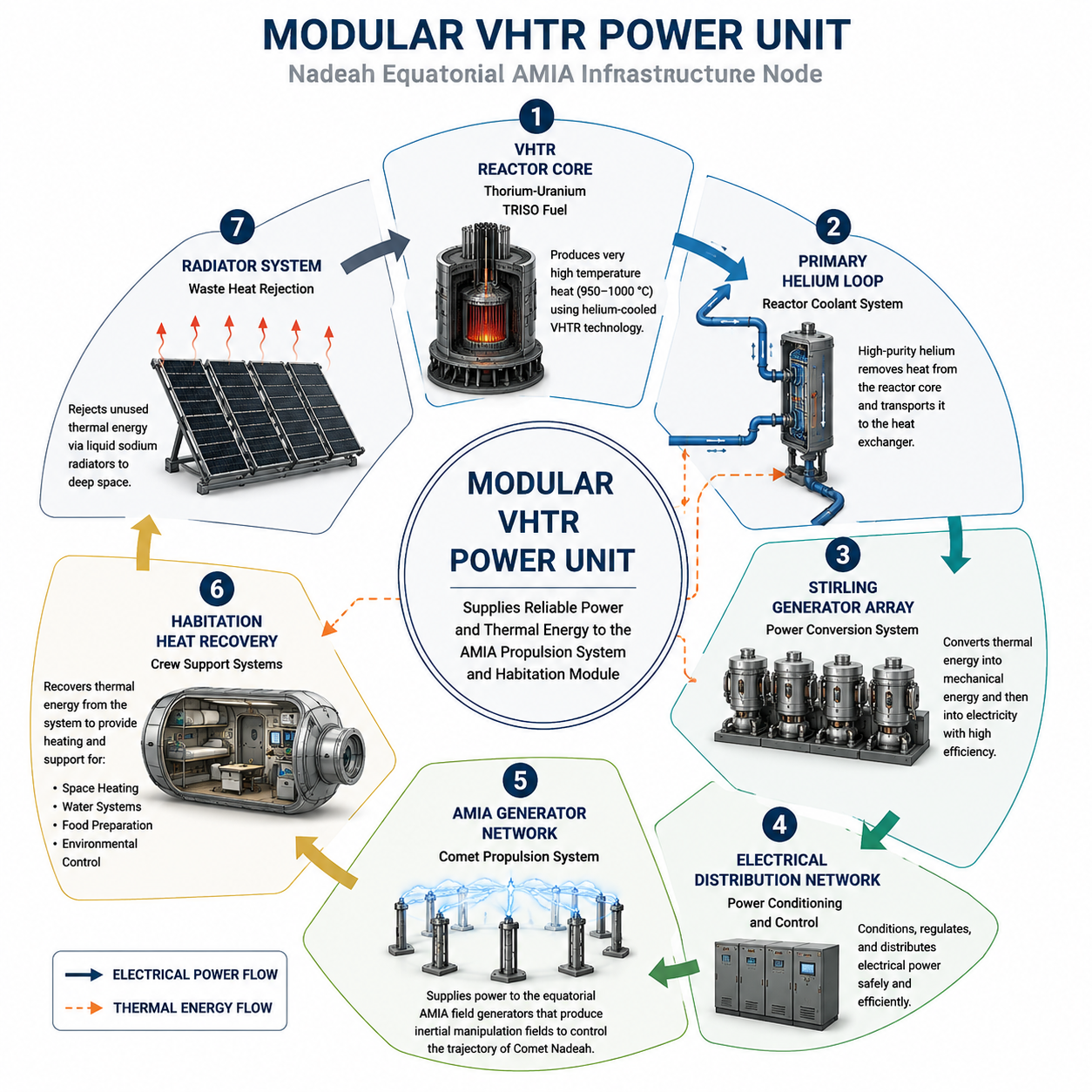
The VHTR converts thermal energy into electricity through a multi-stage process.
Step 1: Nuclear Heat Production
Controlled nuclear reactions within the core generate extreme temperatures.
Unlike chemical fuels, the energy density available from nuclear reactions allows continuous operation for years or even decades.
Step 2: Thermal Transport
Liquid sodium circulates through the reactor system, carrying heat from the core through the Hot Duct Assembly.
This thermal energy is then delivered to the conversion units.
Step 3: Stirling Energy Conversion
A high-efficiency Stirling converter transforms heat into electricity.
The system operates through magnetically coupled pistons that oscillate in response to temperature differences between hot and cold chambers.
This process produces electrical power without combustion.
Advantages include:
- High reliability
- Low mechanical wear
- Excellent efficiency
- Long operational lifespan
Step 4: Heat Rejection
Residual heat enters a secondary loop utilizing liquid ammonia.
The ammonia transfers thermal energy to large external radiators.
In the vacuum of space, heat cannot be removed through convection.
Instead, it is emitted as infrared radiation.
The radiator network therefore functions as the reactor’s cooling system.
Step 5: Life-Support Integration
Not all residual heat is discarded.
A portion is redirected to the Environmental Control and Life Support System (ECLSS), providing thermal stability for:
- Crew habitats
- Laboratories
- Greenhouses
- Water systems
The VHTR thus becomes an integral component of habitat survival.
5. TRISO Fuel: Tiny Particles, Extraordinary Safety
Unlike the molten-salt fuel used by LFTR reactors, the VHTR reactors employ TRISO fuel (TRI-structural ISOtropic particles).
Each fuel particle consists of a microscopic kernel containing thorium and enriched uranium surrounded by multiple protective layers of pyrolytic carbon and silicon carbide. These coatings act as miniature containment vessels, trapping most fission products and radioactive gases within the particle itself.
A single reactor contains billions of these particles embedded within graphite fuel elements. The result is an exceptionally robust fuel capable of tolerating temperatures far beyond those encountered during normal operation.
This makes TRISO fuel particularly attractive for deep-space missions, where maintenance opportunities are limited and reliability is essential.The system delivers enormous amounts of power while occupying relatively little volume.
Deep-Space Independence
Unlike solar arrays, VHTR systems can operate regardless of:
- Distance from the Sun
- Illumination conditions
- Dust storms
- Eclipse events
Thermal Stability
The reactor serves simultaneously as:
- Power plant
- Heating system
- Industrial heat source
This multifunctionality dramatically improves mission efficiency.
Environmental Sustainability
Compared with earlier nuclear technologies, VHTR systems produce:
- Reduced waste streams
- Improved fuel utilization
- Enhanced passive safety characteristics
Modular Design
VHTR units can be:
- Combined
- Scaled
- Replaced
- Integrated into larger infrastructures
This flexibility made them indispensable throughout the Solar System.
6. Role in the Nadeah Mission
The Nadeah Project demanded unprecedented energy resources.
The Comet Surfer carried four specialized VHTR units designed to operate at temperatures approaching 1,000 °C.
These reactors supported:
- NEXUS manufacturing
- Hydrogen production
- Industrial construction
- Ion accelerator operations
- Habitat maintenance
Without VHTR technology, the large-scale engineering required on Nadeah would have been impossible.
The reactors became the invisible engines behind humanity’s most ambitious cometary construction project.
7. Human Experience
Most citizens rarely think about VHTR reactors.
They are hidden beneath floors, buried beneath regolith, or enclosed within engineering decks.
Yet every illuminated habitat, every greenhouse, every life-support system, and every industrial facility depends upon them.
The reactors quietly sustain civilization.
Their success is measured not by visibility, but by reliability.
8. Narrative Context (Spoiler-Free)
Throughout the Comet Surfer universe, VHTR reactors symbolize a fundamental truth:
Exploration requires infrastructure.
While spacecraft and discoveries often capture public imagination, technologies such as the VHTR make those achievements possible.
The reactor represents the marriage of scientific rigor and practical engineering that defines the interplanetary age.
9. Cultural Note
VHTR reactors are rarely celebrated.
They are:
The Fires That Traveled — the controlled stars humanity carried with it into the darkness between worlds.