
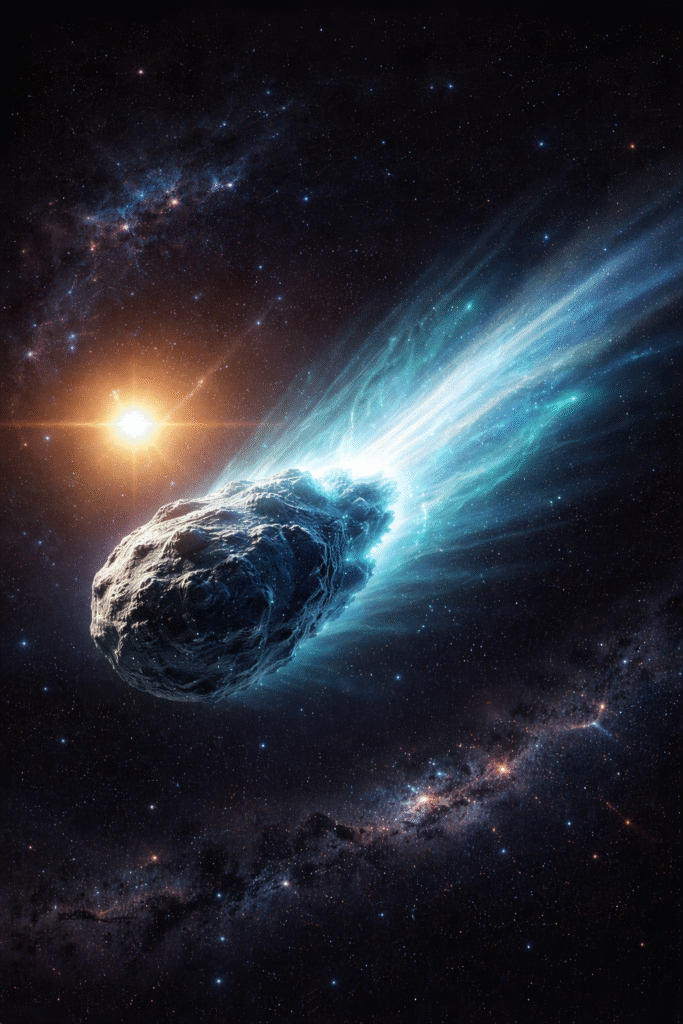
Discover the comet that transformed the destiny of Mars and changed the course of human history.
👉 Learn how Nadeah became the catalyst for the Comet Surfer saga.
Long before Nadeah became the centerpiece of the most ambitious engineering project in Martian history, it was simply a faint anomaly hidden within the immense archives of the Uranus Ring Telescope (TAU). Its discovery by exobiologist Layia Chandra reminds us that even in an age of advanced artificial intelligence, curiosity, intuition, and human insight remain essential tools of exploration. Learn how a quiet observation made while analyzing telescope data would ultimately change the future of Mars.
👉 Read the Origin Story of Nadeah
Nadeah, the central comet of the Comet Surfer saga, was modeled using the latest astronomical knowledge regarding icy bodies within the Solar System. To represent it visually, we used the 3D model of the asteroid Bennu as a structural reference — a real object studied extensively by NASA through the OSIRIS-REx mission.
This choice is far from arbitrary.
Although Nadeah is vastly larger and significantly more active than Bennu, both objects share topographical characteristics commonly observed in small icy bodies:
- irregular morphology,
- asymmetrical terrain,
- impact craters,
- regolith accumulation,
- and fractured surface structures.
Bennu therefore provides an excellent scientific foundation for visualizing the textures and geological complexity expected from a massive cometary object like Nadeah. In our interactive simulations, the original Bennu morphology has been scaled and adapted to represent the immense fictional dimensions of the comet.
Bennu vs. Nadeah
| Property | Bennu (Real) | Nadeah (Fictional) |
|---|
| Object Type | B-type asteroid | Hypermassive comet |
| Diameter | ~0.5 km | ~137 km |
| Main Composition | Rock and carbonaceous minerals | Water ice, CO₂, methane, volatile organics |
| Cometary Activity | None | Extremely active (coma, dust tail, ion tail) |
| Estimated Mass | ~7.8 × 10¹⁰ kg | ~5 × 10¹⁷ kg |
Interactive Simulation
Within the simulation, two essential elements of the Comet Surfer universe are highlighted:
🔹 Comet Surfer Landing Site
A cyan marker identifies the massive crater located in the southern hemisphere of Nadeah — the landing location of the protagonist spacecraft.
🔹 Gravity Belt
A red equatorial band marks the proposed anchoring region for the orbital hyperstructure central to later developments within the story.
Interactive Comet Nadeah Viewer
Explore Comet Nadeah in an interactive three-dimensional environment, including its shape, orientation, and key elements from the Comet Surfer universe.
Structure and Composition
Comet Nadeah is composed of four principal components:
- the nucleus,
- the coma,
- the ion tail,
- and the dust tail.
Its massive nucleus contains a complex mixture of ices and organic compounds. Approximately 80% of its volume consists of frozen water, followed by volatile substances such as:
- carbon dioxide,
- carbon monoxide,
- methane,
- ammonia,
- ethanol,
- and glycolaldehyde.
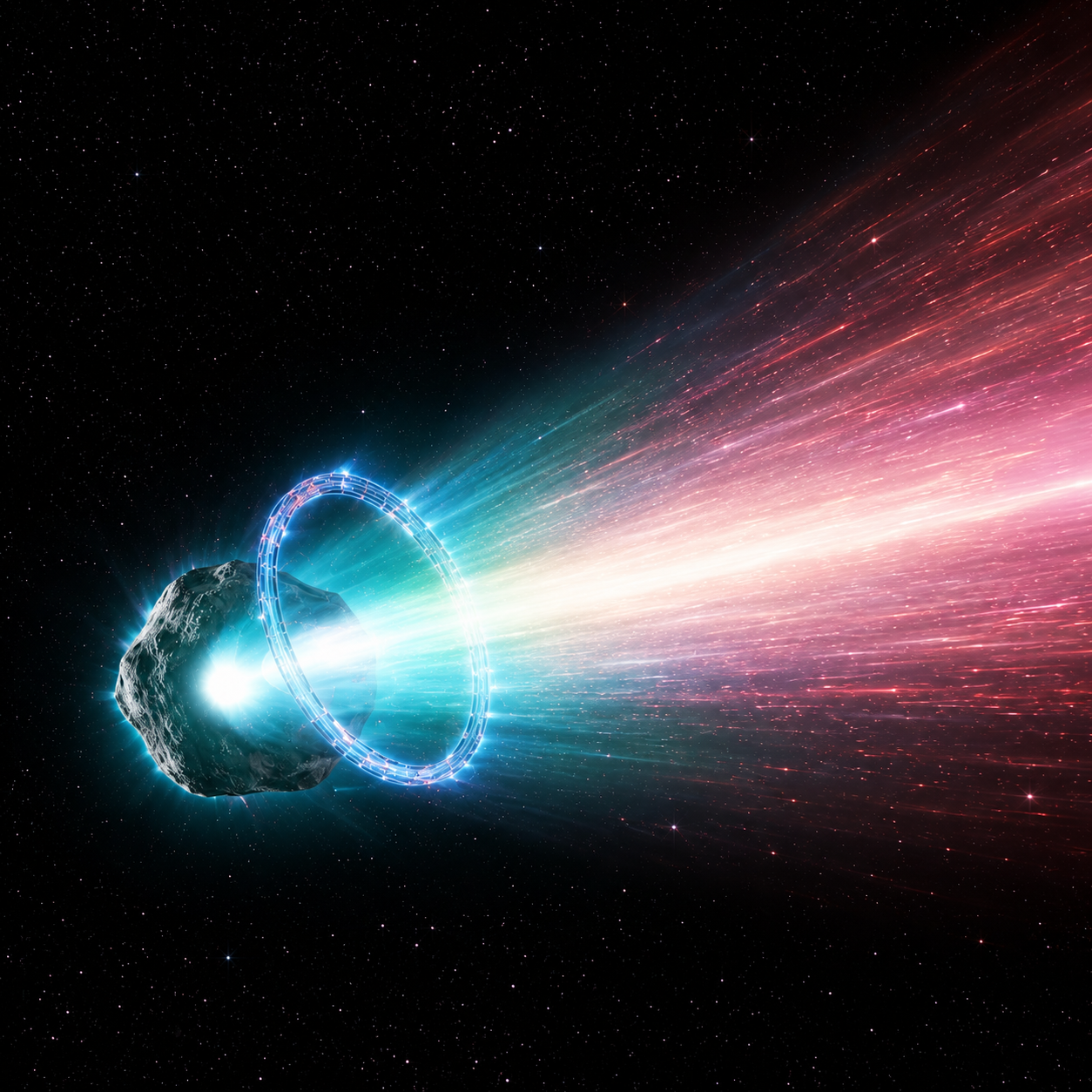
This composition transforms Nadeah into a natural laboratory for prebiotic chemistry and early molecular evolution.
As Nadeah approaches the Sun, its frozen surface begins to sublimate, generating a diffuse atmosphere known as the coma. From this coma emerge the comet’s characteristic tails, shaped by its interaction with solar radiation and the solar wind.
Dust Tail
- Curved
- Yellowish
- Composed of solid particles reflecting sunlight
Ion Tail
- Straight
- Bluish
- Formed by ionized molecules accelerated by solar magnetic fields
These structures are not merely visual phenomena.
They are dynamic manifestations of the interaction between matter, radiation, and magnetism across interplanetary space.
👉 Read more about Nadeah’s internal structure and atmospheric behavior in the complete Comet Nadeah article:
Orbit, Phases, and Cometary Tails

The orbit of Comet Nadeah does not merely define its physical behavior — it also shapes many of the key narrative events within Comet Surfer.
Nadeah follows a highly eccentric elliptical orbit that carries it from the distant outer Solar System into a close perihelion passage near the Sun.
These orbital phases are more than astronomical events.
They become narrative milestones that influence:
- scientific discoveries,
- mission planning,
- resource extraction,
- survival,
- and the critical decisions faced by the crew of the Comet Surfer.
Interactive Orbital Simulation
Explore the orbital trajectory of Nadeah in an interactive three-dimensional environment, including:
- its orbit,
- changing activity levels,
- tail development,
- and key moments within the Comet Surfer universe.
Interactive Orbital Comet Nadeah Viewer
Explore Comet Nadeah in an interactive three-dimensional environment, including its orbital trajectory and key moments from the Comet Surfer universe.
Orbital Phases:
Inactive Phase
Far from the Sun, the nucleus remains frozen and inactive.
Approach Phase
Increasing solar radiation activates volatile ices, initiating sublimation and coma formation.
Coma Formation
Gas and dust particles generate an extended diffuse atmosphere surrounding the nucleus.
Tail Development
Dust Tail
Curved and yellowish, driven primarily by solar radiation pressure.
Ion Tail
Straight and bluish, shaped by the solar magnetic field and charged particles.
Perihelion
The point of closest approach to the Sun, where the comet reaches maximum activity and may experience fragmentation or major structural alterations.
Departure and Cooling
As the comet moves away from the Sun, activity decreases and both the coma and tails gradually fade.
Learn More About Real Comets
If you would like to explore the fascinating world of real comets, the following resources provide excellent scientific information and educational tools:
- 🔗 The Comet Toolbox – Interactive simulations, visualizations, and educational comet resources.
- 🔗 NASA – Solar System Exploration: Comets – Official NASA scientific information and mission updates related to comets.
- 🔗 ESA – Comet Facts and Missions – European Space Agency resources covering cometary science, including the Rosetta mission and comet 67P.