
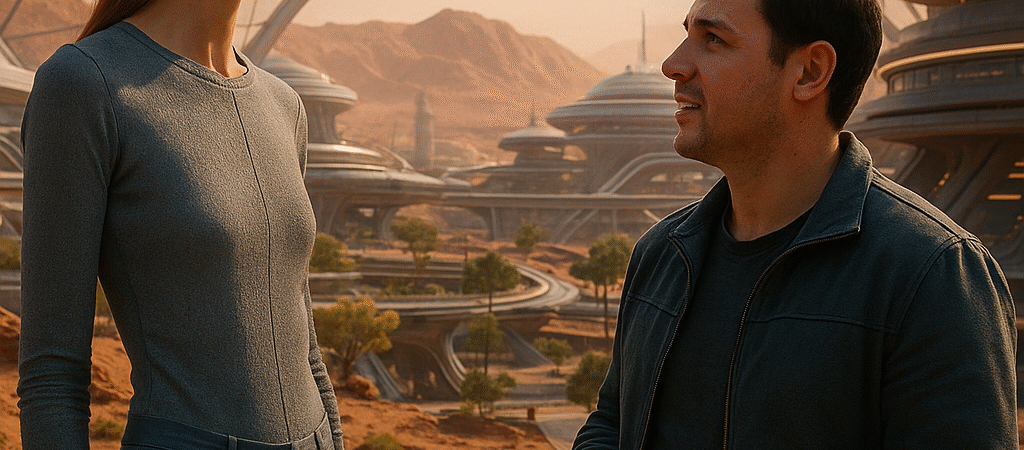
Human bodies born or raised on Mars do not remain identical to those shaped by Earth.
Mars has only approximately 38% of Earth’s gravity, and over time that difference becomes biological, cultural, and even emotional. Gravity is not merely a force that keeps bodies on the ground. It is a constant signal received by bones, muscles, organs, cells, and tissues throughout life.
In the Comet Surfer Universe, Martian anatomy and physiology reflect this central reality: humanity adapts to the worlds it inhabits.
The Second Cradle
Earth is humanity’s First Cradle. Mars becomes the Second.
On Earth, human development occurs under one full gravitational load. On Mars, the reduced load allows the body to grow differently. Martian-born humans tend to be taller, thinner, and more lightly muscled than Earth-born humans. Their skeletal systems experience less compression during growth, while their muscles and cardiovascular systems adapt to lower mechanical demand.
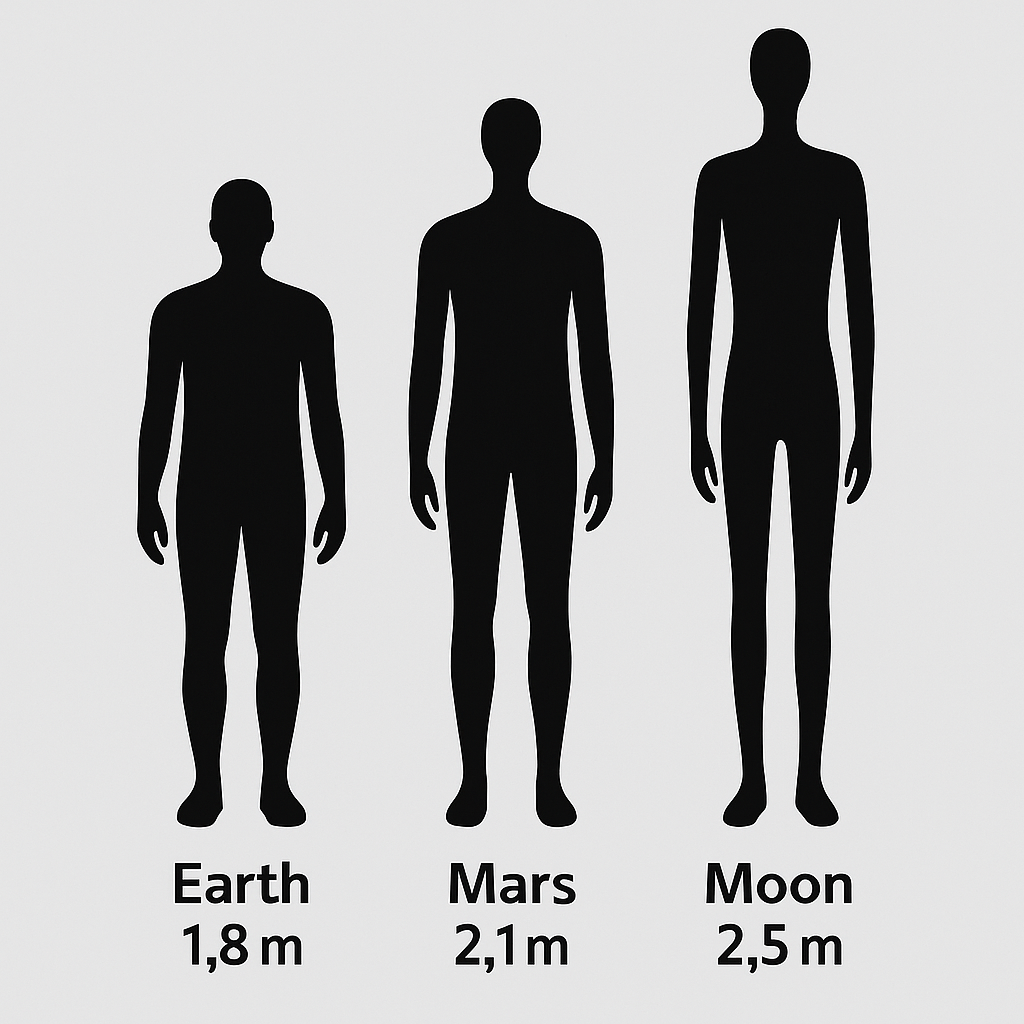
A person who might average approximately 1.80 meters on Earth could plausibly reach closer to 2.10 meters on Mars under long-term developmental conditions. On the Moon, where gravity is only about 0.16 g, even taller bodies might theoretically emerge, but extreme skeletal fragility would impose serious biological limits.
Martian physiology is therefore not a simple improvement or decline. It is a tradeoff.
Bones, Muscles, and Movement
In lower gravity, bones bear less weight. Over time, this can reduce bone density and alter skeletal development. Muscles also require less force to support posture and movement, leading to leaner body types and different patterns of strength.
Martians often move with:
- longer strides,
- lighter steps,
- broader gestures,
- reduced vertical compression,
- and greater ease in jumping or climbing.
To Earth-born visitors, Martian movement may appear elegant or exaggerated. To Martians, Earth-born movement can seem heavy, compressed, and inefficient.
The differences are not only visual. They affect architecture, furniture, transportation, sports, clothing, and workplace design.
Returning to Earth
One of the greatest medical challenges for Martian-born humans is travel to Earth.
Earth’s gravity places intense stress on bodies adapted to Mars. Bones, muscles, circulation, breathing, and organ support must all tolerate forces far greater than those experienced in daily Martian life.
For many Martians, visiting Earth requires extensive preparation through:
- resistance training,
- nutritional conditioning,
- cardiovascular monitoring,
- pressure-support garments,
- and controlled exposure to higher gravity environments.
Without careful adaptation, Earth can be physically dangerous.
This creates one of the most profound tensions in Martian civilization: humanity may share a common origin, but gravity begins to separate its branches.
Gravity as Biological Information
Cells respond to mechanical environments. They convert external physical signals into internal biochemical responses, affecting shape, growth, metabolism, and function.
In different gravity environments, these cellular responses can gradually influence:
- bone formation,
- muscle development,
- organ stress,
- fluid distribution,
- immune function,
- and tissue repair.
This is why gravity becomes one of the central biological themes of the Comet Surfer Universe. It shapes not only the body, but the future of human civilization.
Martian Medicine and Adaptation
Martian medicine develops around continuous adaptation.
Medical systems monitor:
- bone density,
- muscle mass,
- hydration,
- cardiovascular performance,
- mineral absorption,
- and metabolic efficiency.
Exercise is not optional. It is part of daily life. Schools, workplaces, homes, and transportation systems incorporate movement routines and biomechanical support. Athletic training becomes both recreation and preventive medicine.
Nutrition also evolves. Martian diets are designed to support bone and muscle maintenance while using local, sustainable protein sources such as Crickey, fish, shrimp, mushrooms, and frog meat.
Animals, Plants, and Food Systems
Reduced gravity affects more than humans.
Within the Comet Surfer Universe, Martian agriculture and animal husbandry also adapt to lower gravity and controlled ecological systems.
Plants may grow larger than their Earth counterparts:
- lettuce heads can become massive,
- corn stalks may grow unusually tall,
- and fruits or vegetables may develop altered shapes and textures.
Animals raised in Martian biodomes also differ. Bullfrogs, one of the colony’s important protein sources, can grow significantly larger than their terrestrial relatives under controlled humidity, nutrition, and gravity conditions.
These biological changes influence Martian cuisine, agriculture, economics, and culture.
The Role of Fictional Gravity Technologies
Because gravity is such a powerful biological force, Martian civilization eventually develops advanced fictional technologies designed to study, simulate, and manipulate gravitational effects.
Among these is the Variable Gravity Generator, or GGV, one of the major technologies developed within the Comet Surfer series. Its deeper theoretical foundation belongs to the fictional science of the novels and will be explored separately.
Within the broader story, technologies like the GGV represent more than engineering breakthroughs. They symbolize humanity’s effort to reconnect worlds whose inhabitants are slowly diverging under different gravitational conditions.
A New Human Condition
Mars does not create a new species, but it does create a new human condition.
Martians remain human, but their bodies reveal the world that shaped them. Their height, posture, movement, diets, sports, architecture, and medical systems all carry the signature of reduced gravity.
In this sense, Mars does not merely change where humanity lives.
It changes how humanity grows, moves, eats, heals, and imagines itself.
The future of humanity among the planets is not only technological.
- It is anatomical.
- It is physiological.
- It is cultural.
And above all, it is adaptive.