
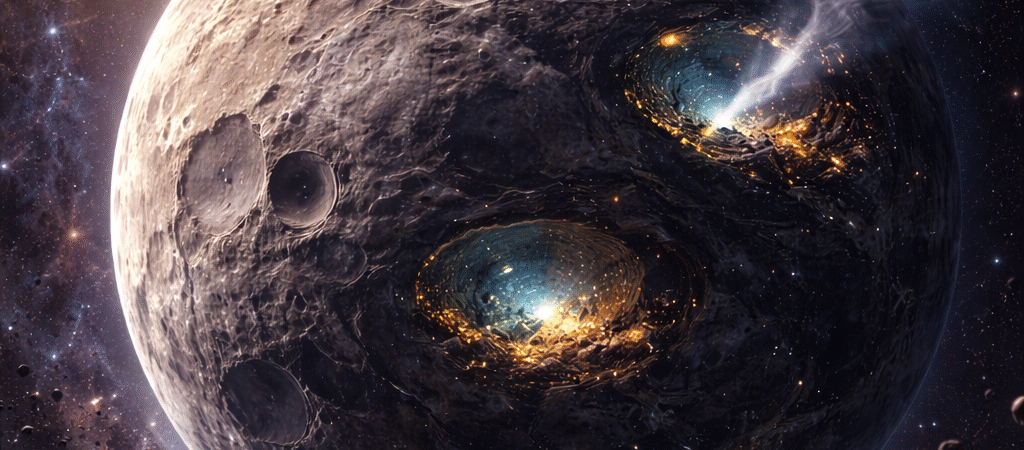
1. Astronomical & Physical Profile
Classification: Dwarf Planet (Main Asteroid Belt, between Mars and Jupiter)
Mean Radius: ~473 km
Mass: ~9.39 × 10²⁰ kg
Surface Gravity: ~0.27 m/s² (≈ 2.8% of Earth’s gravity)
Ceres is the largest body in the Asteroid Belt.
Physically, it is modest.
Civilizationally, it is indispensable.
Its gravity is weak, yet sufficient to retain volatiles and support long-term human habitation. More than any other object in the belt, Ceres demonstrated that permanence in deep space was possible.
2. Composition, Cryogeology, and Habitability
Ceres is composed primarily of water ice and hydrated minerals, including carbonates and clay-rich compounds.
Beneath its surface lies a long-lived subsurface ocean, maintained through radiogenic heating and insulated by thick layers of ice and rock.
Cryovolcanic activity—most notably at Ahuna Mons—has released mixtures of water, ammonia, and methane into the surrounding environment, occasionally producing a tenuous and temporary atmosphere.
Although Ceres is not the richest mining target in the belt, it is canonically regarded as the most habitable.
Its unique combination of:
- Abundant water
- Relative geological stability
- Moderate radiation exposure
- Strategic location
made it the natural center of civilization beyond Mars.
3. Constraints and Opportunities
Life on Ceres exists within clear limitations:
- Extremely low gravity
- No breathable atmosphere
- Complete dependence on closed-loop life-support systems
At the same time, Ceres offers extraordinary advantages:
- Vast water reserves for life support and propellant production
- Greater geological stability than most smaller asteroids
- A central orbital position linking the inner planets to the outer belt
These conditions shaped its destiny.
Ceres would not become a mine.
It would become a hub.
4. Strategic Role in the Asteroid Belt
Ceres functions as the:
- Administrative capital of the Asteroid Belt
- Cultural and educational center
- Manufacturing and logistics coordinator
- Diplomatic crossroads of interplanetary commerce
While extraction occurs elsewhere, refinement, regulation, arbitration, and coordination often occur on Ceres.
Rather than competing with mining settlements, Ceres organizes them.
It is where contracts are written.
Where disputes are resolved.
Where standards are established.
Ceres makes the belt governable.
5. Cities, Complexes, and Institutions (Canonical)
Demeter
Location: South Polar Region
Population: ~150,000
Demeter is the principal city of Ceres and the cultural heart of Belt society.
Originally established by the European Space Agency, it evolved into a vibrant cosmopolitan metropolis strongly influenced by South African and Filipino traditions.
Daily life in Demeter is multilingual, technologically sophisticated, and deeply interconnected.
Humanoid robots are integrated into:
- Commerce
- Infrastructure maintenance
- Transportation
- Public services
Recycling is not viewed as environmental virtue.
It is considered a doctrine of survival.
On Ceres, recycling is living.
Ahuna Mountain Complex (AMC)
Role: Belt-wide security and enforcement
As migration and commerce expanded throughout the Asteroid Belt, so did criminal activity.
The Ahuna Mountain Complex became the largest military and security installation in the belt, responsible for combating:
- Piracy
- Human trafficking
- Organized crime
- Systemic violence
Its creation marked a turning point in Belt history.
The Asteroid Belt was no longer a lawless frontier.
It had become a contested space where order required active maintenance.
Ceres Correctional Institute (CCI)
Role: Rehabilitation and detention
The CCI houses convicted pirates, smugglers, traffickers, and other offenders captured throughout the belt.
Its existence grants Ceres significant political influence, making detention and rehabilitation important elements of interplanetary diplomacy.
On Ceres, justice and stability are inseparable.
6. Human Presence and Lived Experience
Ceres is home to administrators, engineers, educators, researchers, entrepreneurs, and families whose work makes the broader Belt economy possible.
Unlike many asteroid settlements, daily life here feels permanent.
It is also a place of memory.
Within the Comet Surfer canon:
- Layia visited Ceres repeatedly as a child aboard the Solaria
- An important family celebration takes place in orbit around Ceres during the deployment of a solar sail
For many travelers, Ceres is the first place where the Asteroid Belt feels like a society rather than a collection of survival outposts.
7. Narrative Context (Spoiler-Free)
Ceres exists at the intersection of three powerful forces:
- The politics of the Inner Planets
- The economy of the Asteroid Belt
- The ethics of maintaining order far from Earth
It is neither utopian nor exploitative.
It is administrative, imperfect, and necessary.
Without Ceres, the Belt fragments.
Without the Belt, interplanetary civilization slows.
Ceres holds the system together.
8. Cultural Note
Ceres is not the wealthiest world in the Belt.
It is:
The Capital of the Belt — the place that taught humanity that survival in space is never merely a technical challenge.
It is always social.
Always legal.
Always moral.
And ultimately, always human.