
Astrobiological Pseudopersona & Extremophile Exosymbiont
1. Header & Core Identity
- Full Scientific Designation: Aurantifungus prochytridialis [114]
- Common Name / Alias: Auranchy, The Orange Gel, The Cosmic Sower’s Companion
- Classification: Pseudopersona / Protomycota / Extremophile Organotroph [114]
- Origin / Native Habitat: Carbon-ice sublimating boundary on Comet Nadeah [114]
- Primary Discoverers: Dr. Layia Chandra, Biyu Jiàn, and Peter Gorski [114]
- Key Researchers: Dr. Aarya Chandra, Dr. Layia Chandra, and Rahul Oliveira [114–117, 134–138]
2. Quick Facts
| Metric / Attribute | Specification |
|---|---|
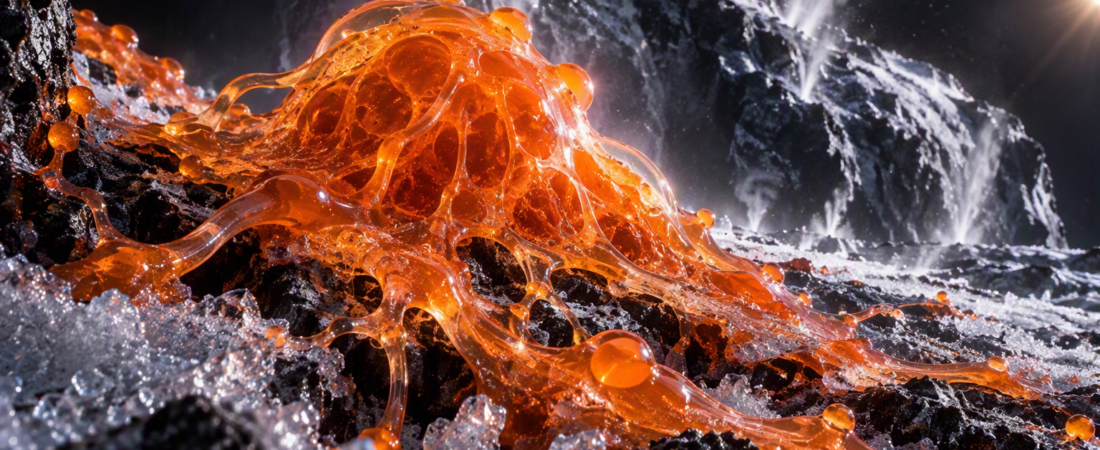
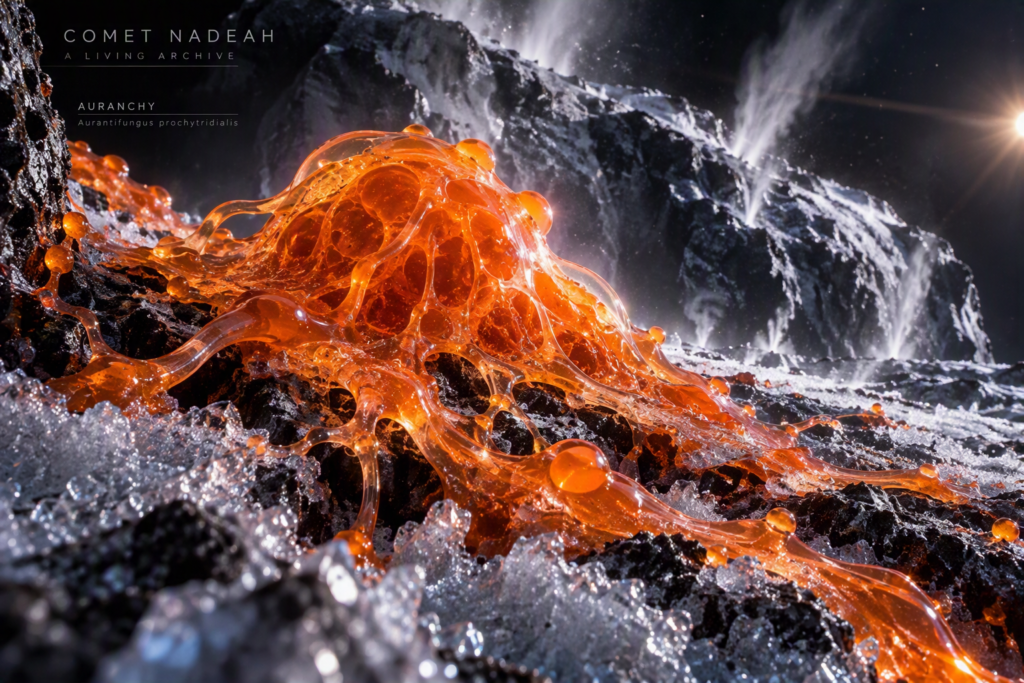
| Physical Appearance | Fluorescent orange, gelatinous mass oozing rhythmically along carbon-ice boundaries [114] |
| Cellular Structure | Chitin-reinforced cell walls, motile flagellated zoospores [114, 131] |
| Metabolic Strategy | Organotrophic (requires organic substrates and partner organisms) [114] |
| Key Ecological Role | Exosymbiont partner to Nitrosphera nadeahhensis (“Nina”) and Synechococcus martianus (“Synechy”) [114–117, 130–138] |
| Control Mechanism | Microencapsulated Bordeaux mixture (copper sulfate + calcium hydroxide) [138–140] |
3. Astrobiological Architecture: The Science of Aurantifungus prochytridialis
Discovery on Comet Nadeah
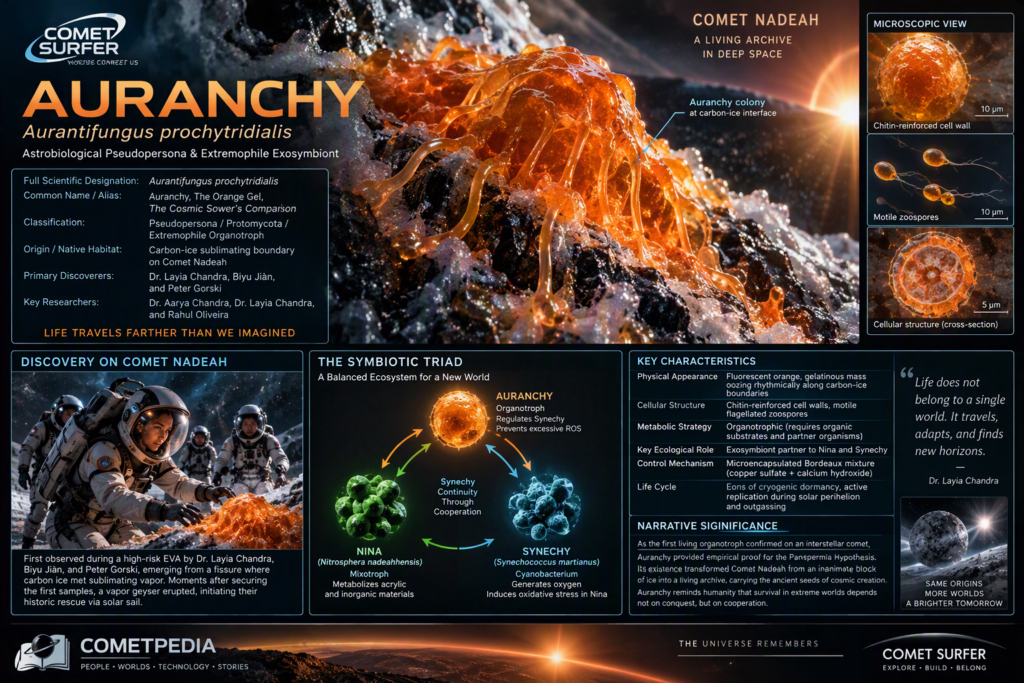
Auranchy was first observed during a high-risk extravehicular activity (EVA) on Comet Nadeah by Layia Chandra, Biyu Jiàn, and Peter Gorski [114]. Emerging from a rocky fissure where carbon ice met sublimating vapor, the organism manifested as a throbbing, fluorescent orange gelatinous mass interacting directly with an iridescent green slime (Nitrosphera nadeahhensis, or “Nina”) [114]. Moments after securing the first samples at this biological interface, a sudden vapor geyser erupted, hurling the three astronauts into space and initiating their historic rescue via solar sail.
Morphology & Biochemistry
Classified by Layia as Aurantifungus prochytridialis, Auranchy exhibits primitive fungal traits reminiscent of Earth’s terrestrial chytrids (Protomycota) [114]:
- Structural Composition: Features chitin in its cell walls and produces motile, flagellum-propelled zoospores [114, 131].
- Life Cycle: Evolved for deep-space opportunism—enduring eons of cryogenic dormancy on comet surfaces before brief bursts of active replication during solar perihelion and outgassing [114].
- Trophic Strategy: Unlike its mixotrophic counterpart Nina (which can extract electrons directly from inorganic materials and synthetic polymers like acrylic), Auranchy is an organotroph—relying on organic compounds and symbiotic signaling from other living systems [114].
4. Symbiosis & The Defense of Mars
The Nina–Auranchy–Synechy Triad
When Nina unexpectedly proliferated across Mars—metabolizing the acrylic seals of geodesic domes and threatening the planet’s agricultural water systems—Dr. Aarya Chandra and Dr. Layia Chandra discovered that Auranchy was the key to stabilizing the outbreak [114–118, 130–138].
Rather than attempting total biological annihilation, Aarya introduced Synechococcus martianus (“Synechy”)—a hardened Terran cyanobacterium adapted for Martian UV conditions—into the culture [128–130]. Auranchy internalized Synechy into an exosymbiotic partnership [130–134]:
- Oxygen Regulation: Synechy generates localized oxygen, which induces oxidative stress in Nina [131–132].
- ROS Dampening: Auranchy regulates Synechy’s activity, preventing excessive Reactive Oxygen Species (ROS) accumulation from destroying the surrounding ecosystem [131–132, 138].
- Targeted Management: This tripartite balance makes the biofilm vulnerable to low-dose, microencapsulated Bordeaux mixture (copper sulfate and calcium hydroxide), allowing autonomous cleaning drones to clear contaminated dome surfaces without damaging underlying infrastructure [138–142].
5. Philosophical & Sociopolitical Impact
Proof of Panspermia
As the first living organotroph confirmed on an interstellar comet, Auranchy provided undeniable empirical proof for the Panspermia Hypothesis [263–265]. Its existence transformed Comet Nadeah in the public imagination from an inanimate block of 500-billion-ton ice into a “Living Archive” carrying the ancient seeds of cosmic creation [268–269].
Continuity Through Cooperation (Synechy)
During emergency debates before the Planetary Bioethics Commission and the Mars Terraforming Organization (MTO), political leaders initially feared Auranchy was an uncontrolled alien vector [116, 134–136]. However, the successful deployment of the Auranchy–Synechy system demonstrated a core Martian tenet: that survival in extreme worlds depends not on conquest or eradication, but on synechy—continuity through cooperation [133–138].
6. Behind the Science & Real-World Inspirations
Fictional Nature of the Taxon
While grounded in real biological principles, Aurantifungus prochytridialis (“Auranchy”) and its partner Nitrosphera nadeahhensis (“Nina”) are fictional extraterrestrial organisms created for the Comet Surfer Saga [100, 114–117]. They function as an exploration of exobiology, evolutionary trade-offs, and planetary bioethics.
Real-World Scientific Inspirations
- Chytridiomycota (Chytrid Fungi): Auranchy’s chitinous cell walls and flagellated, motile zoospores are inspired by Earth’s primitive chytrids—one of the earliest lineage of fungi, renowned for their motile swimming spores and environmental persistence [114, 131].
- Extreme-Environment Cyanobacteria: The symbiotic partner Synechococcus martianus (“Synechy”) is modeled after real-world cyanobacteria found in high-altitude Andean lakes, where microbes adapt to intense UV radiation, low atmospheric pressure, and extreme cold [111–112].
- Polymer Biodegradation: Nina’s ability to digest acrylic (methyl methacrylate) reflects ongoing scientific research into plastic-metabolizing microbes (such as Ideonella sakaiensis and acrylic-degrading fungal strains).
- Traditional & Nanotech Chemistry: The deployment of Bordeaux mixture (copper sulfate and calcium hydroxide)—a traditional agricultural fungicide created in 1885—is reimagined as microencapsulated, drone-dispersed nanoparticles designed for precision ecosystem maintenance [122–123, 138–140].
The Panspermia Hypothesis in Science vs. Fiction
- Scientific Foundation: Originally advocated by scientists including Svante Arrhenius, Fred Hoyle, and Chandra Wickramasinghe, the Panspermia Hypothesis posits that organic precursor molecules, extremophilic microbes, or amino acids are transported throughout space via comets and asteroids.
- Narrative Integration: In the Comet Surfer Saga, Comet Nadeah acts as empirical proof of Panspermia [263–265]. The discovery shifts human consciousness: rather than treating space as a void to conquer, humanity realizes that life across the cosmos shares an interconnected web of origin.