
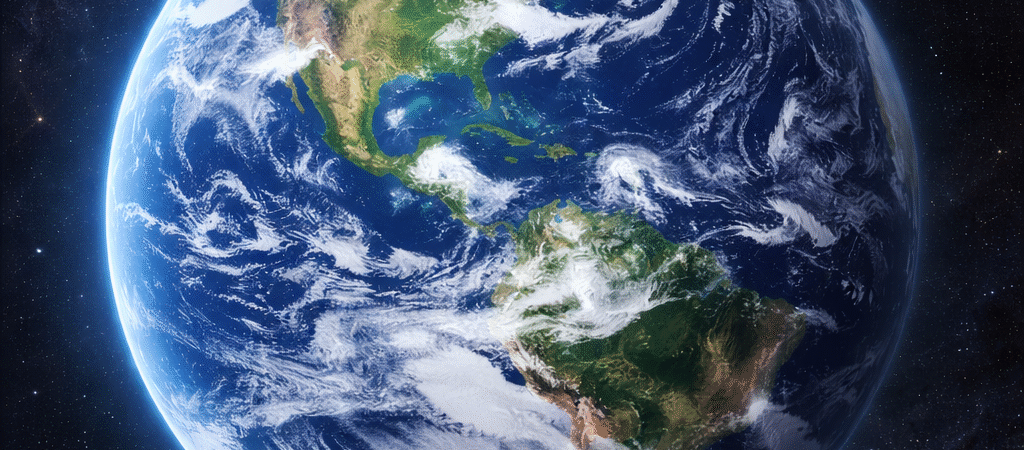
1. Astronomical & Physical Profile
Classification: Terrestrial Planet
Mean Radius: 6,371 km
Mass: 5.972 × 10²⁴ kg
Surface Gravity: 9.81 m/s²
Mean Density: 5.51 g/cm³
Axial Tilt: 23.44°
Rotation Period (Sidereal Day): 23 h 56 m 4 s
Orbital Period (Sidereal Year): 365.25 days
Earth’s stable rotation, moderate axial tilt, and protective magnetosphere created the narrow window within which complex life—and eventually technological civilization—could emerge.
For billions of years, Earth was humanity’s only home.
For centuries afterward, it remained humanity’s reference point for everything that followed.
2. Atmosphere and Environmental Conditions
Atmospheric Composition (21st–22nd Century Baseline)
- Nitrogen (~78%)
- Oxygen (~21%)
- Argon (~0.9%)
- Carbon dioxide, water vapor, and trace gases
For much of human history, Earth’s atmosphere appeared inexhaustible.
By the late twenty-first century, it became clear that it was not.
Climate instability, sea-level rise, and ecological degradation transformed both landscapes and political priorities across the globe.
Environmental management evolved from conservation, to damage control, and eventually to planetary-scale adaptation.
Earth remained habitable.
But it was no longer taken for granted.
3. Hydrosphere and Biosphere
Earth is defined by the presence of liquid water.
Its oceans, rivers, glaciers, and precipitation systems regulate climate and sustain the most diverse biosphere known to humanity.
By the time large-scale off-world migration began:
- Coastal megacities required extensive flood-protection infrastructure
- Freshwater scarcity became a major geopolitical concern
- Biodiversity loss accelerated despite preservation efforts
Earth remained biologically rich.
Yet it had become increasingly fragile.
Its greatest strength—and greatest vulnerability—was the complexity of the life it supported.
4. Political and Civilizational Context
During the mid-twenty-first century, Earth entered an era of unprecedented political centralization.
The One World Organization (OWO) emerged as the dominant planetary governing body.
Its authority extended across:
- Climate policy
- Space access
- Economic coordination
- Global security
The OWO maintained order through a combination of regulation, surveillance, and narrative control.
Supporters viewed it as a necessary steward of a crowded and increasingly vulnerable world.
Critics argued that it often prioritized stability over innovation and preservation over renewal.
The debate would shape humanity’s relationship with the colonies for generations.
5. Major Cities of Earth (Narrative Anchors)
New York
Role: Political, cultural, and institutional capital
By the early twenty-second century, New York had become a model of climate-resilient urbanism.
Protected by vast flood-control systems and redesigned around sustainable infrastructure, it housed the headquarters of the OWO and served as the symbolic center of planetary governance.
Despite its technological sophistication, New York embodied many of the contradictions of late-Earth civilization:
Resilience accompanied by rigidity.
Shenzhen
Role: Technological innovation and applied research
Shenzhen continued its evolution as a global center of engineering, manufacturing, and AI-driven development.
Its culture emphasized:
- Speed
- Efficiency
- Measurable results
Many of the scientists and engineers who later transformed Mars, the Asteroid Belt, and the outer Solar System received their education and training here.
Institutions such as SIAT became legendary throughout the colonies.
Kolkata
Role: Cultural continuity and diasporic anchor
Kolkata remained a bridge between tradition and modernity.
For many off-world families, it served as a cultural and spiritual reference point—proof that identity could endure even as geography changed.
Its influence extended far beyond Earth, shaping communities on Mars, Luna, and throughout the Solar System.
Sydney
Role: Cosmopolitan connector
Sydney functioned as a social and logistical bridge between cultures.
Its comparatively open and relaxed social ethos contrasted with more centralized societies, making it a formative influence on several future interplanetary leaders, explorers, and innovators.
6. Earth and Mars: A Divergence
Earth and Mars share a common origin.
Their philosophies evolved differently.
Earth prioritized:
- Control
- Regulation
- Preservation of existing systems
Mars prioritized:
- Adaptation
- Experimentation
- Negotiated coexistence
Where Earth sought to prevent further loss, Mars increasingly accepted risk in pursuit of renewal.
Neither path was entirely right.
Neither was entirely wrong.
Together they defined one of the great political and philosophical tensions of the interplanetary age.
7. Narrative Context (Spoiler-Free)
Earth is the world humanity loved first—and struggled most to leave behind.
It is the source of:
- The political pressures that fueled Martian autonomy
- Ethical debates surrounding terraforming
- Institutional resistance to radical planetary transformation
Many characters carry Earth with them long after departure.
In memories.
In loyalties.
In grief.
In hope.
8. Cultural Note
Earth is not a failed world.
It is:
The First Cradle — the planet that taught humanity how to live and, through its limitations, why it eventually had to learn how to depart.