
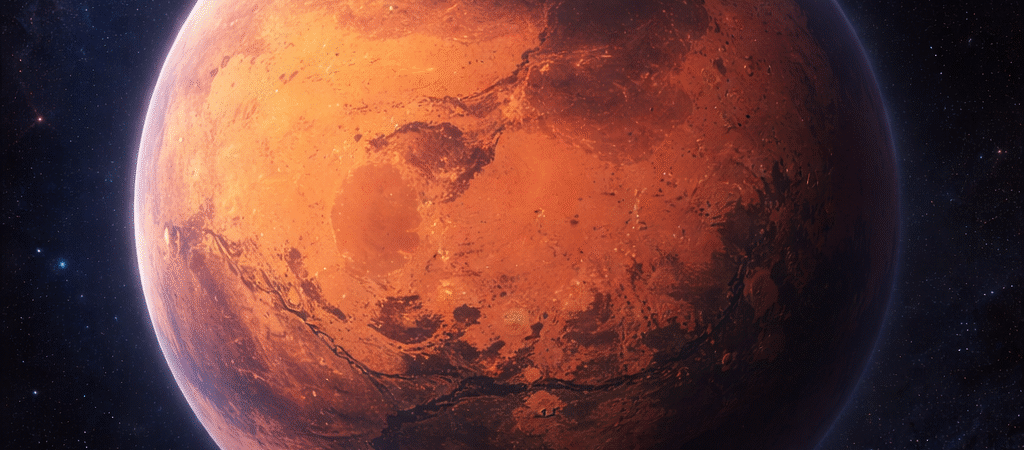
1. Astronomical & Physical Profile
Classification: Terrestrial Planet
Mean Radius: 3,389.5 km
Mass: 6.417 × 10²³ kg
Surface Gravity: 3.71 m/s² (≈ 38% of Earth’s gravity)
Mean Density: 3.93 g/cm³
Axial Tilt: 25.19°
Rotation Period (Sidereal Day / Sol): 24 h 39 m 35 s
Orbital Period (Sidereal Year): 687 Earth days (≈ 668.6 sols)
Mars is the fourth planet from the Sun and the first world beyond Earth to sustain a permanent human civilization.
Its axial tilt is remarkably similar to Earth’s, producing seasonal cycles that are broadly familiar yet significantly longer and more pronounced. Spring, summer, autumn, and winter unfold across nearly twice the duration experienced on Earth, creating environmental rhythms that profoundly shaped the development of Martian society.
These seasonal patterns became essential to:
- Agricultural planning
- Energy production
- Water management
- Transportation systems
- Cultural celebrations and calendars
The Martian year eventually became the foundation for the Martian Calendar, a civilizational framework that helped transform a frontier settlement into a distinct planetary culture.
Unlike Earth, Mars possesses a thinner atmosphere, reduced gravity, and greater environmental variability. These conditions influenced not only the engineering of habitats and life-support systems, but also the physiology, psychology, and identity of those born beneath its salmon-colored skies.
For early settlers, Mars was a hostile destination.
For later generations, it became home.
And for those born there, it was never anything else.
2. Atmosphere and Environmental Conditions
Atmospheric Composition (Canonical, Post-Settlement)
- Carbon dioxide (dominant)
- Nitrogen
- Argon
- Trace oxygen
- Variable water vapor
Surface Pressure
Natural baseline: ~6–7 mbar
Locally elevated within domes, corridors, habitats, and controlled ecological zones
Mars is not a world where breathable air can be taken for granted.
Every habitable environment is engineered, regulated, and ethically managed. Beyond protected zones, survival depends on biosuits and strict adherence to environmental protocols.
Life on Mars is not sustained by nature alone—it is sustained by responsibility.
3. Moons of Mars
Phobos
- Low-orbit, rapidly moving moon
- Gradually decaying orbit
- Historically used for observation platforms, defensive systems, and early tethering experiments
Deimos
- Smaller, more distant, and dynamically stable
- Functions as a navigation and communications relay
- Symbol of continuity and balance
Together, Phobos and Deimos are known as The Witnesses:
One falling inward.
The other keeping its distance.
4. Major Geographic Features
Olympus Mons
The largest volcano in the Solar System.
Its immense scale dominates the Tharsis region and shaped generations of settlement planning, transportation networks, and scientific exploration.
Valles Marineris
A planetary-scale canyon system.
Its depth and complexity influenced underground construction techniques and became a natural laboratory for geological and environmental research.
Hellas Basin
One of the deepest known impact basins in the Solar System.
Its lower elevation and unique atmospheric conditions made it attractive for major human settlements.
Elysium Planitia
A broad volcanic plain associated with early robotic infrastructure and later expansion efforts.
These regions determined where humanity could safely build—and where it learned the importance of restraint.
5. Martian Cities (Canonical)
Nova Recife
Founded: February 10, 2041 (10 Apus, Mir 229)
Origin: Brazilian Center for Martian Colonization (CBCM)
Nova Recife became the first permanent human city on Mars.
What began as a bold technological and political experiment evolved into the demographic, cultural, and emotional birthplace of Martian civilization.
Early industries focused on:
- Chemistry
- Food production
- Education
- Life-support systems
Many of the most influential figures in Martian history were born here, making Nova Recife synonymous with first-generation Martian identity.
Saint Maroun
Location: Rim of Hellas Basin
Origin: Syrian Christian refugee community
Saint Maroun grew into one of Mars’ most influential cities.
It became a center for:
- Energy production
- Advanced materials
- Textiles
- Higher education
- Planetary governance
The University of Saint Maroun and the nearby council chambers placed the city at the center of Martian political life.
Many of the most important debates concerning:
- Human rights
- Planetary rights
- Interplanetary ethics
originated here.
Kopernika
Location: Terra Sirenum, near Copernicus Crater
Origin: Polish settlement
Kopernika is an industrial city forged by necessity.
Its specialties include:
- Heavy machinery
- Water extraction
- Pumping systems
- Critical treatment infrastructure
Life here is demanding, technically disciplined, and socially intense.
Much of Mars depends upon systems designed and maintained in Kopernika, making it one of the quiet engines of planetary survival.
Huǒ Xīng (火星)
Location: Southeastern flank of Olympus Mons
Primary Role: Agricultural, ecological, and bioengineering capital
Huǒ Xīng is often described as a living city.
Its vast network of pressurized glass domes and greenhouse complexes stretches across the gentle slopes of Olympus Mons, sustaining Mars through highly efficient closed-loop ecosystems.
Agricultural domes operate at reduced pressure with elevated carbon dioxide and humidity levels optimized for photosynthesis and structural efficiency.
Within these systems coexist:
- Rice paddies
- Aquaculture facilities
- Amphibian habitats
- Insect protein farms
- Genetically optimized crops
The Agricultural University of Huǒ Xīng is a leading center for genetic engineering and exobiology, educating generations of Martian scientists.
Culturally, Huǒ Xīng embodies a distinctly post-terrestrial identity.
Many residents refer to themselves as wài xīng rén—people of the outer world.
Several pivotal scientific and political developments unfolded here in the years preceding the Nadeah Mission, making Huǒ Xīng a focal point of both hope and vulnerability.
6. Human Presence and Martian Identity
Canonical Definition of a Martian
A Martian is:
Any individual born on Mars, or any person who has permanently committed to living on and sustaining life on the planet, regardless of Earth citizenship.
Martian identity is shaped by:
- Reduced gravity
- Engineered environments
- Interdependence
- Long-term planetary thinking
Being born on Mars is not incidental.
It influences physiology, psychology, culture, and worldview.
7. Narrative Context (Spoiler-Free)
Mars represents humanity’s first successful experiment in planetary coexistence.
It is where:
- Assumptions inherited from Earth were challenged
- New legal systems emerged
- Humans, artificial intelligences, and planetary infrastructures began negotiating shared futures
Many of the defining events of the Comet Surfer saga take place on Mars.
Each leaves the planet transformed—not through conquest, but through consequence.
8. Cultural Note
Mars is no longer simply the Red Planet.
It is:
The Second Cradle — the world that taught humanity how to remain, adapt, and belong without erasing where it came from.
9. The Science Behind the Story
Mars is more than the setting of the Comet Surfer saga. It is a real world that scientists and engineers hope humanity may one day call home.
From its giant volcanoes and ancient river valleys to its thin atmosphere and polar ice caps, many of the locations featured throughout the novels are inspired by actual Martian geography.
👉 Visit: Mars to explore the planet’s geology, climate, gravity, moons, and scientific history.