
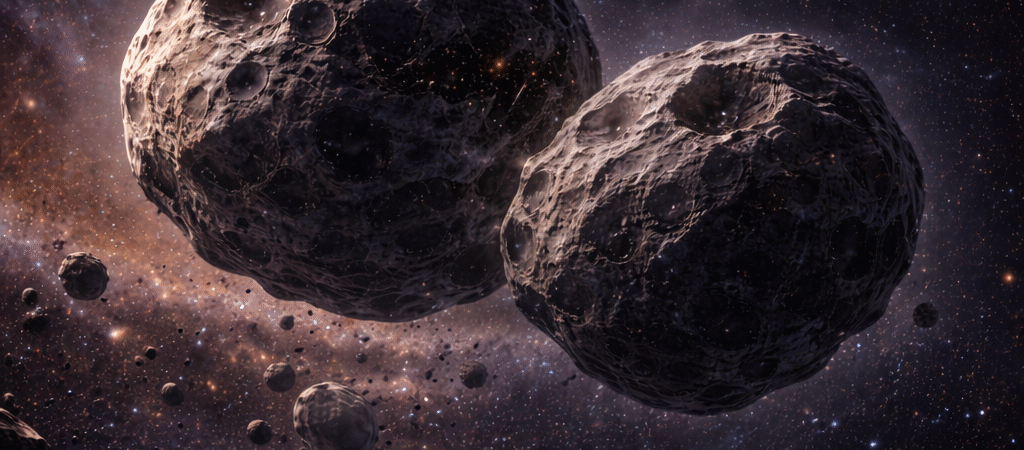
“Some worlds are connected by gravity. Others are connected by destiny.”
Far beyond the Main Asteroid Belt, trailing Jupiter along its immense journey around the Sun, lies one of the most fascinating binary systems in the Solar System: Patroclus and Menoetius.
Unlike most asteroids, these two bodies orbit one another in a celestial dance that has endured for billions of years. Together they belong to Jupiter’s Trojan Camp, a vast population of asteroids occupying stable gravitational regions known as Lagrange points. Patroclus and Menoetius reside in the L5 region, sixty degrees behind Jupiter in its orbit, where gravity and motion combine to create a remarkable zone of stability.
In the universe of Comet Surfer, that stability made them something even more valuable:
A fortress.
A Rare Binary World
Patroclus and Menoetius are among the largest known Jupiter Trojans and one of the few binary systems where both components are similar in size.
Patroclus measures approximately 113 kilometers in diameter, while Menoetius is slightly smaller at around 104 kilometers. The two bodies orbit a common center of mass separated by roughly 680 kilometers.
Scientists believe they contain significant amounts of water ice mixed with dark organic-rich material. Their low density suggests that much of their interior may consist of porous ice and primitive Solar System material preserved since the earliest days of planetary formation.
For planetary scientists, they are time capsules.
For settlers, they are resources waiting to be transformed.
The Gateway to the Trojan Frontier
The Trojan populations represent one of the Solar System’s great untapped frontiers.
Rich in carbon compounds, volatiles, and water ice, these bodies provide many of the ingredients necessary for long-term human expansion beyond the Main Belt.
The distance from major population centers has historically limited development. Yet those same distances also provide advantages. The Trojans are far from Earth’s political influence, beyond most routine commercial routes, and ideally positioned for deep-space operations.
In many ways, the Trojan Camps became the equivalent of the great frontier territories of earlier centuries: remote, resource-rich, and difficult to govern.
Patroclus and Menoetius stand at the heart of that frontier.
The Twin Citadels
By the early twenty-second century, human settlements transformed both asteroids into a thriving enclave.
Mining tunnels penetrated deep into the rock. Colonial ships were permanently anchored to the surface. Rotating habitats, industrial facilities, communications arrays, and sensor networks turned the binary system into one of the most heavily developed Trojan settlements.
Because the two asteroids orbit one another, infrastructure naturally evolved around their shared center of mass. Cargo traffic, maintenance stations, and transportation hubs connected the pair into what many residents simply called The Twins.
From a distance, the settlement appeared as two illuminated worlds suspended in perpetual motion around one another.
A civilization balanced between two rocks.
Capital of the Black Belt
Not all frontiers remain peaceful.
In The Rings of Mars, Patroclus and Menoetius become the principal stronghold of Bilan’s Black Belt Confederation, a loose alliance of pirates, smugglers, dissidents, and independent settlements operating beyond the reach of traditional governments.
Protected by vast sensor networks, hidden approaches, fortified mining complexes, and a growing fleet, the binary system evolved into one of the most formidable enclaves in the outer Solar System.
The isolation that once attracted miners and entrepreneurs also attracted those seeking freedom from regulation—or opportunities outside the law.
Within the caverns of Patroclus and the stations of Menoetius, political movements were born, fortunes were made, and wars were planned.
The Twin Citadels became both sanctuary and threat, depending on who was telling the story.
Names from an Ancient War
The asteroids are named after Patroclus and Menoetius, figures from Greek mythology associated with the Trojan War.
Patroclus was the beloved companion of Achilles, whose death altered the course of the conflict. Menoetius was Patroclus’s father.
Their names are fitting.
Just as the heroes of myth were bound by loyalty, family, and destiny, these two worlds remain forever linked by gravity. Neither can be fully understood without the other.
Separated by hundreds of kilometers.
United for billions of years.
Why Patroclus and Menoetius Matter
In the Comet Surfer universe, Patroclus and Menoetius represent more than a pair of asteroids.
They symbolize a recurring question that appears throughout human history:
What happens when people move beyond the reach of established institutions?
For some, the answer is freedom.
For others, chaos.
For still others, opportunity.
The Twin Citadels stand at the intersection of all three.
They are a reminder that the Solar System is not merely a collection of worlds. It is a collection of choices—and every frontier eventually becomes a test of what kind of civilization humanity wishes to build.
Quick Facts
Type: Binary Jupiter Trojan Asteroid System
Location: Jupiter Trojan Camp (L5 Lagrange Region)
Primary Bodies: Patroclus and Menoetius
Average Separation: ~680 km
Composition: Ice, silicates, carbon-rich organic material
Role in Comet Surfer: Major Trojan settlement and headquarters of the Black Belt Confederation during The Rings of Mars
Known For: Twin asteroid architecture, frontier culture, strategic importance, and deep-space commerce