
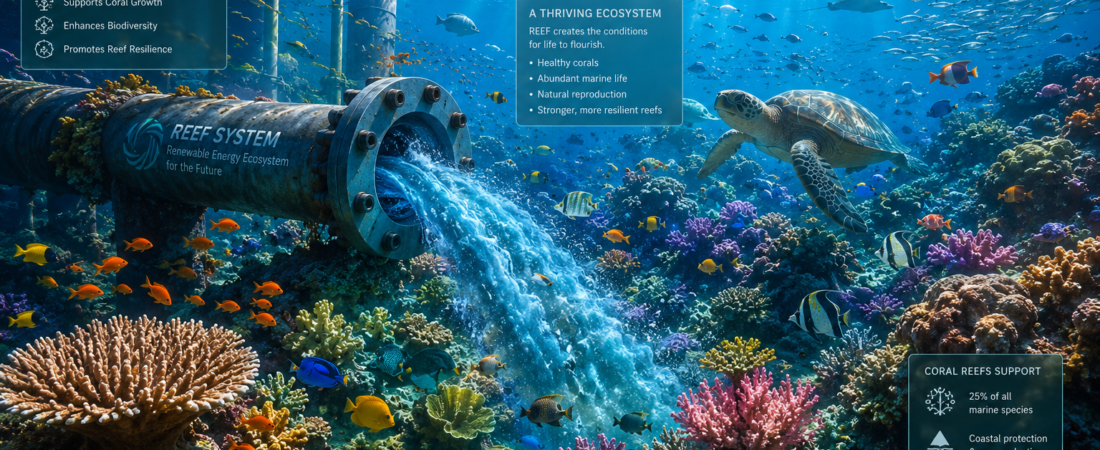
In the Comet Surfer universe, humanity’s expansion into the Solar System begins with a deeper lesson learned on Earth: before we could reshape other worlds, we first had to learn how to protect our own.
One of the most ambitious environmental initiatives of the twenty-second century is the Renewable Energy Ecosystem for the Future, known simply as REEF.
Located along the Australian Great Barrier Reef, REEF combines renewable energy, marine engineering, ecological restoration, and planetary stewardship into a single coordinated system designed to protect coral ecosystems from the growing threat of ocean warming.
Why Coral Reefs Matter
Coral reefs are among the most important ecosystems on Earth.
Although they occupy only a small fraction of the ocean, they support an extraordinary diversity of marine life. Fish, crustaceans, mollusks, turtles, sharks, rays, and countless smaller organisms depend on reefs for food, shelter, reproduction, and protection.
For many species, coral reefs function as nurseries. Young fish and invertebrates grow among the complex branches, cavities, and surfaces of the reef, shielded from predators until they are mature enough to move into open waters.
Reefs also protect coastlines by reducing wave energy, buffering storms, supporting fisheries, sustaining tourism, and preserving the biological richness of the oceans.
When reefs collapse, the consequences do not remain local. Entire marine food webs are weakened.
Corals: Extraordinary Symbiotic Beings
Corals are not rocks, although they build structures that can last for centuries.
They are living animals.
Each coral colony is made of thousands of tiny polyps that secrete calcium carbonate skeletons. Over time, these skeletons accumulate into the vast reef structures visible from space.
But corals are also partnerships.
Inside their tissues live microscopic algae called zooxanthellae. These algae use sunlight to perform photosynthesis, producing nutrients that help feed the coral. In return, the coral provides the algae with shelter and access to sunlight.
This symbiosis is one of nature’s most elegant collaborations: animal, plant-like algae, sunlight, minerals, and seawater working together to build living architecture.
What Is Coral Bleaching?
Coral bleaching occurs when corals become stressed and expel their symbiotic algae.
Without these algae, the coral’s transparent tissue reveals the white calcium carbonate skeleton beneath. This is why stressed reefs appear “bleached.”
Bleached corals are not always dead, but they are weakened. If stressful conditions persist, they may starve, become more vulnerable to disease, and eventually die.
Many factors can contribute to bleaching, including pollution, sediment, changes in salinity, disease, and physical damage. However, the primary driver of mass bleaching events is elevated sea temperature.
As oceans warm, reefs experience more frequent and intense thermal stress. When high temperatures persist for days or weeks, coral ecosystems can suffer widespread bleaching and mortality.
The REEF Concept
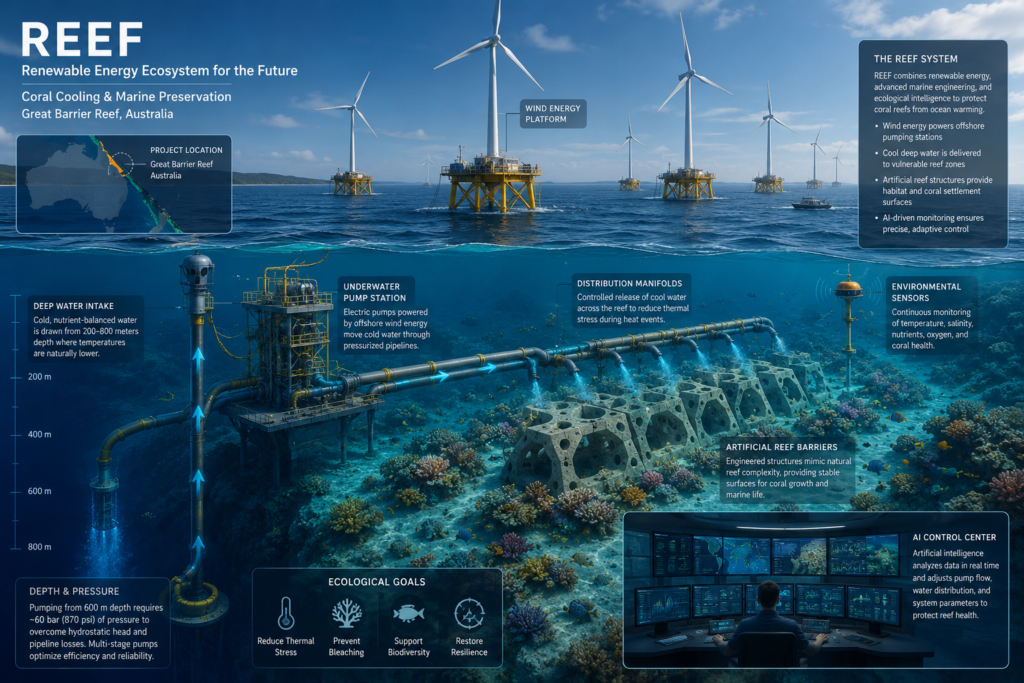
REEF was designed to reduce thermal stress in vulnerable coral systems.
The project combines three major components:
- Artificial reef structures
- Deep-water cooling pipelines
- Wind-powered underwater pumping stations
Large seawater-concrete structures are placed along damaged or vulnerable reef zones. These structures mimic the contours and complexity of natural reef formations, creating surfaces where corals can anchor, grow, and form new colonies.
From offshore wind-energy platforms, underwater pipelines extend into deeper ocean layers where the water is naturally cooler. Pumping stations then move controlled amounts of this cooler water upward toward the reef during periods of dangerous heat stress.
The goal is not to replace the natural reef.
The goal is to help the reef survive long enough to recover.
Cooling the Reef Without Damaging It
REEF does not simply flood coral ecosystems with cold water.
That would be dangerous.
Corals are adapted to specific temperature ranges, and rapid or excessive cooling could create a new form of stress. The system must therefore operate with precision.
Temperature sensors, current monitors, salinity probes, nutrient sensors, and AI-controlled flow systems regulate when, where, and how much deep water is delivered.
The cooling effect must be gentle enough to reduce heat stress without shocking the coral.
Another concern is nutrient balance.
Deep ocean water can contain higher concentrations of nutrients than surface water. If too many nutrients are brought upward, they could promote algal blooms, reduce water clarity, and contribute to eutrophication. That would harm the reef rather than protect it.
For that reason, REEF includes continuous ecological monitoring. The system tracks:
- Water temperature
- Nutrient concentration
- Oxygen levels
- Salinity
- Turbidity
- Algal growth
- Coral stress markers
- Fish and invertebrate activity
REEF is not a brute-force intervention. It is a carefully managed ecological support system.
Renewable Energy at Sea
The pumping stations are powered by offshore wind.
This is essential to the philosophy of the project.
A coral-preservation system that depends on fossil fuels would contradict its own purpose. By using wind energy, REEF operates with minimal carbon emissions while taking advantage of one of the most abundant energy sources available over the ocean.
The wind platforms generate electricity that powers underwater pumps, environmental sensors, control systems, communication nodes, and maintenance drones.
Because seawater is heavy, moving large volumes from depth requires substantial pressure. The deeper the intake point, the more energy is needed to overcome the hydraulic resistance of long pipelines, friction losses, and vertical lift.
REEF solves this through distributed pumping.
Rather than relying on a single massive station, the system uses multiple staged pumps along the pipeline network. Each pump contributes part of the required pressure, making the system more efficient, more resilient, and easier to control.
If one section fails, other sections can continue operating at reduced capacity.
A Living Infrastructure
REEF is not merely an engineering project.
It is a living infrastructure.
Its artificial structures become colonized by corals, sponges, mollusks, algae, fish, and microorganisms. Over time, the distinction between engineered reef and natural reef begins to blur.
The project supports coral restoration by providing stable surfaces for larval settlement, protecting young colonies from rubble movement, and reducing the thermal stress that would otherwise prevent recovery.
In the Comet Surfer universe, REEF becomes one of the first great symbols of planetary stewardship: a project built not to dominate nature, but to cooperate with it.
Why REEF Matters
The importance of REEF extends beyond the Great Barrier Reef.
It represents a change in civilization’s relationship with Earth.
For centuries, humanity extracted from ecosystems faster than they could recover. By the twenty-second century, the survival of civilization required a different philosophy.
REEF embodies that transformation.
It combines renewable energy, ecological intelligence, artificial structures, ocean monitoring, and adaptive control into a system designed to protect life rather than merely harvest resources.
It is not a perfect solution. It cannot replace the need to reduce global warming, protect watersheds, control pollution, and limit destructive fishing practices.
But it gives coral ecosystems time.
Time to recover.
Time to adapt.
Time for humanity to learn how to become a better partner to the planet that gave it life.
The Future Begins Beneath the Waves
Before humanity built habitats on Mars, before it navigated comets, before it learned to reshape atmospheres and protect planets from cosmic storms, it faced a humbler challenge on Earth:
Could we save the reefs?
REEF was one answer.
A network of wind-powered pumps, artificial reef structures, sensors, pipelines, and living coral colonies became more than an environmental project.
It became a promise.
That the future would not be built by abandoning Earth, but by learning how to care for it.
Useful supporting links:
Coral bleaching and monitoring: NOAA Coral Reef Watch
Great Barrier Reef biodiversity: UNESCO and the Great Barrier Reef Marine Park Authority
Bleaching events and science: Australian Institute of Marine Science
Reef restoration examples: Great Barrier Reef Foundation and RRAP