
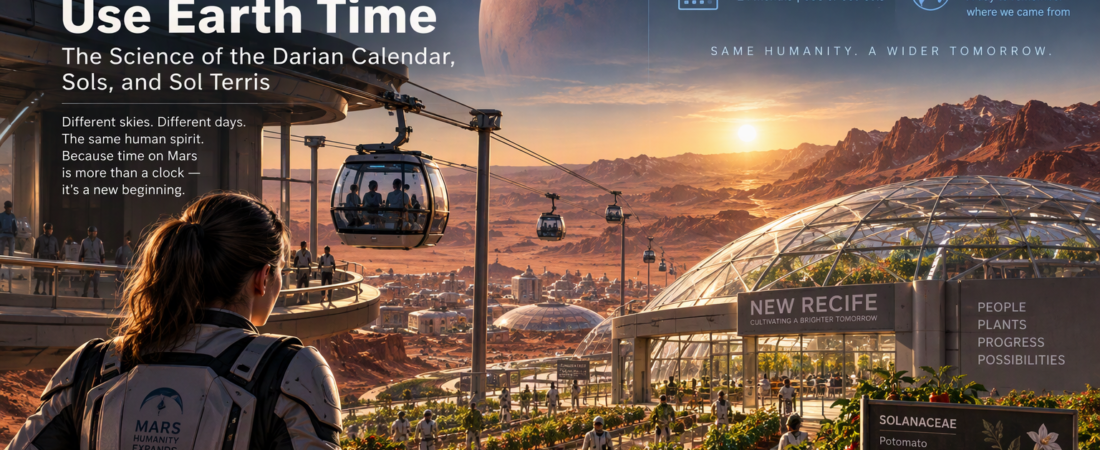
When humanity establishes permanent roots on another planet, the first thing that breaks isn’t our technology—it’s our clocks.
If you step onto the Martian surface with a standard Earth wristwatch, it will tell you the time in London, New York, or Tokyo. But it will tell you almost nothing useful about the sun hanging above the rust-red horizon of Chryse Planitia.
Living on Mars forces humanity to solve a fundamental astronomical puzzle: how do you build a working human civilization when both the days and the years refuse to sync with Earth?
1. The 39-Minute Problem: Why We Can’t Just “Use UTC”
On Earth, a solar day lasts 24 hours. On Mars, one rotation relative to the Sun—known as a sol—lasts 24 hours, 39 minutes, and 35.244 seconds.
Thirty-nine and a half minutes sounds negligible, like hitting snooze on an alarm clock twice. But in human biology, those 39 minutes compound relentlessly:
- In just 18 days, Martian noon drifts into Earth midnight.
- In just over five weeks, day and night invert completely.
NASA rover drivers who operate on “Mars time” during active surface missions have experienced this firsthand: their shift schedules slide by nearly 40 minutes every single day. Within weeks, human circadian biology breaks down. Sleep cycles fragment, endocrine balances unravel, and cognitive fatigue sets in.
To live, work, raise families, and govern cities in places like New Recife, settlers cannot live in permanent circadian jet lag. Martian daily life must sync to the sol.
2. The 668-Sol Orbital Year
The second challenge is orbital mechanics.
Mars orbits the Sun at an average distance of 228 million kilometers. Because its path is longer and slower than Earth’s, a Martian year lasts 687 Earth days—or precisely 668.5991 sols.
If you tried to map this onto the traditional Gregorian calendar of 12 months, each month would stretch to nearly 56 days. The seasons—which are already asymmetrical on Mars due to its pronounced orbital eccentricity (axial tilt of 25.19° versus Earth’s 23.44°)—would drift hopelessly out of phase with the names of the months.
Human agriculture, thermal management in pressurized domes, solar power generation, and seasonal dust storm monitoring all depend on an accurate, predictable solar calendar. Mars needed its own temporal architecture.
3. The Architecture of the Darian Calendar
The most rigorous, elegant solution ever engineered for Martian timekeeping is the Darian Calendar, originally designed in 1985 by aerospace engineer Thomas Gangale.
Instead of stretching 12 months to absurd lengths, the Darian system divides the Martian year into 24 months:
- The first five months of each six-month quarter contain 28 sols (exactly four 7-sol weeks).
- The sixth month of each quarter contains 27 sols in a standard year (28 sols in a leap year).
- This creates a baseline year of 668 sols in normal years and 669 sols in leap years.
The names of the months draw from the Latin and Sanskrit names for the zodiac constellations through which the Sun passes as viewed from Mars—spanning from Sagittarius and Dhanus to Pisces and Mina.
The leap-year rule is remarkably clean: odd-numbered Martian years (and years divisible by 10) have 669 sols. This keeps the calendar synchronized with the Martian equinoxes and solstices for centuries without perceptible seasonal drift.
4. Culture on the Frontier: The Tradition of Sol Terris
Astronomical equations organize the gears of a clock, but culture gives time meaning.
When the first generation of Martian settlers grew up in the subterranean caverns of New Recife, they faced a poignant cultural dilemma. If a Martian year is nearly two Earth years long, when do you celebrate birthdays? How do children honor Christmas, Diwali, or the New Year?
This cultural tension gave birth to Sol Terris—the “Day of Earth.”
Rather than letting the memory of the mother planet fade into abstract numbers, the Martian civil calendar reserves Sol Terris as an intercalary day of remembrance and cultural continuity. It is a day when dome lights dim, families gather beneath the transparent acrylate roofs, and the colony pauses to honor the world that birthed humanity before turning their eyes back toward the new sky.
5. Convert Your Time to Mars
What sol is it in New Recife right now? What Martian month corresponds to your birthday?
To bridge the gap between orbital mechanics and daily life, we built a dedicated, live interactive tool:
👉 Try the Comet Surfer Martian Calendar & Sol Converter
You can convert any Gregorian date and time directly into Martian sols, track the 24 Darian months, and see the exact planetary timekeeping that anchors the stories in The Comet Surfer Saga and The Comet Boogie Series.

Explore Further:
- The Living Story: Read how the first children born on Mars discovered the stars and the secrets of the calendar in A Christmas Mystery on Mars.
- The Interplanetary Canvas: Explore the complete timeline of the Martian transformation in Book 2 of the saga, The Rings of Mars.